BIOL105 Lecture #5 (10/11/26)
 Call Kai
 Learn
Learn Practice Test
 Spaced Repetition
 Match
Match Flashcards
 Knowt Play
1/68

There's no tags or description
Looks like no tags are added yet.
Name | Mastery | Learn | Test | Matching | Spaced | Call with Kai | Chat |
|---|
No analytics yet
Send a link to your students to track their progress
69 Terms
What are phylogenies constructed from?
characters (also called traits)
What is a homology?
a hypothesis that the similarity of a trait in 2 or more species indicates descent from a common ancestor
What three types of characters can be used to construct phylogenies? (fly low = my bad mate)
morphological
behavioral
molecular (genetic or biochemical)
Why is constructing phylogenies usually not simple?
not all the characters/traits we analyze point to the same phylogeny
What must be true about the characters used to construct a phylogeny?
Homologous (based on homology), have variation
What do the six characters (bipedal, position of orbits, endotherm, hair, bony skeleton, tailless) have in common?
They are all morphological characters that can be used to build a phylogeny
How are characters scored for each species in a character matrix?
As a (a 1 or 0), based on whether the character is present in an individual or not
What does a score of 1 indicate for a character?
The shared derived state (synapomorphy)
What is parsimony?
The principle that things should be kept as simple as possible
What is the best phylogenetic tree, according to parsimony?
the one with fewest character changes to explain the data
(most efficient, least complicated)

In the 7-step tree, why are characters 2, 3, 4, 5 a group called synapomorphies?
they evolved once, were never lost, and are in the ancestor of more than one species (shared derived trait)

In the same 7-step tree, why is character 1 a different group called an autapomorphy (bipedal)
distinct to one taxa on the tree
(evolved only once and only in one taxon - humans)

In the same 7-step tree, why is character 6 a different group called a homoplasy (tallness?)
it evolved twice (separately)

What does “7 steps” mean in this tree, and what is a tree in this context?
7 traits; hypothesis (of relationships)
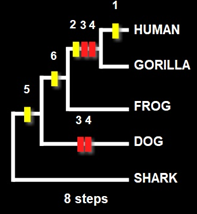
How many steps does Tree II need vs Tree I, and which branching change causes the difference?
8 steps instead of 7; dogs diverging before frog

In the 8-step tree, which characters are synapomorphies and which are homoplasies?
1, 2, 5, and 6 are synapomorphies
3 and 4 are homoplasies

Based on the step count, which tree is more parsimonious and more likely to be correct?
The 7-step tree (least number of character changes)
In the 8-step tree, what is character 1 and why?
autapomorphy (distinct to one taxa on tree, appeared once and only once)
How do systematists figure out which of many possible trees is the most parsimonious?
develop a mathematical algorithm and
implement a computer program
Why do most systematists rely on computer programs instead trying trees by hand?
Because it is more practical than the impractical method trying all trees
What happens when there are hundreds of taxa under study?
Not even a computer program will necessarily find the single shortest tree.
What is used to construct a phylogeny from DNA?
a portion of a gene that is present in all species in question
How is homology of molecular characters determined?
Sequence alignment
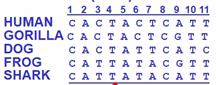
In a DNA character matrix, what are the characters?
nucleotides
What 2 things can be used to build a phylogeny?
characters = compared features (e.g. aligned pos in dna, bipidal or not)
character states = values of features (e.g., A/C/G/T for DNA, or 1/0 for morphology)
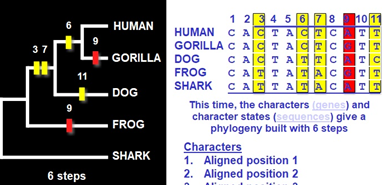
How many steps does the molecular phylogeny in this example require?
6 steps

What happens when you use both morphological and molecular characters to construct a tree?
The tree will include more changes

How many traits are being used when morphology and DNA are combined?
17
What do yellow and red indicate on this tree?
yellow = synapomorphies
red = homoplasies

How many steps does this most parsimonous tree require? and how many steps does the alternative require and why is it less parsimonous
13; 16; more character changes
What is the advantage of a rooted tree?
the direction of evolutionary change can be inferred (we have direction now)
What are the three steps to change an unrooted tree to a rooted tree?
1. Introduce an outgroup
2. Identify the likely derived condition (the new state which is different from the outgroup)
3. arrange rooted tree
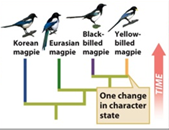
What does the magpie example reveal about the yellow bill?
The yellow bill is not the ancestral condition - it evolved recently after the yellow-billed magpie and black billed magpie split off at their most recent common ancestor (the North American magpies)

What does the magpie example reveal about where magpies originated
Magpies originated in East Asia, then dispersed across the Bering Strait to North America, where they split into yellow-billed and black-billed species
How can systematics help identify criminals?
By building phylogenies from HIV sequences to determine who transmitted the virus
In the HIV example, what does it mean if a suspect’s HIV sequences are more similar to the survivor’s
The fewer differences between the suspect and survivor (more similar) the more likely the suspect’s guilt
What was Richard J. Schmidt accused of?
injecting his girlfriend with HIV+ blood during an argument
What was the outcome of the Schmidt case?
convicted of attempted second degree murder
Why is the Schmidt case significant?
first time that phylogenetic analysis was used in a U.S. criminal proceeding
What was built to help convict in the Schmidt case?
a phylogeny of HIV sequences
Why must genes be present in all organisms when constructing huge phylogenies? (think working backwards)
because that’s the only way they can all be placed on the phylogeny
Why must the genes’ functions be essential and remain the same? (think working backwards instead of how I learned similar seq → to same func)
so that the sequence similarities are recognizable (even between distantly related species)
What kind of selection keeps these genes from diverging
stabilizing selection
Who began constructing phylogenies from ribosomal RNA sequences, and when?
Carl Woese; late 1970s
What are the three reasons ribosomal RNA genes are useful for systematics?
1. Ribosomes are found in all organisms
2. All ribosome function the same (translate mRNA)
3. Ribosome show sequence similarities
What is the first reason ribosomal RNA genes are useful for systematics?
Ribosomes are found in all organisms
What is the second reason ribosomal RNA genes are useful for systematics?
All ribosomes function the same
What is the third reason ribosomal RNA genes are useful for systematics?
Ribosomes show sequence similarities
What are the three major branches of the Tree of Life?
bacteria
eukaryota
archea
Where are the basic divisions of life found?
unicellular and micro = organisms
What view did Woese’s findings replace?
traditional five kingdoms (prokaryota, protists, fungi, plants, and animals)
What genus of lizards is native to the Caribbean, and what two distinctive features do they have?
Anolis; toepads and dewlaps

What kind of evidence could be used to decide which lizards are the most closely related?
ecology, color, and/or body form
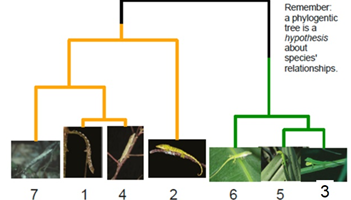
What is the phylogenetic tree a hypothesis about?
The relationship among species
What is an ecomorph?
a character the describes an adaptive morphology linked to specific ecological aspects
What does an ecomorph combine?
ecology + morphology
If a phylogeny is proposed using ecomorphs, what is being assumed?
species that exhibit the same ecomorphs are very closely related
What does a phylogeny based on ecomorph characteristics fail to explain?
The dispersal of different species throughout the Caribbean
What question arises because each ecomorph is found on multiple islands and each island has multiple ecomorphs
Which came first? The ecomorphs or the islands

What is hypothesis one for the case study of lizards in the Caribbean (ecomorphs)
Lizards living on the same island are most closely related
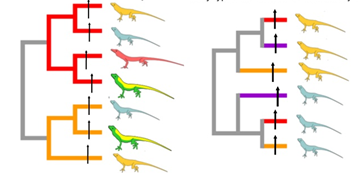
What is hypothesis two for the case study of lizards in the Caribbean (ecomorphs)
Lizards with the same body type and habitat are most closely related

According to the slide, what do by-island groups and ecomorphs become under these hypotheses?
Ecomorphs become polyphyletic (under hypothesis one)
By-island groups become polyphyletic under hypothesis two
What kind of data was used to infer the Anolis phylogeny, and how much?
DNA sequencing data; 1500 nucleotides
Which hypothesis was supported in the case study of lizards in the Caribbean (by island vs. ecomorph)
hypothesis 1 (lizards living on the same island are more closely related)
What does the fact that hypothesis 1 being accepted mean about when the ecomorphs evolved?
The ecomorphs evolved on each island after lizards dispersed
What does the Anolis case study demonstrate about ecomorphs?
convergent evolution of ecomorphs
What is an easy way to understand ecomorphs, convergent evolution, dispersal?
Ecomorphs arose after the anolis dispersed and ecomorphs worked through convergent evolution
What are the three key features of convergent evolution? (extra-ish)
1. Similar ecology
2. Similar morphology
3. not close relatives