Pre-lab 7: Earthworm Action Potential
 Call Kai
 Learn
 Practice Test
 Spaced Repetition
 Match
 Flashcards
 Knowt Play
1/39

There's no tags or description
Looks like no tags are added yet.
40 Terms
why study earthworm
simple linear nervous system that allows action potential to be easily identified and measured
invertebrate axons increase nerve conduction velocity by being _____
large in diameter
What characteristic of the axon is essential for the fast propagation of action potentials in Invertebrates?
a The length
b The size
c Existence of myelin
the size

earthworm anatomy
invertebrates have a ___ nerve cord, whereas vertebrates have a ____ nerve cord
ventral, dorsal
What anatomic feature enables continuous recording of electrical activity in the earthworm?
a ventral position of the nerve cord
b lack of myelin
c electrical connections between fibers
electrical connections between fibers
earworm has 2 giant fiber systems in the ventral side:
lateral giant fibers (LGF) and medial giant fibers (MGF)
fiber systems are responsible for
flight (escape, survival) reflexes, twitches of the worm
the two fibers have segmental cross-connections so can be regarded as ____
a single functional unit
mechanical stimulus to the front leads to
activation of the skin sensory cells
the earthworm ____ can be used as an anatomical landmark since it is always close to the ____ part of the earthworm (head)
clitellum, anterior
during the experiment, we orient the earthworm ___ (darker) side up
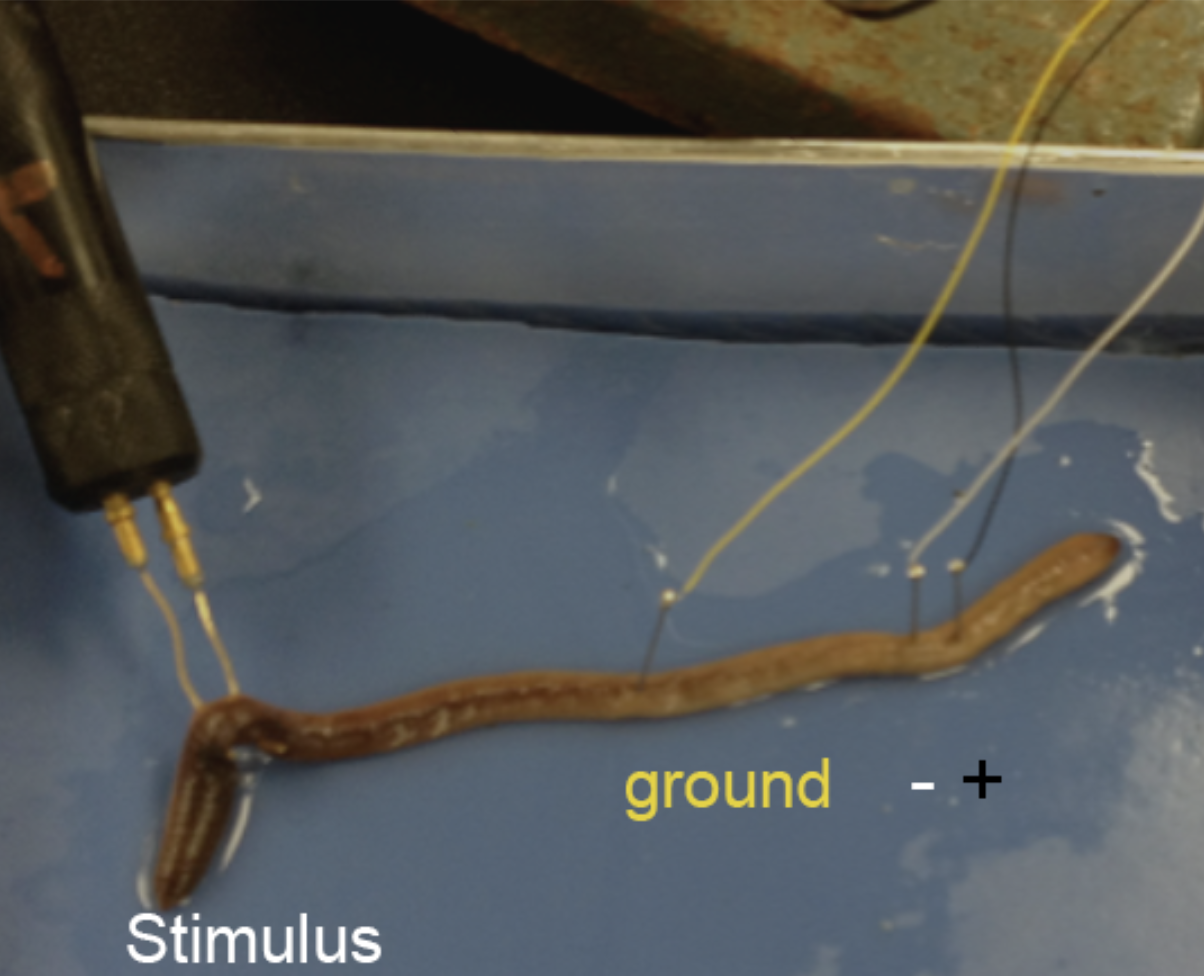
set up in lab
diameter of the giant fibers
LGF — 0.05 mm
MGF — 0.07 mm
How is action potential elicited in the earthworm experiment recording?
a By mechanical stimulation
b By electrical stimulation
c Spontaneously
by electrical stimulation
how do lateral differ from the median giant fiber
higher threshold, slower conduction
intracellular recording
measuring voltage and/or current across the membrane of a cell —- record resting MP for accurate assessment of electrical activity of a single cell
extracellular recording
less demanding w/ 1 electrode close to excitable cell & ref @ another location
records potential changes at the membrane surface rather than across the membrane
differences between intracellular and extracellular recording
different information is attained from each type that answer diff questions
shape of recording
how are both intracellular and extracellular AP recordings biphasic
both have pos and neg deflection, for diff reasons
intracellular: pos - depolarization, neg - hyperpolarization
extracellular: neg - due to manner of how recorded
2 recording electrodes, changes as it picks up on AP
situation changes as the CAP travels along the nerve

intracellular vs extracellular recording

biphasic extracellular recording
what is baseline reading
before stimulus delivered, both electrodes measure the same voltage - no deflection
what does shape of AP depend on
relationship between inter-electrode distance
the length of axon segments depolarized by AP
conduction velocities of axons
The biphasic nature of the action potential recorded extracellularly is a consequence of:
a the use of two extracellular electrodes spaced some distance apart to record the potential
b the fact that, in action potential, membrane depolarization is followed by repolarization
c the different conduction velocities of different axons
the use of two extracellular electrodes spaced some distance apart to record the potential
we can use earthworms to demonstrate the _______ phenomenon (because)
all-or-none (giant axon contains individual cells, one in each segment linked through gap junctions)
Select correct sentence
a All or none phenomena can be demonstrated in earthworm because each axon represents single unit
b MGF and LGF have the same threshold stimulus
c After reaching the threshold for axon in earthworm experiment you still observe an increase in amplitude with stronger stimulus
all of none phenomena can be demonstrated in earthworm because each axon represents single unit
experimental setup and execution
anesthetize worm but not so much it drowns (10% ethanol) - until doesn’t respond to touch
done from dorsal side of worm — ventral surface has bristles
head end on stimulating electrodes, recording electrodes by 3 metal pins through body (negative then positive, 5-10 mm)
things to remember
handle worm gently, signal may be contaminated by electrical devices, clean recording pins, periodically apply anesthetics
absent in properly anesthetized worm
withdrawal reflex
lack of constant movement
MGF threshold should always be ____ than the LGF threshold
lower
if the diameter of a nerve fiber is increased, the threshold for eliciting APs is _____
decreased
2 ways of calculating conduction velocity
absolute method and difference method
absolute method
distance between sites of stimulation and first recording electrode divided by recorded time interval between stimulus and pos peak
difference emthod
distance of two recording sites and two intervals of recorded potentials used
refractory period
due to inactivation property of voltage-gated sodium channels
absolute refractory period
majority of sodium channels in inactive state - will not open
relative refractory period
stronger stimulus is applied to cause AP
T/F: During absolute refractive period, a stronger stimulus will be required to reach the threshold voltage, and thus, initiate another action potential.
false
If earthworm you are using in your lab is frequently moving, what would be the best advice to proceed the experiment?
a To get another worm
b To use additional ethanol to anesthetize the worm
c To pin stronger worm to the tray
to use additional ethanol to anesthetize the worm