Lecture 6: Regulation of the Transcriptome
 Call Kai
 Learn
Learn Practice Test
 Spaced Repetition
 Match
Match Flashcards
 Knowt Play
1/16

There's no tags or description
Looks like no tags are added yet.
Name | Mastery | Learn | Test | Matching | Spaced | Call with Kai | Chat |
|---|
No analytics yet
Send a link to your students to track their progress
17 Terms
review of rna processing and coupling transcription
in eukaryotes, when does RNA processing occurs
When does coupling occur?
How is it regulated
RNA processing done before transcription is even complete
During transcriptional elongation
CTD of RNA pol binds to RNA processing proteins and transfers to the RNA at the appropriate time to bind
Regulated by phosphorylation of RNA pol
Depending on the phosphorylation pattern; different proteins will bind

RNA transport out of the nucleus
What specific RNA does it transport
How can it identify the specific type?
Two things it looks four
Three subtypes
How many RNA is transported out vs how much the nucleus currently has in total
In the nucleus: what happens if the specific RNA has not been formed
transporting the mature rNA (with all modifications complete) out of the nucleus
Markers of mature mRNA must be acquired for export
Cap binding complex (CPC) - found after G cap placed
Exon junction complexes (EJC) - found after splicing
poly-A-binding proteins - found after poly A tail placed
Marker of immature mRNA must be lost before export
Proteins involved in RNA splicing (e.g. snRNPs)
1/20 RNA will leave the nucleus
Any RNA not processed correctly into the mature mRNA will degrade in the nucleus by exosomes
Post-transcriptional Gene regulation: mRNA quality Control
What are some issues once the mRNA are transported out of the nucleus
Why is this also an issue for the cell (one possible consequence)
Some mRNAs are incompletely process or damaged in the cytosol once transported
Prevent the production of weird, and unsuual proteins that could potentially be toxic to cells
Review of Translation
tRNA match the amino acids to codons in the genetic code
MRNA message is decoded in ribosomes made up of proteins and RNA molecules
Ribosomes: resource-intensive to make (made up of a lot of proteins
Amino acids are added to the C-terminal end of the growing polypeptide chain (synthesizing proteins from 5’ to 3’ or N to c-terminus)

mRNA Quality control in eukaryotes
Eukaryoteic intuition factors binds to the mRNA (eIFs) - two kinds
EIF4E binds to the 5’ cap
EIF4E binds to the poly-A binding protein
Once the mRNA loops
Recruit small ribosomal complex which will initiate translation at first AUG downstream of 5’ cap (some exceptions)
Once they find the sequence; the large ribosomal subunit will bind to the small ribosomal complex
Ensures that both ends of mRNA are intact
A loop is a mRNA quality control; indicating that the
This entire process occurs in the cytosol
(EJC) also stimulates translation ensuring proper
splicing

EJC helps with non-sense-mediated mRNA deday
what is it’s main job
Recall: EJC are where the intron use to be before they were spliced
prominent mRNA surveillance system
surveys for nonsense (STOP) codons in the “wrong place”
Indicates improper splicing
If there is a premature stop codon: its stops and the 2nd EJC does not get removed, and upf proteins will trigger the degradation the mRNA

EJC helps with non-sense-mediated mRNA deday - normal splicing
still requires the loop and eIFs, even if not shown on the diagram
Steps
The ribosome binds mRNA as it emerges from the nuclear pore
EJCs are displaced by the moving ribosome
The stop codon is in the last exon
No EJCs remain bound when the ribosome reaches the stop codon
mRNA is released in the cytosol
the first ribosome still makes protein

EJC helps with non-sense-mediated mRNA deday - abnormal splicing
The ribosome binds mRNA as it emerges from the nuclear pore
EJCs are displaced by the moving ribosome
The stop codon is premature
The EJCs remain on the mRNA when the ribosome reaches the stop codon
mRNA is degraded (mediated by Upf proteins)
**if there is no EJCs by the stip it meet the premature stop codon, the EJC cannot mediate the degradation (there is no EJC to actually help)

The importance of nonsense-mediated mRNA decay
May have played an important role in the evolution of eukaryotes by allowing the selection of DNA rearrangements or alternative splicing patterns that produce full-length proteins
Important role in cells of the immune systems where extensive DNA rearrangements occur to produce antibodies
Also plays a role in many human disease cause by mutations that produce aberrant proteins. Cells can degrade aberrant mRNA and allow functional protein to accumulate
occur in the cytosol
Post-transcriptional gene regulation
MRNA quality control in prokaryotes
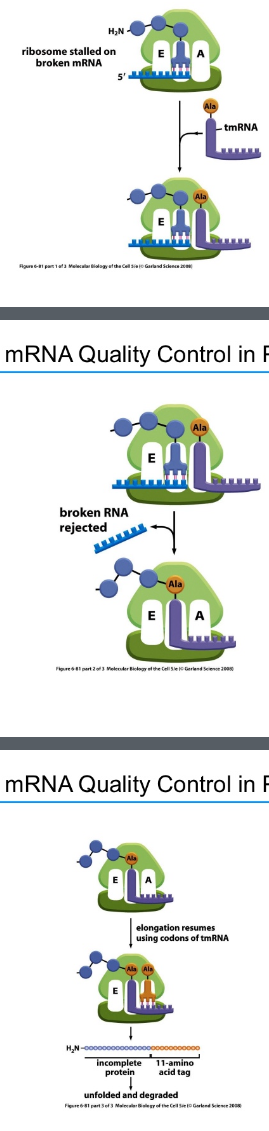
Ribosomes stall on broken or incomplete mRNAs and do not release
A special RNA tmRNA is recruited to the A site
Carries an alanine amino acid
Acts as both tRNA and mRNA
Broken mRNA is released
Alanine is added onto the polypeptide from the tmRNA, which acts like a tRNA but with no anticodon-codon binding
The ribosome translates 10 codons from the tmRNA, which now acts as an mRNA
The 11 amino acid tag is recognized by proteases that degrade the entire protein
11th codon is the stop codon
Kind of degradation in prokaryotes and eukaryotes
method of degradation of both of them
The ribosome translates 10 codons from the tmRNA, which now acts as an mRNA
The 11 amino acid tag is recognized by proteases that degrade the entire protein
Processes carried out by an exonuclease (deadenylase) when mRNA reaches the cytoplasm – acts as a timer of mRNA lifetime
eats the poly-A tail, until reaches 25 nucleotides of A-tail
Two possible things that happens next
Breaking of 5’ cap
Continue degradation and losing all A tail
e.g. of mRNA stability and Transferrin
Transferring receptor
imports iron into the cell
Low iron: receptor is express
High iron: no receptor is expressed
Low iron
mRNA stabilized by cytosolic aconitase that binds 3’UTR
High iron
aconitase binds iron and undergoes a conformational change
mRNA released
exposes 3’UTR endonucleolytic cleavage site (polyA removed); mRNA is degraded

mRNA stability and Deadenylase
Another example of protein-regulated mRNA stability…
There is competition between mRNA translation and mRNA degradation
➢ deadenylase that shortens the poly-A tail binds the 5’ cap (like eIFs)BIO230 Lecture 1-6 21

MiRNAs
non-coding RNAs called microRNAs (miRNAs) also regulate mRNA stability
(>2000 in humans)
• miRNAs base-pair with specific mRNAs
• synthesized by RNA polymerase II and get a 5’ cap and poly-A tail
• after special processing, the miRNA associates with a protein complex called an RNA-induced silencing complex (RISC
enzymes does cropping
Moves into cytosol
dicing done by the diver enzyme (the diver cuts long double stranded RNA)
RISC seeks mRNA with complementary nucleotide sequences
• A protein of RISC called Argonaute plays a critical role in base-pairing miRNA with mRNA
• Two possible outcomes are possible
For the less extensive math:
blocks translation
can also be reused

RNA Interference (RNAi)
➢ Double-stranded RNAs that end up suppressing the gene expression of other RNAs in a sequence-specific manner
➢ The proteins used in the miRNA regulatory mechanisms also serve as a defense mechanism against foreign RNA molecules
➢ Found in eukaryotes, including fungi, plants, and worms
SiRNAs
• Many viruses (and transposable elements) produce double-stranded
RNA as part of their life cycles
• RNAi destroys double stranded RNA
• Initiated by Dicer protein complex that cuts the RNA to form siRNAs
• siRNAs can interact with Argonaute and RISC proteins and follow the miRNA route to destroy double-stranded RNA or another method (RNA degradation)
Other method (DNA silencing)
• siRNAs can also regulate transcription
• siRNAs interact with Argonaute and the RNA-induced transcriptional silencing (RITS) complex
Interacts with newly transcribed RNA
• Recruits chromatin modifying enzymes to silence the DNA (no more transcription at all from the DNA itself)

CRISPR-Cas Prokaryotic Immunity
not a mechanism found in eukaryotes (however, you can put the CAs protein into eukaryotic cells and small RNAs to cut things inside the eukaryotic cells)
100% prokaryotes
• short fragments of viral DNA integrate into the CRISPR region of the genome and become templates to produce crRNAs (CRISPR RNAs)
Aside: The viral genes are transcribes into pre-crRNA and processed using CAs protein to create crRNAs (targeting mechanism) that can cleave a previous known viral DNA
• Viral DNAs complementary to CRISPR regions are directed for degradation by Cas (CRISPR-associated) proteins
• Similarly to (Eukaryotic): use of small single-stranded RNA
Differences
Argonaute is cutting RNA
The cas proteins cut DNA
