economics in a global business world
 Call Kai
 Learn
 Practice Test
 Spaced Repetition
 Match
 Flashcards
 Knowt Play
1/195

There's no tags or description
Looks like no tags are added yet.
196 Terms
When designing an incentive scheme: when can you rely on strong incentives
When “what you pay for” is close to “what you want”
Who has a stronger incentive to cut costs and improve productivity; owner of private firm or governmental firm
Owner of private firm because they get to keep the resulting profits
When is a strong incentive scheme worse than a weak incentive scheme
When the strong incentive scheme incentivized the wrong thing
What is the difference between piece rate and hourly wage
Hourly wage is pay for input (time), piece rate is pay for output
When can piece rates increase productivity
When output is easy to measure and quality is not important
What is tournament theory
When a manager want to reduce risk of an agent (risk of depending heavily on outside factors) by giving bonusses for actions an agent can control (giving a bonus to the sales agents with the highest, second highest, and third highest sales) → can discourage cooperation
What type of risk does tournament theory reduce and what type of risk does it create
It reduces environment risk (payment is less reliable on outside factors) but it creates ability risk (some people are way better then others)
How can ability risk be reduced
Splitting the tournament into age classes or experience classes (so each player has strong incentive to work hard)
What is an executive’s pay based on
Stock price of the firm
What is a better payment method of paying executives based on stock price
Paying based on how well their stock performs relative to other firms in the same industry (because many other factors than executive effort influence the price of just the firms stock)
Which executives can receive more payment when using relative performance instead of just stock performance
Executives of firms that have at least one large shareholder (this shareholder has incentive to monitor closely; so executive can not take advantage of shareholders that do not monitor closely how much executives are being paid)
What is intrinsic motivation
Doing an activity because you find it naturally fun, interesting, or personally rewarding in itself (e.g. painting)
What is extrinsic motivation
Doing an activity to earn an external reward or to avoid a negative consequence (e.g. studying hard for an “A”)
What are monetary rewards
financial payments or cash-equivalent benefits given to employees to recognize strong performance, goal achievement, or contributions
When are monetary rewards most successful
When they are supported by intrinsic motivation and social status
What types of rewards form the best incentives
Intrinsic coupled with extrinsic
What is the corporate culture
Shared collection of values and norms that govern how people interact in an organization or firm. This helps firms incentivize what is difficult to measure
What is asymmetric information
When one party of an exchange has more or better information than the other party
What is the principal-agent problem
The principal has more information than the agent, and has incentive to work in its own interest
What is moral hazard moral hazard
Party with better information are tempted to exploit their information advantage at expense of their trading partner (arises after an agreement is made)
What are two solutions for asymmetric information and moral hazard
(1) provide more information (reducing asymmetry) (2) reducing incentive for the knowledgeable party to exploit their information advantage
What part does the internet play in reducing moral hazard
An upset buyer can warn a lot of people at the same time, therefor decreasing the incentive for sellers to attempt a moral hazard rip-off
What new asymmetric problem does the internet bring
The more important a rating becomes, the greater the incentive to fake or manipulate that rating (can be fixed by third-party trusted organizations)
What is the free-rider problem
People benefit from resources, goods, or services but do not pay for them (which results in an under provision of those goods)
In which types of goods is the free rider problem common
Non-excludable goods (like public goods) and situations of the tragedy of the commons
What is adverse selection
One party knows more about the true quality, value, or risk (negative information) then the other before a contract or deal is signed.
What to do against adverse selection (in car market)
(1) have experienced mechanic look over the car/accompany repair history of used car (2) get certified car (bought by dealer, inspected, repaired, refurbished, sold) and warranty (3) presence of sellers who sell regardless of price??
What is the problem of adverse selection in health insurance
Only the sickest individuals, or those with the greatest potential future problems are the ones to get insurance. Therefor the insurance company has to raise its raise to reflect higher costs → makes the health insurance even a worse deal for healthy individuals, pushing them out of the market
What 3 market features help limit the adverse selection problem for insurance companies?
(1) inspections or check-ups: inspect the health of potential insurance customer to overcome asymmetric information
(2) Group plans: insurance company emphasizes sales to groups (e.g. through the workspace) to increase changes of both healthy and unhealthy customers signing up
(3) conscientiousness: some people value insurance more than others
What are the 2 purposes of a warranty
(1) if something goes wrong the warranty has value as insurance
(2) a warranty signals that a company is serious about quality
What is a benefit of signals
Eases some problems of asymmetric information
What type of problems can signaling create
Moral hazard → can be fixed by aligning incentives of buyer and seller
What is utility for the consumer
Measure of value, satisfaction, pleasure or benefit one gets from consuming a good or service
What is marginal utility
Increase in utility by generating one additional product
What is meant by ‘marginal utility is diminishing’
The first apple is great, the second is good, the third is not bad etc.
When should a consumer buy less oranges and more apples
When the the marginal utility per dollar of apples is higher than he marginal utility per dollar oranges (MUa/Pa > MUo/Po)
At what condition can the consumer not increase its utility by adjusting it’s spending
When marginal utility per dollar is equal of both products (MUa/Pa = MUo/Po)
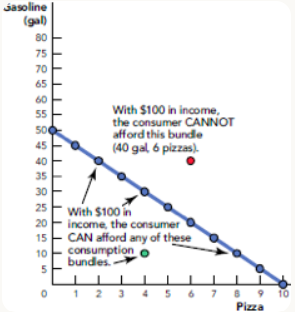
What is a budget constraint
All the bundles of products the consumer can afford given its income and prices
What is an indifference curve
It connects all the bundles that give the consumer an equal amount of utility
What is the marginal rate of substitutions (MRS)
Amount of one good a consumer is willing to give up to get an extra unit of another good, while keeping their total utility the same (given by the slope of indifference curve)

Where can we find the optimal consumption bundle
MRS = P1/P2 = slope of budget constraint
What is the substitution effect
Change in quantity demanded of a good because its relative price has changed compared to its substitutes
What is the income effect
Change in quantity demanded of a good caused y a change in a consumers real income (purchasing power) resulting from a price change
Which 2 effects does a lower wage have
Substitution effect (price of leisure also decreases, so substitution effect says you should buy more leisure by working less) and income effect (you also become poorer, so the income effect says that when your income falls you should but fewer goods including leisure)
How does the budget constraint change after the government sets a minimum income (with welfare)
look at figure, last part becomes horizontal becomes horizontal (first part remains the same until the guaranteed minimum income)

When the income effect from a wage increase is greater than the substitution effect, the supply curve for labor …
Slopes downward
When the income effect from a wage increase is less than the substitution effect, the labor supply curve …
slopes upwards
What is a patent
Gives market power (→ power to raise the price above marginal cost without fear others will enter the market)
What are the 5 sources of market power
Patent, economies of scale, exclusive access to input, technological innovation and governmental regulation
When is profit maximized
(MR = MC) Profit is maximized when marginal cost equals marginal revenue, where the firm produces the quantity of output that leads to maximum overall profitability.
How to calculate marginal revenue
Marginal revenue can be calculated by determining the change in total revenue that results from producing one additional unit of output. This is typically represented as the derivative of total revenue with respect to quantity.
Which 2 effects make the demand curve of pharmaceuticals more inelastic
You can’t take it with you effect → if you are dying, there is no better use of your money
Other peoples money effect → public and private health insurance
What will a monopolist do when the demand curve is more inelastic
The monopolist will raise its price more above marginal cost

When is monopoly bad
When it creates deadweight loss (reduces total surplus/gains from trade)
When is monopoly most harmful
Goods that the monopoly creates are used to produce other goods
What is a benefit from monopoly
Monopoly profit encourages firms to do research and development for new product (e.g. if pharmaceutical patents are not enforced, number of new drugs will decrease)
How to eliminate deadweight loss from patents without reducing incentive to innovate
Government buying the patent and ripping it up, letting competitors enter and drive the price down to the marginal costs of production (but government creates deadweight losses because it must raise taxes)
How does a monopoly arise from economies of scale
One large firm can produce at lower costs than many small firms, bc average costs are reduced as quantity increases. When one firm can supply the entire market at lower costs than 2 or more firms, the industry is a natural monopoly
What price should the government set in a natural monopoly without creating a shortage
Optimal quantity is found at P=MC, but this wont work because economies of scale make profit by having a price above marginal cost
Therefor the government should subsidize the monopolist to make up for the loss at P=MC → also creates deadweight loss
At P=AC the monopolist will break-even
What happens with the total surplus in a monopoly with monopolist pricing (compared to perfect competition)
Total surplus is smaller: consumer surplus is smaller, producer surplus is bigger and deadweight loss is created

What is the difference between natural monopolist pricing and government set price
Monopolist will produce till MC = MR
Government will set price at AC = demand

What is a cartel
Group of suppliers acting like monopoly
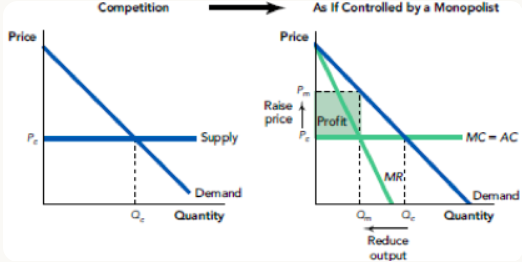
What are firms trying to achieve with a cartel
Maximized profits through cuts in supply (so total supply falls) and increase in price
What are the 3 reasons why cartels tend to collapse and lose power
(1) Cheating by the cartel members
(2) New entrants and demand response
(3) Government prosecution and regulation
Cartel agreements tend to fail if they produce manufactured rather than natural goods and if the long run AS demand curves become more elastic?, also likely to collapse the more firms are in the industry
Why do cartel members have incentive to cheat
If everyone else reduces production and the price rises, profits will increase if a cheater produces more than promised
What is the dominant strategy
When a strategy has a higher payoff than any other strategy, no matter what the other player does
What is the Nash equilibrium
Players cannot gain more by individually changing their strategy
What are the 2 characteristics of prisoner’s dilemma
(1) Both players have a dominant strategy
(2) Dominant strategy is suboptimal (does not lead to the one Nash-equilibrium
(Prisoner’s dilemma is a negative counterpart of invisible hand)

What is “tit for tat” strategy
If one firm cooperates now, the other firm can cooperate next time (e.g. with bidding on contracts; I bid low today, you bid low tomorrow)
What is coordination game
Two Nash equilibrium and no dominant strategies (the best option changes when the other players option changes) for players
Why are oligopoly prices above competitive price levels
(1) if a firm produces more and cuts prices earns all gains for itself, it only bears a fraction of the costs???
(2) a firm in an oligopoly has incentive to raise prices above competition levels: if a firm cuts output, the prices raise (because there is less supply) there prices rise (P > MC, while perfect competition: P = MC)

When are monopolies, cartels and oligopolies most successful?
When barriers to entry are high (especially control over key resources or an input)
What are Economies of Scale
Advantage of large-scale production: it is cheaper because fixed costs are spread over more units
What are network effects
A good becomes more valuable when more people use them (e.g. Facebook)
What are government barriers
When a government tries to combat a monopoly and oligopolies (e.g. antitrust laws) or create barriers to entry with licenses or other regulations (e.g. OPEC: cartel of governments for oil)
What are antitrust laws
Regulations that promote fair and open market competition and prevent single firms or groups to gain too much power (e.g. Sherman Antitrust Acts of 1890 that made cartels illegal in U.S.)
What is a negative effect of government-enforced monopolies and cartels
It means higher prices, lower-quality service, less innovation (people with new ideas find it hard/impossible to join market)
How can businesses reduce their incentive to cheat in a prisoners dilemma
Price match guarantees and loyalty programs
What are price match guarantees
A guarantee one firm will accept the same (higher) price as competitor, e.g. offering each customer a 10% difference of posted price. Because if the other firm decides to lower its prices, the firm that doesn’t, automatically has it’s prices 10% bellow the cheating firm, so it gets all revenue
What are loyalty programs
Loyalty programs gives regular customers a special treatment/better price (this reduces incentive for small price reduction because customers will stay loyal to company) - e.g. airline points:
make demand more inelastic
Loyalty plans are form of price discrimination
Is it easier or harder to form a cartel for a product with a few substitutes
Easier
What is a network good
Good of which the value of one user increases the more people use it
What are the 3 main features of markets for network goods
(1) network goods are usually sold by monopolies or oligopolies
(2) The “best” product may not always win
(3) Competition is “for the market” instead of “in the market”
Why are network goods usually sold by monopolies and oligopolies
There is a strong tendency for users to gravitate toward a single or very few dominant platforms (most users want the software that everyone else is using e.g. to seamless share files with microsoft)
Why does the best product may noy always win
A product that gets an early lead in user adoption can become “locked in” as the standard (even if a technologically superior alternative comes along)
Coordination game: players are better off choosing the same strategy as other players
Why is competition for the market instead of in the market
Firms don’t compete for small shares of the market, but to become the dominant (winner can enjoy monopoly-like profits for a time)
Can make a market contestable:
Gives incentive to keep prices low and to keep innovating
Incumbents try to create switching costs
What does contestable mean
New competitor entering the market and takes away business from incumbents
What are switching costs
Costs that make it more difficult to leave the network
What are platform firms
Businesses that connect two or more different groups of customers (Uber, Airbnb, Facebook: users and advertisers)
What are cross-externalities
One group of users creates a benefit for another group
What are direct network effects
Service becomes more valuable to a user as more users of the same type join
What are indirect network effect
The service becomes more valuable to one group as more users from the other group join, which in turn make the service more valuable for the first group
What are 3 characteristics of monopolistic competition
Many sellers, free entry (long run profits are driven to zero P=AC), product differentiation
What happens to the demand curve as more entrants enter a monopolistic competition
Demand shifts down to the left (previous customers start preferring other restaurants)
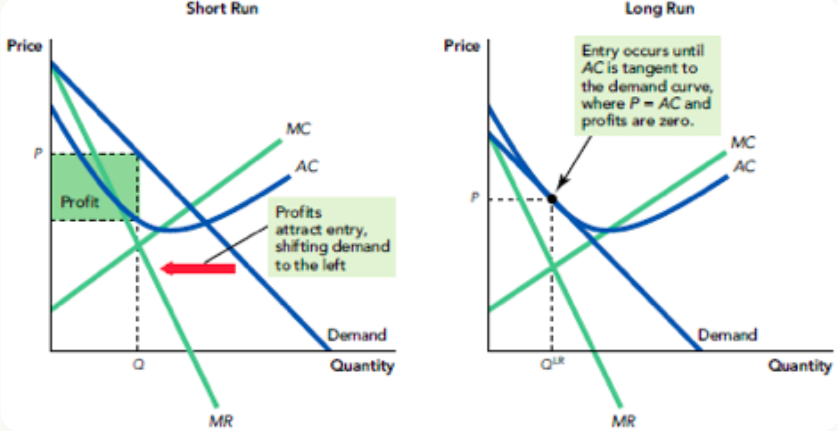
Why do firms keep producing, even when in the long run profits are zero (P=AC)
Because the price is still higher then MC: P>MC → social surplus is higher if the firm produces more
In monopolistic competition, do firms produce at the minimum of the AC curve
No, (figure)

Why do perfectly competitive firms not advertise
P = MC: there is no gain from selling additional units
Monopolies, oligopolies, monopolistic competition do advertise to differentiate products and build brand identity
Why is production under monopolistic competition considered inefficient
Because price is greater than marginal costs: P > MC
What is the marginal product of labor (MPL)
Increase in revenue created by hiring an additional worker
Why is the supply-curve of an individual different from the market supply of labor
Because an individual may choose to work less when it starts earning more
