Objects study

0.0(0)
Studied by 0 people
call kaiCall Kai
learnLearn
examPractice Test
spaced repetitionSpaced Repetition
heart puzzleMatch
flashcardsFlashcards
GameKnowt Play
Card Sorting

1/5

encourage image

There's no tags or description

Looks like no tags are added yet.

Last updated 12:25 AM on 9/29/26
Name
Mastery
Learn
Test
Matching
Spaced
Call with Kai
Chat

No analytics yet

Send a link to your students to track their progress

6 Terms

1
New cards

The Colossus of Constantine

  • A huge statue of the Roman emperor Constantine the Great, created in the early 4th century CE and displayed in the Basilica of Maxentius and Constantine in Rome.

  • Its size and appearance presented Constantine as a powerful, almost superhuman ruler chosen to govern the Roman Empire.

  • Helped establish the idea that rulers could use monumental art and religious symbolism to demonstrate their authority.

  • Later Christian and medieval rulers adopted similar ideas, portraying themselves as divinely supported leaders whose political power was connected to God.


<ul><li><p>A huge statue of the Roman emperor Constantine the Great, created in the early 4th century CE and displayed in the Basilica of Maxentius and Constantine in Rome. </p></li><li><p>Its size and appearance presented Constantine as a powerful, almost superhuman ruler chosen to govern the Roman Empire.</p></li><li><p>Helped establish the idea that rulers could use monumental art and religious symbolism to demonstrate their authority. </p></li><li><p>Later Christian and medieval rulers adopted similar ideas, portraying themselves as divinely supported leaders whose political power was connected to God.</p></li></ul><p></p>
2
New cards

Childeric’s signet ring

  • A gold ring found in the tomb of Childeric I, a 5th-century Frankish king and father of Clovis.

  • It showed Childeric wearing Roman-style military clothing and represented his authority as both a Frankish ruler and Roman-style leader.

  • Showed how rulers combined Roman traditions with Germanic identity to legitimize their rule.

  • Demonstrates how early medieval kings used Roman symbols of authority to present themselves as powerful and legitimate successors to the Roman political order.


<ul><li><p>A gold ring found in the tomb of Childeric I, a 5th-century Frankish king and father of Clovis. </p></li><li><p>It showed Childeric wearing Roman-style military clothing and represented his authority as both a Frankish ruler and Roman-style leader.</p></li><li><p>Showed how rulers combined Roman traditions with Germanic identity to legitimize their rule. </p></li><li><p>Demonstrates how early medieval kings used Roman symbols of authority to present themselves as powerful and legitimate successors to the Roman political order.</p></li></ul><p></p>
3
New cards

Justinian mosaic, Church of San Vitale

  • Created around 547 CE, shows Byzantine Emperor Justinian I surrounded by soldiers, government officials, and church leaders.

  • Justinian is placed at the center with a halo, connecting his political authority to Christian religious authority.

  • Presented the emperor as a ruler whose authority came from God.

  • Helped establish the medieval idea that political and religious power were closely connected and that rulers could use Christian imagery to strengthen their legitimacy.


<ul><li><p>Created around 547 CE, shows Byzantine Emperor Justinian I surrounded by soldiers, government officials, and church leaders. </p></li><li><p>Justinian is placed at the center with a halo, connecting his political authority to Christian religious authority.</p></li><li><p>Presented the emperor as a ruler whose authority came from God. </p></li><li><p>Helped establish the medieval idea that political and religious power were closely connected and that rulers could use Christian imagery to strengthen their legitimacy.</p></li></ul><p></p>
4
New cards

Theodora mosaic, Church of San Vitale

  • Shows Empress Theodora, wife of Justinian I, surrounded by members of the imperial court and carrying a golden chalice for the Eucharist.

  • Her rich clothing, jewelry, halo, and central position emphasize her wealth, status, and imperial authority.

  • Connected royal authority with Christianity and divine approval.

  • Shows how rulers used religious imagery, luxury, and ceremony to present themselves as powerful figures whose authority was supported by God.
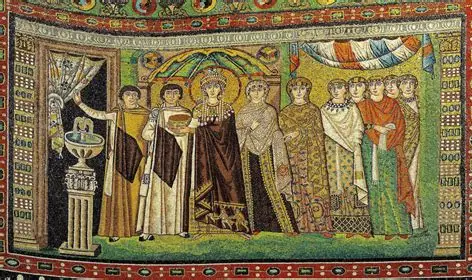

<ul><li><p>Shows Empress Theodora, wife of Justinian I, surrounded by members of the imperial court and carrying a golden chalice for the Eucharist. </p></li><li><p>Her rich clothing, jewelry, halo, and central position emphasize her wealth, status, and imperial authority.</p></li><li><p>Connected royal authority with Christianity and divine approval. </p></li><li><p>Shows how rulers used religious imagery, luxury, and ceremony to present themselves as powerful figures whose authority was supported by God.</p></li></ul><p></p>
5
New cards

Gold coins of Abd al-Malik

  • Part of a new Islamic coinage that replaced Byzantine-style images of rulers with Arabic inscriptions and Islamic religious statements.

  • Emphasized belief in one God and identified the authority of the Islamic state.

  • Showed how rulers could use money to communicate political and religious authority.

  • By creating a distinct Islamic coinage, Abd al-Malik demonstrated the independence and power of the Islamic caliphate instead of relying on older Roman and Byzantine symbols.
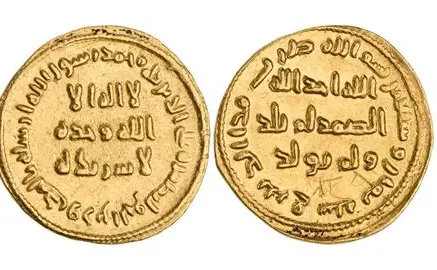

<ul><li><p>Part of a new Islamic coinage that replaced Byzantine-style images of rulers with Arabic inscriptions and Islamic religious statements. </p></li><li><p>Emphasized belief in one God and identified the authority of the Islamic state.</p></li><li><p>Showed how rulers could use money to communicate political and religious authority. </p></li><li><p>By creating a distinct Islamic coinage, Abd al-Malik demonstrated the independence and power of the Islamic caliphate instead of relying on older Roman and Byzantine symbols.</p></li></ul><p></p>
6
New cards

Gospel Book of Otto III

  • Created around 1000 CE, was a richly decorated Christian manuscript made for Holy Roman Emperor Otto III.

  • Shows Otto seated on a throne, surrounded by church and government officials, while personifications of different regions approach him with gifts.

  • Portrayed Otto as a Christian emperor with divinely supported authority.

  • Connected his rule to the Roman and Byzantine imperial traditions, showing how medieval rulers used Christian imagery and Roman traditions to legitimize their power.


<ul><li><p>Created around 1000 CE, was a richly decorated Christian manuscript made for Holy Roman Emperor Otto III. </p></li><li><p>Shows Otto seated on a throne, surrounded by church and government officials, while personifications of different regions approach him with gifts.</p></li><li><p>Portrayed Otto as a Christian emperor with divinely supported authority. </p></li><li><p>Connected his rule to the Roman and Byzantine imperial traditions, showing how medieval rulers used Christian imagery and Roman traditions to legitimize their power.</p></li></ul><p></p>



