Antimicrobial Agents (Inhibitors of Bacterial Nucleic Acid Synthesis) (L)
 Call Kai
 Learn
 Practice Test
 Spaced Repetition
 Match
 Flashcards
 Knowt Play
1/28

There's no tags or description
Looks like no tags are added yet.
29 Terms
How do inhibitors of bacterial nucleic acid work?
1) Inhibiting RNA Synthesis
OR
2) Inhibiting DNA Synthesis
What do RNA synthesis inhibitors do?
Inhibit selectively bacterial RNA due to differences between prokaryotic and eukaryotic RNA polymerase
What class of drugs are RNA synthesis inhibitors? How are they synthesized?
Rifamycins
- a group of antibiotics that are synthesized either naturally by Gm+ Amycolatopsis rifamycinica or artificially
What are the Rifamycin derivatives?
- Rifampicin (or Rifampin)
- Rifabutin (Mycobutin)
- Rifapentine (Priftin)
- Rifaximin (Xifaxan)
- Rifalazil (KRM-1648)
Rifamycin MOA
Inhibits RNA synthesis by inhibiting bacterial RNA polymerase and thus, blocking transcription, and causing bacterial cell death
Rifamycin is ___ spectrum, what is it effective against?
Rifamycin is broad-spectrum, effective against many Gm+ and some Gm- as well as Mycobacterium
What are the clinical uses of Rifamycin?
Combination therapy for treatment of tuberculosis, Hansen's disease, N. meningitidis meningitis
(T/F) Resistance to Rifamycin does not develop rapidly
FALSE; Resistance to Rifamycin develops rapidly
Quinolones can be classified into ___ based on their antimicrobial activity or ___
Quinolones can be classified into generations based on their antimicrobial activity or Spectra
1st generations (Quinolones) have what type of spectrum?
Gm-
What is the second generation of Quinolones called?
Fluoroquinolones
* most end in "floxacin"
2nd generation (Fluoroquinolones) have what type of spectrum?
An extended antibacterial spectrum covering Gm- and Gm+ bacteria
What is the 1st generation Quinolones?
Nalidixic acid (NegGram)
What are the 2nd generation Fluoroquinolones?
- Norfloxacin (Noroxin)
- Ofloxacin (Floxin)
- Ciprofloxacin (Cipro)
What is the 3rd generation Fluoroquinolone?
Levofloxacin (Levaquin)
What are the 4th generation Fluoroquinolones?
- Gatifloxacin (Zymaxid)
- Moxifloxacin (Avelox)
- Delafloxacin (Baxdela)
What is the 1st gen. quinolone effective against?
Gm-, but not Pseudomonas species
What is the 2nd gen. fluoroquinolone effective against?
Gm- (including Pseudomonas species), some Gm+ (S. aureus), and some atypicals (mycoplasma pneumoniae and chlamydia pneumoniae)
What is the 3rd gen. fluoroquinolone effective against?
Same as 2nd gen. with Gm-, extended Gm+ and atypical coverage
Which generation of fluoroquinolones slow development of resistance and how?
4th gen.; Act at both DNA gyrase and topoisomerase IV, resulting in slow development of resistance
Quinolones/Fluoroquinolones MOA
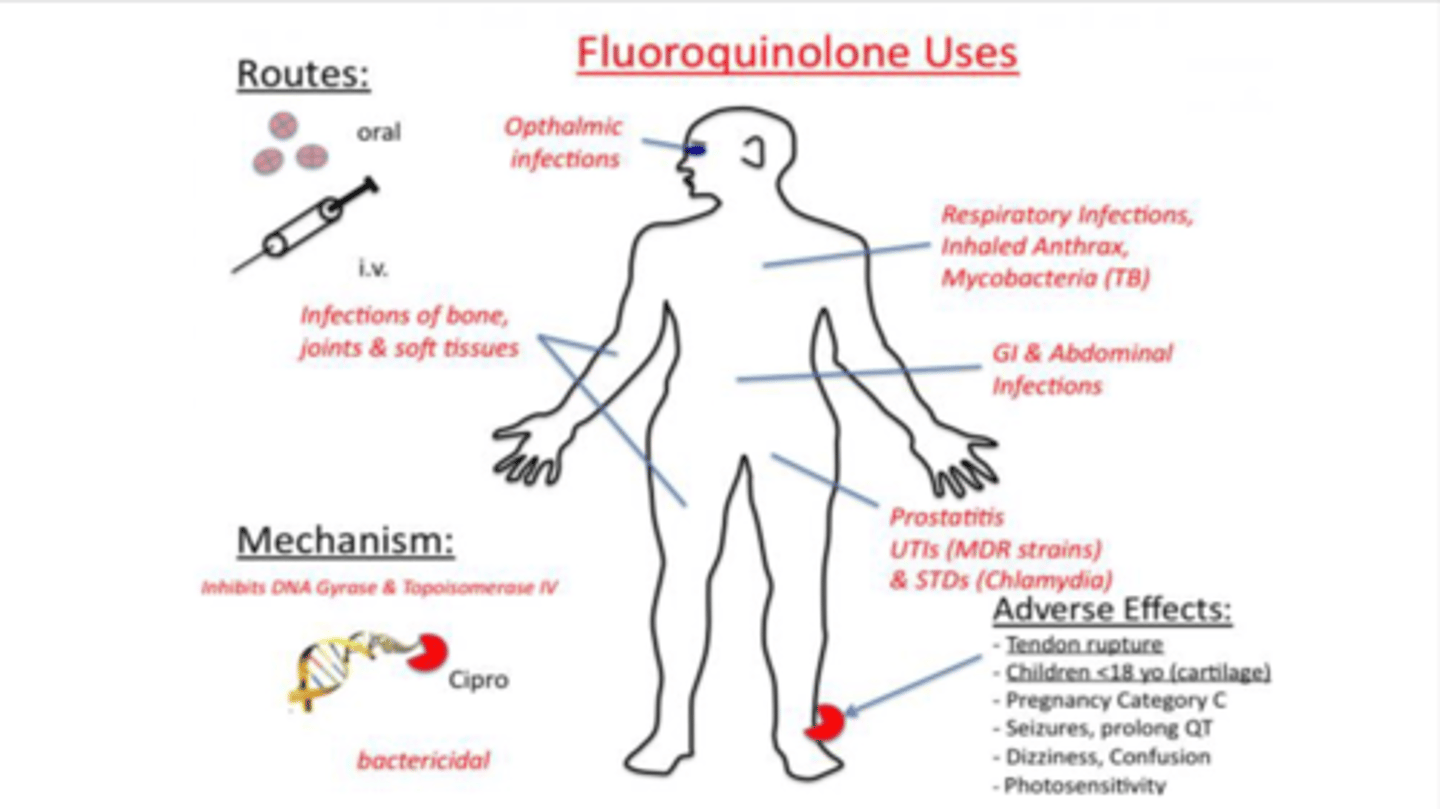
Block bacterial DNA synthesis by inhibiting bacterial topoisomerase II (DNA gyrase) and IV
- Inhibition of DNA gyrase prevents the relaxation of positively supercoiled DNA, inhibiting normal transcription and replication
- Inhibition of topoisomerase IV interferes with separation of replicated chromosomal DNA into the respective daughter cells during cell division
Quinolones/Fluoroquinolones are bacteri___
Quinolones/Fluoroquinolones are bactericidal
Pharmacokinetics of Quinolones/Fluoroquinolones
> Excellent absorption and bioavailability
> Given PO and IV
> Widely distributed, except for a poor CNS penetration
> All are metabolized to some extent by P450 enzymes; but those not metabolized are excreted by renal tubular secretion and can be blocked by probenecid
-- Except moxifloxacin, which is excreted primarily in the bile and gemifloxacin which is excreted in bile and urine (60:40)
What are the general clinical uses of 1st gen. Quinolones?
Uncomplicated urinary tract infections
What are the general clinical uses of 2nd gen. Quinolones?
- Uncomplicated and complicated UTI, STDs, prostatitis, Traveler's diarrhea
- Bone, joint, skin, and soft tissue infections (SSTIs)
- Respiratory tract infections, community-acquired pneumonia
- GI and abdominal infections, Chlamydia, pelvic infections, Mycobacterial infections
How does bacterial resistance to quinolones develop during therapy?
(1) Mutations in the bacterial chromosomal genes coding DNA gyrase or topoisomerase II and IV
(2) Develop active efflux system (transport of the drug out of the bacteria)
(3) Impair drug access into bacteria by decreasing the number of porin proteins in the outer membrane
What are the adverse effects of Quinolones/Fluoroquinolones?
GI - mild N/V and abdominal discomfort
Neurological - mild headache and dizziness. Rarely, hallucinations, delirium, and seizures: may be enhanced by co-admin. of NSAIDs
Prolongation QT interval and torsades de pointes arrhythmias
Increased risk of tendon injury and tendon rupture esp. in older pts >60 yoa, taking corticosteroids, and patients with kidney, heart, or lung transplants
In what patients should Quinolones/Fluoroquinolones be avoided?
Children (<18 yoa) b/c of arthropathy (disease of joints) in animal models
Pregnancy Category C
Fluoroquinolone Uses Summary (pic)