Lecture 2 MBB
 Call Kai
 Learn
Learn Practice Test
 Spaced Repetition
 Match
Match Flashcards
 Knowt Play
1/38

There's no tags or description
Looks like no tags are added yet.
Name | Mastery | Learn | Test | Matching | Spaced | Call with Kai | Chat |
|---|
No analytics yet
Send a link to your students to track their progress
39 Terms
Carbohydrate
A class of biomolecules
composed of carbon, hydrogen, and oxygen
used for energy storage (starch, glycogen)
structure (cellulose)
signaling
Lipid
Hydrophobic biomolecule
including fats and membranes
composed of fatty acids and glycerol
functions in energy storage and membrane structure
Protein
Polymer of amino acids that folds into three‑dimensional structures to perform a wide range of cellular functions.
Nucleic Acid function
Polymers of nucleotides (DNA and RNA)
store and express genetic information.
atomic number vs atomic weight vs isotope
Atomic number = # of protons = # electrons
• Atomic weight/MW = # protons + # neutrons
• Isotope: Same number of protons, different number of
neutrons
Covalent Bond define and key characteristics
Bond formed by sharing electrons between atoms
generally strong and directional
includes single, double, and triple bonds.
polar covalent bond
electrons shared unequally
electronegativity
indication of an atom’s ability to attract an electron
Noncovalent Bond
Interactions that do not involve shared electrons; individually weak but collectively can be very strong; includes hydrogen bonds, ionic interactions, and van der Waals forces.
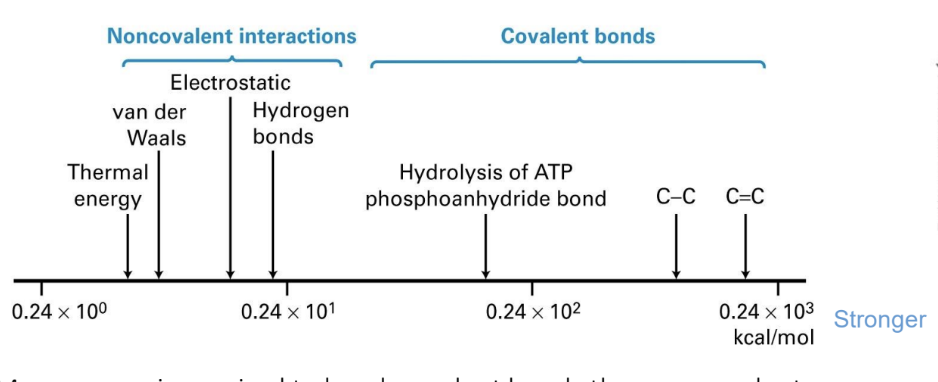
Ionic Bond
Electrostatic attraction between oppositely charged ions, often formed when electrons are transferred between atoms.
held together by electrostatic interactions
Hydrogen Bond
Weak attraction between a covalently bonded hydrogen (donor group) and an electronegative atom on another molecule (acceptor group)
donor group attaches to electroneg atom
Nonpolar Covalent Bond
A covalent bond in which electrons are shared roughly equally, producing no permanent dipole.
4 major families of small organic compounds and what they make in the cell
sugars
polysaccharides, glycogen, and startch in plants
fatty acids
Fats and membrane lipids
amino acids
Proteins
nucleotides
nucleic acids
Monosaccharide
The simplest carbohydrate unit (e.g., glucose/sugar)
building block of more complex sugars
fastest burning energy source
Polysaccharide (definition and function)
A long chain of monosaccharides
energy storage
structural integrity (cartilage, cellulose).
Monomer
A single subunit that links to form a polymer.
Fatty Acid
Hydrocarbon chain that are the building blocks of fats and membrane lipids
Triacylglycerol (TAG)
made up of fatty acids
slow burning energy source
Amino Acid definition and structure
Building block of proteins; contains an amino group, a carboxyl group, and a unique R group/ side chain.
R Group
The variable side chain of an amino acid that determines its properties.
at pH__, the carboxyl and amino groups are _______
7, ionized
Peptide Bond
Covalent bond linking the carboxyl group of one amino acid to the amino group of the next.
Polypeptide
A long linear chain of amino acids that can fold to form a protein.
Protein Folding (& how?)
Process by which a polypeptide adopts a unique, stable, three‑dimensional, biologically active structure.
folds using both covalent and noncovalent interactions
Nucleotide structure
A nucleoside attached to one or more phosphate groups
nucleotide function
short term carriers of ATP
storage and retrieval of DNA and RNA
Nucleoside
A nitrogenous base bonded to a five‑carbon sugar, without any phosphate group.
nucleic acid
nucleotides connected by phosphodiester bonds
RNA function
Expresses genetic information.
Most macromolecules are made from a set of ______ that are
slightly ____ from one another
monomers, different
Proteins, nucleic acids and polysaccharides are synthesized by the stepwise __________ __ __________
polymerization of monomers
Condensation Reaction
A chemical reaction that links monomers by releasing water (dehydration synthesis).
Native State and position of r groups
The unique three‑dimensional conformation of a protein or RNA species due to noncovalent interactions
hydrophobic r groups on inside, hydrophilic on outside
why is good specificity (shape alignment and chemistry) required between bonding macromolecules?
cumulative effect of one noncovalent bond isn’t very strong
contact at multiple points creates multiple noncovalent bonds able to withstand thermal jolting
Electrostatic Interaction
Attraction or repulsion between charged groups that is distance‑sensitive
either molecule charge is weak on its own
Starch
Polysaccharide used for energy storage in plants.
Glycogen
Polysaccharide used for energy storage in animals.
Cellulose
Structural polysaccharide in plant cell walls.
where are hydrogen bonds commonly found?
crucial in water, DNA, and proteins.