calc 3 ch13
 Call Kai
 Learn
Learn Practice Test
 Spaced Repetition
 Match
Match Flashcards
 Knowt Play
1/21

There's no tags or description
Looks like no tags are added yet.
Name | Mastery | Learn | Test | Matching | Spaced | Call with Kai | Chat |
|---|
No analytics yet
Send a link to your students to track their progress
22 Terms
f(x,y) is a multivariable function, and it can be written as
f(x,y) = z just like how f(x) = y
ellipse equation
Where:
the ellipse is centered at (h,k)
a represents the radius along the x-axis (e.g. if the ellipse is centered at 0,0 and a=10 then at x=-10 and x=10 you will have a point on the ellipse… it is 10 units away from the center along the x-axis!)
b represents the radius along the y-axis
note the =1

elliptic cylinder equation & explanation of why it works & visualize in your head
this is the same equation of an ellipse… the reason this works is because z can be anything and therefore the elliptic shape stretches across all z values, making a cylinder
where
a and b are the radius along the x and y axis respectively
h,k is the center of the elliptical cross section

ellipsoid equation & visualize in your head
same as ellipse but with the z and c
where:
(h,k,l) is the center of the ellipsoid
a is the radius along the x-axis
b is the radius along the y-axis
c is the radius along the z-axis

cylinder equation & visualization & why does it work
where:
just like the circle equation
(h,k) is the center
r is the radius
this works because z is not in the equation because z can be anything so it stretches across the entire z axis (the circle just goes up towards positive z and down towards negative z for infinity making a cylinder)

circular double cone equation + explanation + visualization
explanation: it has cross sections of +-sqrt(x2) aka |x| and -|x| which is why you have 2 cones rather than one
where:
(h,k,l) is the point where the cones meet.
same as cylinder equation except the radius = z axis… Think about why this works: as you increase the z, the circle gets wider making a conical shape when you have a bunch of those circles (of varying sizes) stacked on top of each other
note the +- sqrt as that is why there are 2 cones
the basic (non shift) equation is x2 + y2 = z2 if that helps to remember at first

elliptical double cone equation + explanation + visualization
this is also the same as the circular double cone equation but since a≠b in an ellipse (unlike a circle), a2 b2 and c2 are all present in this one
where:
(h,k,l) is the point where the cones meet
a and b control the parameters in the elliptical cross section (same as they normally do for ellipses)
c controls how fast the cone flares outwards as the cone expands up the z-axis (e.g. large c value makes the cone narrower and steeper)
the basic (non shift) equation is [x2 / a2] + [y2 / b2] = [z2 / c2] if that helps to remember at first
![<p>this is also the same as the circular double cone equation but since a≠b in an ellipse (unlike a circle), a<sup>2</sup> b<sup>2</sup> and c<sup>2</sup> are all present in this one</p><p>where:</p><ul><li><p>(h,k,l) is the point where the cones meet</p></li><li><p>a and b control the parameters in the elliptical cross section (same as they normally do for ellipses)</p></li><li><p>c controls how fast the cone flares outwards as the cone expands up the z-axis (e.g. large c value makes the cone narrower and steeper)</p></li></ul><p>the basic (non shift) equation is [x<sup>2 </sup><strong>/</strong> a<sup>2</sup>] + [y<sup>2 </sup><strong>/</strong> b<sup>2</sup>] = [z<sup>2 </sup><strong>/</strong> c<sup>2</sup>] if that helps to remember at first</p>](https://assets.knowt.com/user-attachments/159735da-ee32-4cbc-b61a-4e884f009961.png)
note that double cones could have restrictions that lead to only 1 of the cones being graphed
e.g. z>0
paraboloid equation
(z-l) = (x-h)2 + (y-k)2
where (h,k,l) is the bottom of the paraboloid

cross sections of 2d cone equation
x2 = y2
y = +-sqrt(x2)
recall that sqrt(x2) = |x| and then +- sqrt(x2) would include -|x|

level sets defined + what are they used for
{ (x,y) : f(x,y) = c } is the level set of f at height c
f(x,y) = z → z=c… You use a level set to find what a 3D function looks like at a certain z level… imagine taking a slice out of a 3d function at z=c

level curves vs level surfaces… what do they give information for?
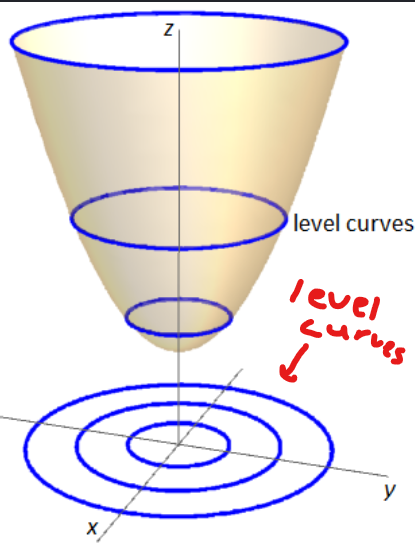
level curves are 2D objects that give information on a 3D object (function of 2 variables like f(x,y) )
level surfaces are 3D objects that give information on a 4D object (function of 3 variables like f(x,y,z) )
what is a level curve?
it’s just a 2D image showing what the function looks like (birds eye view) at different z levels as you plug in different c values into the level set
level surfaces + what are they used for
Let w=f(x,y,z)
Let c equal some constant.
You set c=f(x,y,z) just like a level curve.
Use case: When you have a function with 4 variables, it can be hard to visualize. You use a level surface to represent how the function looks when you set w=c.
For each level surface, f(x,y,z) is a constant on that entire surface!
note that for f(x,y) when a variable (such as y) is missing then…
that means the variable (in this e.g. y) can be anything; the function will stretch along that variable’s axis (in this e.g. it will stretch along the y-axis).
any f(x,y) can be written as
any f(x,y) can be written as g(x,y,z) = 0 for g(x,y,z) = z - f(x,y)
*note on the for: f(x,y) is just z so it’d be g(x,y,z) = z-z = 0
fy(x,y) notation meaning
the partial derivative of f with respect to y
*respect to y as y is the subscript
∂f/∂y
fx(x,y) notation meaning
the partial derivative of f with respect to x
*respect to x as x is the subscript
∂f/∂x
fy(x,y) = *limit defn and other definition
= (∂f / ∂y)(x,y) = same as picture
for fx you’d keep y as a constant instead

fyx(x,y) meaning
take partial derivative of f with respect to y first then with respect to x
*you just read it from left to right and take partial derivative from left to right
how to take a partial derivative with respect to some variable (e.g. x)
if you are taking partial derivative with respect to x, treat “y” as if it is a constant. you can replace “y” with c and then take derivative of that as if c were a constant. Then, at the end, put the “y”s back to where they would be
e.g. 3y2 → 3c2 and this is just a constant so the derivative is 0
but 3xy2 → 3xc2 → 3c2 → 3y2
3x2y → 3x2c → 6xc → 6xy
fyx = fxy IFF
fyx = fxy IFF second derivative is continuous