Chapter 7: Human Skeletal Anatomy: Divisions and Bone Structures
 Note
 Call Kai
 Learn
 Practice Test
 Spaced Repetition
 Match
 Flashcards
 Knowt Play
1/23

Earn XP
Description and Tags
Vocabulary flashcards covering the divisions, bone counts, anatomical structures, and distinguishing features of the human skeletal system, including axial and appendicular components.
24 Terms

Skeleton
The body’s framework, with about 300 bones at birth that fuse into 206 bones in adulthood. Provides support, helps movement, makes blood cells, and stores fat and minerals.
Haematopoiesis
The production of blood cells in red bone marrow.

Axial skeleton
The 80 bones forming the body’s central axis, including the skull, middle ear bones, hyoid, spine, ribs, and sternum.
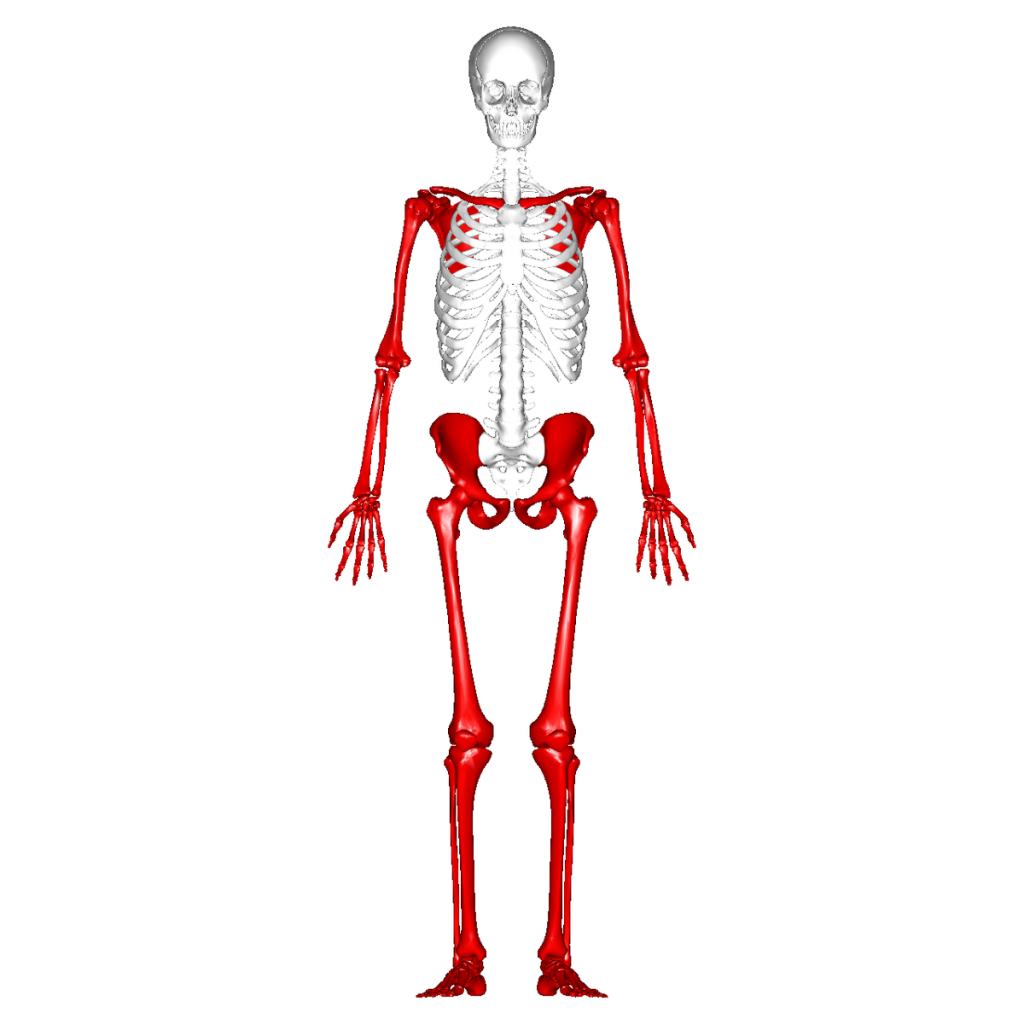
Appendicular skeleton
The 126 bones of the arms, hands, legs, and feet, plus the shoulder and pelvic girdles that attach them to the axial skeleton.

Neurocranium
The part of the skull that surrounds and protects the brain.

Viscerocranium
The facial bones of the skull that shape and support the face and provide attachment sites for facial structures.

Skull (anterior view anatomy)
The front view of the skull, showing the forehead, eye sockets, cheekbones, nasal cavity, upper jaw (maxilla), and lower jaw (mandible).

Vertebral column
The backbone that supports the body and protects the spinal cord.
Divided into cervical (C1–C7), thoracic (T1–T12), lumbar (L1–L5), sacrum (S1–S5, fused), and coccyx.

Vertebra structure
The parts of a spinal bone are the body, vertebral foramen, pedicles, laminae, spinous process, transverse processes, and articular processes.

Intervertebral disc
A cushion between vertebral bodies with a tough outer ring (annulus fibrosus) and a jelly-like center (nucleus pulposus).

Rib cage
The ribs, sternum, and thoracic vertebrae that protect the heart and lungs and provide attachment sites for breathing muscles.
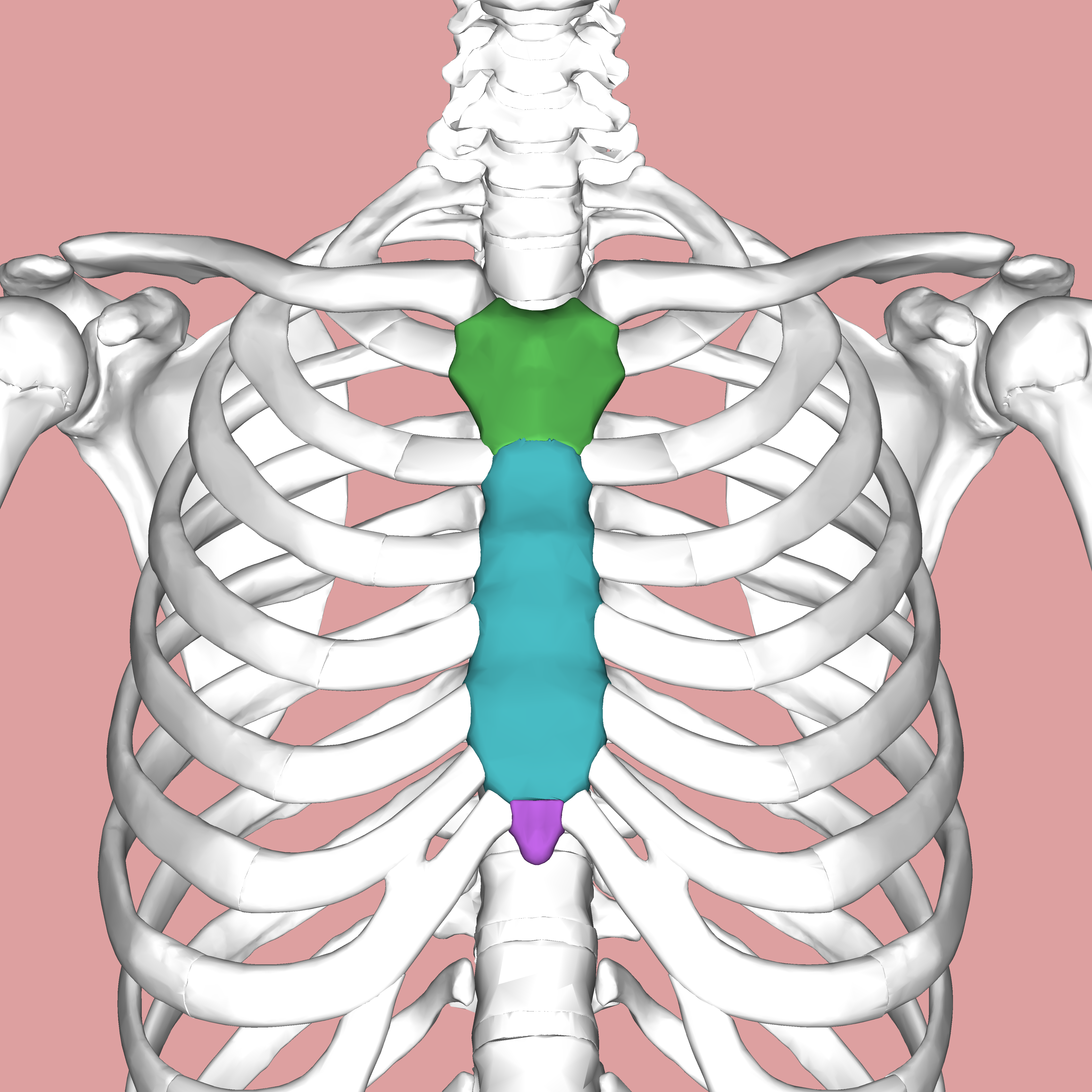
Sternum
The breastbone in the front center of the chest, made of the manubrium, body, and xiphoid process. The sternal angle is where the manubrium meets the body.

Typical rib
A curved chest bone with a head, neck, tubercle, angle, and shaft, plus a costal groove along its inner lower edge.

Pectoral girdle
Made of 2 clavicles (collarbones) and 2 scapulae (shoulder blades).
Connects the upper limbs to the axial skeleton; each scapula has a socket for the humerus that forms the shoulder joint.

Clavicle (collarbone)
A bone connecting the sternum to the scapula.
Has a sternal end, acromial end, shaft, deltoid tubercle, conoid tubercle, trapezoid line, and subclavian groove.

Humerus
The upper arm bone that connects the scapula at the shoulder to the radius and ulna at the elbow.
Features include the head, anatomical and surgical necks, greater and lesser tubercles, deltoid tuberosity, capitulum, and trochlea.

Forearm bones
The radius (thumb side) and ulna (little finger side) support the forearm.
They meet near the elbow and wrist at the radioulnar joints and are connected along their lengths by a strong sheet of tissue called the interosseous membrane.

Carpals
The 8 small bones in each wrist (16 total), arranged in a proximal row—scaphoid, lunate, triquetrum, and pisiform—and a distal row—trapezium, trapezoid, capitate, and hamate.

Pelvic girdle
The two hip bones that connect the lower limbs to the axial skeleton and support body weight.
Each hip bone has a socket that holds the head of the femur to form the hip joint.

Hip bone (os coxae)
A large bone of the pelvis formed when three bones—the ilium, ischium, and pubis—fuse together.

Female pelvis
A pelvis adapted for childbirth, typically with lighter, thinner bones, a wide, shallow cavity, a round or oval inlet, and a large outlet.
It also has outward-turned sitting bones, a straighter, more flexible tailbone, and a wide subpubic angle.

Male pelvis
A pelvis typically with heavier, thicker bones, a narrow, deep cavity, a heart-shaped inlet, and a smaller outlet.
It also has inward-facing sitting bones, a curved, less flexible tailbone, and a narrow subpubic angle.

Femur
The thigh bone that supports body weight and helps with movement.
Features include the head with its fovea capitis, neck, greater and lesser trochanters, linea aspera, and medial and lateral condyles.

Bones of the foot
Each foot has 26 bones: 7 tarsals, 5 metatarsals, and 14 phalanges (toe bones)—52 bones in both feet. The tarsals are the talus, calcaneus, navicular, cuboid, and three cuneiforms.