Range resto exam 1
 Call Kai
 Learn
 Practice Test
 Spaced Repetition
 Match
 Flashcards
 Knowt Play
1/78

There's no tags or description
Looks like no tags are added yet.
79 Terms
Why are range improvements needed
Needed to enhance or improve livestock grazing management, improve watershed conditions, enhance wildlife habitat
Give two examples each of structural and nonstructural vegetation improvements.
Structural: Fences, facilities, wells, water pipeline
Non-structural: seeding, prescribed burns, mechanical control treatments, herbicides, grazing treatments
How are range improvements funded on federal land?
Law says that either half of the grazing fees paid by operators or $10 million will be provided to the BLM to fund range improvements
CRIA
Cooperative Range Improvement Agreement
Agreement made between operated & US that outlines provisions for building, using and maintaining permanent structural improvements on public land
ex: fencing, guzzlers, wells, pipelines
RIP
Range Improvement Permit
authorizes construction of removeable range improvement. Operator funds 100% of the cost
Ex: cattle chute
EQIP
Environmental quality incentives program
Government pays farmers for conservation upgrades for water, irrigation, soil health, air quality, wildlife habitat
EX: government pays part of cost for guzzler to draw cattle away from riparian areas
CRP
Conservation Reserve Program
Program retires farmland so it can recover. Implements restoration efforts for wildlife (pollinators, deer, quail, pheasants)
Cons for CRP
Takes away acerage in rural communities which decreases jobs & incomes.
There is land being farmed that shouldn't be or farmable land that isn't being farmed and should be. The program doesn't do a good job specifying which is which.
Rental rates for CRP are higher than local land cache values so it negatively impacts next generation of farmers
CSP
Conservation Stewardship Program
incentives for continuing good conservation practices
5 principles in regenerative agriculture
Minimize mechanical or chemical disturbance. Don't till the soil any more than you have to.
Amor the soil. Use cover crops, don't leave soil bare where it's prone to erosion and temperature changes.
Promote diversity.
Leave living roots in the soil.
Use animals as nature intended. The landscape evolved with animals on it and still needs them there to manage it. Graze grasslands that will proliferate its growth.
Professional areas using rangeland vegetation improvement principles
Nature Conservancy
Utah DWR
Seed producer
Mine reclamation - Kennecott mine
Utah Department of agriculture and food
Environmental consultant
Roadside revegetation
What is ecological succession & how can understanding it help us manage/improve rangeland?
Ecological succession: directional change of plant community over time
Understanding succession will help us know what plant communities might move into an area after disturbance. Work with natural processes of succession instead of against them
Climax community
stable group of plants and animals that is the end of the succession process
How do the amounts and ratios of bacteria:fungi change with succession?
At the beginning of succession, bare soil is 100% bacteria. Fungus ratio slowly increases.
Grasses prefer more bacteria, woody plants prefer more fungus. As bacteria:fungus ratio changes so will the plants
Restoration
Intentional activity that initiates or accelerates recover of an ecosystem with respect to its health, integrity & sustainability
Rehabilitation
Doesn’t intend to re-establish the entire plant community but rather stop further degradation
EX: post fire we need to stabilize soil and prevent weeds so goal is just to get something on the ground
Reclamation
returning function and cover to drastically-disturbed lands
EX: Rebuilding soil in disturbed mine land site
Active restoration
revegetation and severe modifications of plant communities to remove/restrict some species or favor others. May be necessary if desired species were taken out or timeline for recovery thru passive restoration is long and won't meet objectives.
EX: Herbicides, lop & scatter, chaining, mastication, prescribed fire
Passive restoration
change management which allows natural processes to move plant community to desire outcome
EX: Altering number of livestock, closing a road. Changing human input and letting plants do their thing
Resilience
capacity of ecosystem to respond to disturbance by resisting damage and recovering quickly
Resistance
the ability to withstand change when subject to disturbance
3 soil temperature regimes
Mesic (warm)
Frigid (cool)
Cryic (cold)
5 moisture regimes
Aridic (dry)
Xeric (winter moist)
Ustic (summer moist)
Udic (moist, high elevation)
Aquic (saturated by water)
under what soil temperature & moisture regimes does cheatgrass do well?
Soil temperature: mesic (warm)
soil moisture: xeric, some aridic
Why is cheatgrass lmited at higher elevations
High elevations are usually colder (frigid to cryic) and relatively moist (zeric to ustic)
Cheatgrass limited by cold temperature (frigid to cryic), dry moisture regimes (dryer aridic), & limited in systems with significant summer precip (ustic)
Minimum bunchgrass densities at xeric and aridic sites
xeric: 3 plants per 10 ft2
Aridic: 2 plants per 10 ft2
Post settlement juniper (new growth)
Conical with pointed tip
few to no dead trees/ branches
absence of understory, lichens
branches are thinner
bark is thinner
lots of leader growth
Pre settlement juniper (old growth):
flat, uneven tops
dead trees, branches
lichens in bark/canopy
bigger branches
thicker bark
less leader growth
4 land uses/disturbances impacting restoration areas
wildfire frequency: time since fire, severity & intensity
roads, trails, campsites, pipellines, well pads, power lines, wind towers
past cultivation
livestock use of area
Juniper/ pinyon encroachment phases canopy percentage
Phase I: less than 1/3
Phase II: 1/3 to 2/3 of maximum
Phase III: greater than 2/3 of maximum
what does a restoration goal include
Species, group, location, attribute, action, quantity or status, time frame
2 pros & 2 cons for use of a rangeland drill and a no-till drill
Rangeland drill
Pro: very durable, creates microsite for seed
Con: causes high disturbance to soil due to making individual furrows. It’s more susceptible to wind & water erosion and weed encroachment
No-till drill
Pro: low soil disturbance so soil structure is preserved, seed placed at optimal depth
Con: Drill costs more, has more parts that can break
When would you choose to broadcast or when would you use a seed drill?
Broadcast: steep, rocky areas where drill can’t plant
Seed drill: on flatter land, need exact depth control
What should you do if you can’t buy seed of a species for your area?
Choose a related or similarly functioning species
Name 4 general rules when developing a seed mix
Choose 6-10 species of grasses, forbs and shrubs
build resiliency by planting at least 2 species within the same functional group
be mindful of compatibility issues between species, especially when combining native and introduced species
Be aware of recommended seeding depths for each species
**A pure stand seeding rate typically delivers how many seed per row foot? (Large & small seeds)
large: < 500,000 seeds/lb. Pland 24 seed/ft
Small: >500,000 seeds/lb. Plant 48 seeds/ft
List pros and cons associated with using native vs introduced species for restoration
Native
Pro: well adapted to site, function well as part of the community
Con: may not compete as well with introduced weeds, difficult or slow to establish, expensive, seed is difficult to get
Introduced
Pro: well adapted to environmental extremes similar to site, compete well with introduced weeds, easy/quick to establish
Con: may form monocultures with limited diversity, concerns about spreading into non-target areas
Cultivar
A distinct plant type that has been bred or selected for specific traits. Restoration cultivars are usually bred to be well adapted to an environment
**Locally sourced seed vs cultivars and challenges to each approach
Local seed
Pro: already adapted to the area
Con: difficult or expensive to collect
Cultivar
Pro:
Con: may not necessarily be suitable or optimal for all situations
**Why may it be important to plant locally sourced seed (use terms genetic drift and natural selection in answer)
Definition of genecology and how does Genecology help managers find the right seed for restoration?
Study of genetic variation within species and relationship to the environment from which they came
Genecology helps us correlate plant traits and the habitats where they evolved. A consistent correlation indicates adaptation as determined by natural selection. It helps managers match a seed to a habitat that needs to be restored
Empirical seed zones
Specific geographic area suitable for a species seed based off of genetic, molecular and field research
Provisional seed zones
Generalized, climate-based zones within which seeds can be transferred with little risk of maladaptation
These are basic guidelines for seed movement when we don’t have species-specific data.
How big are mega fires
100,000 acres
How does smoke from a prescribed fire compare to a wildfire? How is each regulated by national air quality regulations
RX smoke is much less than wildfire smoke but it’s regulated by the government as “an avoidable nuisance.”
Name 3 management practices we should do to prevent mega fires
prescribed fires
mechanical thinning
manage fire instead of suppress fire
What benefits can be achieved through conducting prescribed fires
Less smoke, thin out fuels, increases patchiness and natural fire breaks
What are the disadvantages to prescribed fire
Publicly not supported
intensive planning requirements
liability concerns
requires qualified applicators
impaired air quality and reduced aesthetics over the short term
Imprecise and variable treatment (doesn’t burn like you think it will, get rained on or it burns hotter/faster than predicted)
Need for adequate fire weather conditions, narrow time period for application
can favor invasion of non-native plants
Draw the fire triangle and environmental fire triangle
Fire triangle: Oxygen, heat, fuel
Fire environment triangle: weather, topography, fuel

What weather parameters are most important in determining when to conduct RX? Why?
RH, air temperature, wind speed
They affect the fire behavior, how hot it burns, and the rate of spread
Prescribed fires should be conducted at what temperature, RH and wind speed?
Temperature <60 F
Wind speed <20 mph
RH > 40
For every 20 F (11.1 C) increase in temperature, relative humidity is reduced by
half
EX: at 8am, the temperature is 60 degrees and RH is 80%. What is the expected RH when temperature goes to 80 degrees?
RH will be 40 %
8 factors that affect temperature
season
cloud cover
topography
aspect
shading
vegetation
wind
elevation
RH
6 factors affecting wind speed
Topography
diurnal variation: As temps rise in the day, wind goes up (heat goes up). As they cool down, the wind goes down (cool air goes down)
vegetation
eddies
frontal boundary: Two types of airmasses: low pressure and high pressure. Boundary between the two is called a front and is where most weather occurs.
slope effect
Why is it dangerous to burn within 12 hours of a predicted frontal movement?
A front is the boundary between a low pressure and high pressure air mass. There’s a lot of wind and sudden changes in wind direction. This will cause your fire to spread erratically and you do not want to be there.
5 factors affecting fire behavior considering fuels
Fuel loading
Fuel size
continuity & arrangement
chemical properties
fuel moisture
Fuel loading
The amount of fuel in an area
Total fuel: entire biomass (everything)
Potential fuel: part of total fuel that could burn (what will probably burn)
Available fuel: what would burn in a given situation (not likely to burn)
Fuel size - light, medium, heavy
Fuel with high SA:V ratio require less heating for ignition (more area to dry out interior)
Light: moisture content changes rapidly due to weather and topo. take on and give up moisture quickly. (grasses)
Medium: mod to high intensity burning but slower ROS (shrubs & grass under 6 ft)
Heavy: High-intensity burning, low to moderate ROS (heavy continuous shrubs or brush over 6 ft)

Fuel size - moisture content
1 hr: ¼ inch diameter. (pine needles)
10 hr: ¼ - 1 inch diameter. (small branches)
100 hr: 1-3 inch diameter. (tree limbs)
1000 hr: 3-8 inch diameter (logs)
This is the time for moisture content to equalize with surrounding air. 1 hr fuels respond to changes in RH faster than 100 hr fuels. (If it rains for an hour, a 1 hr fuel will be soaked. 100 hr fuels take a long time to soak up moisture but a long time to dry out.)
Fuel continuity
Continuity = the amount of coverage or distribution of fuels
Horizontal continuity: stuff on the ground. Is it patchy or uniform (sagebrush steppe vs cheatgrass)
Vertical continuity: fuels up and down (ladder fuels)

Fuels complex
Amount and arrangement of fuels in an area
Canopy, surface and ground fuels

chemical properties
Fuels can contain chemicals and minerals that can enhance or retard combustion.
Volatile substances: oils, resins, wax, pitch (juniper, sagebrush, pinyon, pine)
Minerals reduce fire spread and intensity (duff)
fuel moisture
The amount of water in fuels changes how fast it dries out and catches fire.
Fresh foliage: 300% moisture content
Maturing foliage: 200% moisture content
Mature foliage: 100% moisture content
Entering dormancy: 50% moisture content
Completely dead: <30% moisture content
Relative humidity
the ratio of the amount of water vapor currently in the air compared to the maximum amount of water vapor that the air can hold at that specific temperature and pressure, expressed as a percentage
What are fire breaks and 8 examples
Fire breaks are breaks in the fuel continuity that prevent fire from spreading
EX: mowed lines/wet line, cattle/hiking/horse trails, road line, Dozer/scraped lines, disked/tilled/plowed line, hand line, natural line, black lines
5 ignition sources and describe how they’re applied
Fusee
drip torch
exploding flares
Delayed aerial ignition device
terra torch, heli torch
what is a test fire
A test fire is a small fire done before firing. Check the fire and smoke behavior to make sure the fire is burning as expected. It helps determine if you should go forward with the prescribed fire
Describe eight different ignition methods
Head fire
Back fire
Flank fire
Strip head fire
Spot ignition fire
Center ignition fire
Ring fire
Chevron
Head fire
Moves with wind
Rapid ROS, long flame length, most intense, hottest temp, most difficult to control, damaging to shrubs & trees

Back fire
Moves against wind
Slowest ROS, shortest flame length,
Safest method. used to establish a baseline and good for heavy fuel loads
Can damage roots from prolonged heat

Flank fire
Moves parallel or at right angle to wind
moderate intensity
Used to secure flanks of back or head fires

strip head fire
Burn with the wind in small strips
Can burn small strip from the green to a road/black to increase buffer area. Once you have a bigger black area you can increase strip width.
Most commonly used

Spot ignition
Uses series of small spot ignitions that burn together and minimizes possibility that a spot will gain momentum to start to run.
This is what you get with a DAID (delayed aerial ignition device)

center ignition
Conduct a backfire and start a fire in the center and then fire off around the entire perimeter
Convection with draw the fire toward the center, moving smoke high into the air
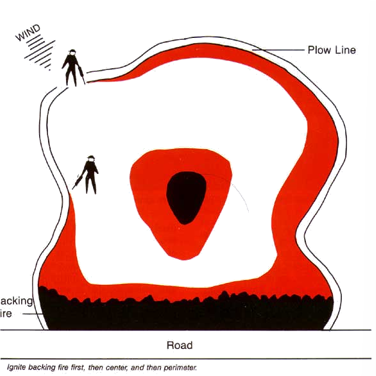
ring fire
Used for site-prep, minimizes spotting
traps wildlife, high intensity

Chevron
establishes a line of fire in v-shape to burn off ridge points or ends. burn progression must be downhill

***In Utah, when can you conduct a prescribed fire, and is it always within this period?
RX can't be done June 1 to October 31. The state forester can advance/extend the closed season.
***In Utah, name two things you should do with the County Fire Warden before conducting a prescribed fire.
Get a burn permit. Notify them when you'll be burning….
***Describe the recommendations for post-burn rest and deferment.
Resting an area after fire depends on vegetation composition, site conditions and burn objectives. It's suggested to not graze for 2 growing seasons. Depending on the site, you could rest only one year or may need to reseed.