Week 8: School age (9-12)
0.0(0)
Studied by 6 people Call Kai
 Learn
Learn Practice Test
 Spaced Repetition
 Match
Match Flashcards
 Knowt Play
Card Sorting
1/49

Earn XP
Description and Tags
Last updated 12:10 PM on 10/11/26
Name | Mastery | Learn | Test | Matching | Spaced | Call with Kai | Chat |
|---|
No analytics yet
Send a link to your students to track their progress
50 Terms
1
New cards
by age 12 girls have attained about __% of their adult height while boys have reached about __% of theirs
93%
84%
84%
2
New cards
Growth
girls in this age range are ahead of boys in their overall rate of
growth
girls have slightly more body fat and slightly less muscle tissue
than boys
sex differences in skeletal and muscular maturation cause
girls to be better coordinated but slower and somewhat weaker
than boys
growth
girls have slightly more body fat and slightly less muscle tissue
than boys
sex differences in skeletal and muscular maturation cause
girls to be better coordinated but slower and somewhat weaker
than boys
3
New cards
myelinization
further development in the frontal lobes (logic and planning) and reticular formation (selective attention becomes possible)
4
New cards
immunization
HPV and Hep B (If missed in infancy)
5
New cards
Injury
Injury-related mortality increases with age and is higher for males than females
6
New cards
more than _/_ of fatal injuries are due to motor vehicle crashes (next most common is drowning)
1/2
7
New cards
_/_ of Canadian children between 5-11 have unhealthy/sub optimal body weights
1/4
8
New cards
_% of boys and _% of girls are considered overweight
14% and 19%
9
New cards
_% of boys and _% of girls are obese (the highest level ever recorded)
8% and 9%
10
New cards
Obesity results from many factors:
- genetic predisposition
- epigenetic modifications set early in life
- environment (overeating or low PA)
- lower SES is a higher risk (lower participation in sports)
* weight loss is risky in this group- requires
specialized diets developed by
nutritional experts and increased exercise
- epigenetic modifications set early in life
- environment (overeating or low PA)
- lower SES is a higher risk (lower participation in sports)
* weight loss is risky in this group- requires
specialized diets developed by
nutritional experts and increased exercise
11
New cards
Obesity risk factors
- overweight parents
- large size for gestation age at birth
- early onset of being overweight (age 5 and under)
- large size for gestation age at birth
- early onset of being overweight (age 5 and under)
12
New cards
24-Hour movement guidelines
1. Sweat
- at least 60 mins a day of MVPA (Involving aerobic activities)
2. Step
- light PA (several hours of structured LPA)
3. Sleep
- uninterrupted 9-11 hours of sleep at night
4. Sit
- no more than 2 hours a day of recreational screen time (limit sitting for extended periods)
- at least 60 mins a day of MVPA (Involving aerobic activities)
2. Step
- light PA (several hours of structured LPA)
3. Sleep
- uninterrupted 9-11 hours of sleep at night
4. Sit
- no more than 2 hours a day of recreational screen time (limit sitting for extended periods)
13
New cards
ParticipACTION report card on physical activity for children and youth
Overall PA: 23.8% of children met MVPA recommendation at the start of the pandemic compared to 17.5% of children in October 2020
organized sport: 74% of children pre COVID-19 and 63% during COVID-19 participated in sport
Sedentary behaviours: 18% of children met the screen time recommendations (no more than 2 hours recreational screen time/day)
organized sport: 74% of children pre COVID-19 and 63% during COVID-19 participated in sport
Sedentary behaviours: 18% of children met the screen time recommendations (no more than 2 hours recreational screen time/day)
14
New cards
Cognitive skills
- horizontal decalage (apply new cognitive
skills to all kinds of problems)
- emergence of problem solving rules from
experience and trial and error (not
necessarily age linked)
skills to all kinds of problems)
- emergence of problem solving rules from
experience and trial and error (not
necessarily age linked)
15
New cards
Horizontal decalage (will be on the test)
applying knowledge to new situations
eg.
- its lightly snowing outside so wear a coat
- its heavily snowing so you must also wear a coat
Once a child learns a certain function, they do not have the capability to immediately apply the learned function to all patterns
ex. ball of clay into different shapes - from 6-7 knows it is the same amount, at 9-10 realizes it weighs the same, 11-12 understands it's the same volume
*VERY SIMILAR to conservation but extends beyond matter and mass to everyday situations
eg.
- its lightly snowing outside so wear a coat
- its heavily snowing so you must also wear a coat
Once a child learns a certain function, they do not have the capability to immediately apply the learned function to all patterns
ex. ball of clay into different shapes - from 6-7 knows it is the same amount, at 9-10 realizes it weighs the same, 11-12 understands it's the same volume
*VERY SIMILAR to conservation but extends beyond matter and mass to everyday situations
16
New cards
Horizontal decolage example
A 7-year-old child understands that when one of two equivalent balls of clay is transformed into a sausage-shape, the two lumps still consist of equal amounts of clay. The child, however, fails to correctly comprehend that the differently shaped clumps of clay weigh the same. Both tasks are similar, but the child is clearly unable to apply his understanding about the first situation to the second situation.
17
New cards
Vertical decalage
same cognitive function in different stages
- walking to the other side of a room with their physical body
mastery of this skill = walking to the other side of the room in their mind (they can imagine or draw a map without being in the room)
Using same cognitive function in different stages
2 years old - can navigate around environment
Years later, can develop a map
- walking to the other side of a room with their physical body
mastery of this skill = walking to the other side of the room in their mind (they can imagine or draw a map without being in the room)
Using same cognitive function in different stages
2 years old - can navigate around environment
Years later, can develop a map
18
New cards
vertical decolage example
at the age of 2, a child can navigate around a familiar environment, such as their home. It is not until years later that they can represent this knowledge symbolically by drawing a map. There is vertical décalage between a problem that a child can physically master and their ability to solve it in an abstract manner.\[6\]
19
New cards
Automaticity
ability to recall information from long-term
memory without using short-term memory
capacity (achieved through practice)
memory without using short-term memory
capacity (achieved through practice)
20
New cards
Expertise
more knowledge an individual has about a
topic the more efficient their information processing system will work (despite age)
*advanced skills in one area does not improve general levels of memory or reasoning
topic the more efficient their information processing system will work (despite age)
*advanced skills in one area does not improve general levels of memory or reasoning
21
New cards
Elaboration
finding shared meaning or a common referent for two or more things that need to be remembered
22
New cards
Mnemonic
a devise to assist memory
(Every Good Boy Deserves Fudge - musical staff)
(Every Good Boy Deserves Fudge - musical staff)
23
New cards
Systematic searching
'scanning' ones memory for the whole domain in which a piece of information might be found
24
New cards
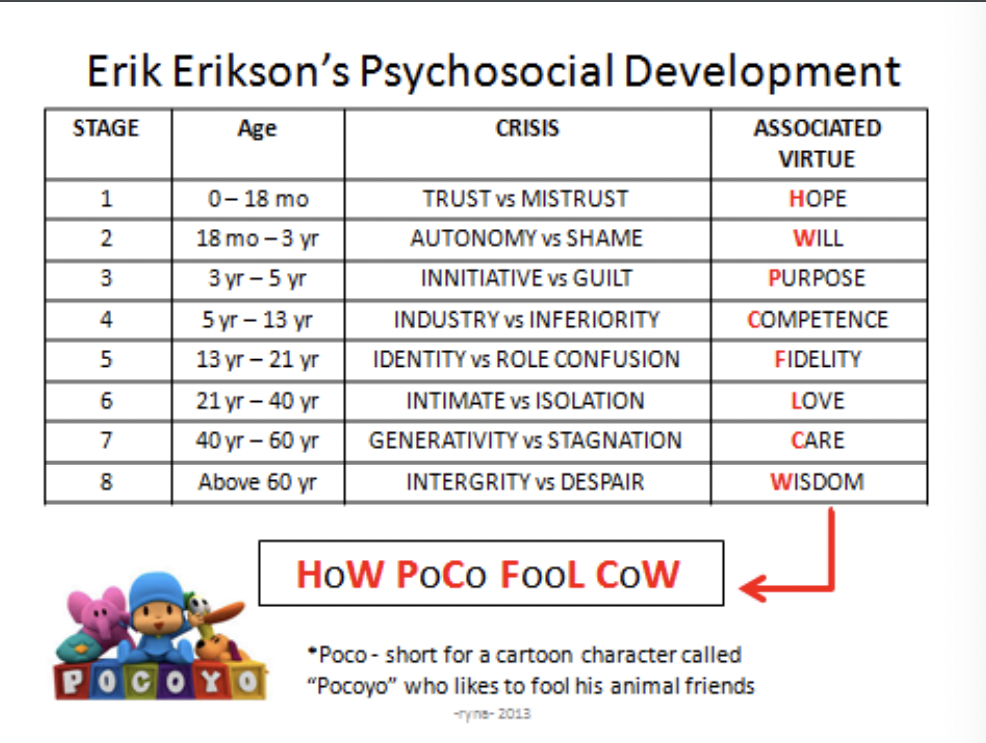
Erikson's psychosocial development
Industry vs Inferiority
*image will be on exam - learn the mnemonic
*image will be on exam - learn the mnemonic
25
New cards
Language
vocabulary grows at a rate of 5,000-10,000 words per year
by age 8 or 9, the child shifts to a new level of
understanding of the structure language, figuring out
relationships between whole categories of words, such as
between adjectives and adverbs or between adjectives and
nouns
by age 8 or 9, the child shifts to a new level of
understanding of the structure language, figuring out
relationships between whole categories of words, such as
between adjectives and adverbs or between adjectives and
nouns
26
New cards
Literacy
Balanced approach - reading instruction that combines explicit phonics instruction with other strategies for helping children acquire literacy
*early elementary school years are the best time to identify and help poor readers
*early elementary school years are the best time to identify and help poor readers
27
New cards
3 components of emotional intelligence
1. Awareness of our own emotions
2. Ability to express our emotions appropriately
3. The capacity to channel our emotions into the pursuit of worthwhile goals
children's ability to exercise control over their emotions in early childhood is strongly related to measures of academic achievement in high school
2. Ability to express our emotions appropriately
3. The capacity to channel our emotions into the pursuit of worthwhile goals
children's ability to exercise control over their emotions in early childhood is strongly related to measures of academic achievement in high school
28
New cards
Achievement vs assessment
Achievement
- assess specific information learned in school
Assessment
- formal and information methods of gathering information that can be used to improve learning (no grades or marks)
*Achievement tests may not measure what child learns in
school (child may have learned the skill at home)
- assess specific information learned in school
Assessment
- formal and information methods of gathering information that can be used to improve learning (no grades or marks)
*Achievement tests may not measure what child learns in
school (child may have learned the skill at home)
29
New cards
Group Differences
when total scores in schooling are broken down into several separate skills some long-standing (and perplexing) patterns of
gender differences emerge:
- girls have always achieved better school marks than boys for
all subjects
- especially language studies but also in science and math (with
the latter going against the common narrative)
gender differences emerge:
- girls have always achieved better school marks than boys for
all subjects
- especially language studies but also in science and math (with
the latter going against the common narrative)
30
New cards
why group differences?
could be due to learning styles
- analytical
(tendency to focus on the details of the task - suits the school system)
vs
- relational
(tendency to ignore the details of the task of the order to focus on the 'big picture')
- analytical
(tendency to focus on the details of the task - suits the school system)
vs
- relational
(tendency to ignore the details of the task of the order to focus on the 'big picture')
31
New cards
ADHD
root cause is unknown; however, twin studies suggest a genetic basis
- premature birth is a risk factor
- not likely due to environmental factors, diet or brain damage
- premature birth is a risk factor
- not likely due to environmental factors, diet or brain damage
32
New cards
Characteristics of ADHD
- Higher activity level,
- lower ability to sustain attention and control impulses
- treating/managing ADHD behavioural strategies
- stimulant medications
- lower ability to sustain attention and control impulses
- treating/managing ADHD behavioural strategies
- stimulant medications
33
New cards
Industry vs Inferiority (Erikson)
development of a child's sense of competence through
mastery of culturally defined learning tasks
mastery of culturally defined learning tasks
34
New cards
Reciprocal determinism (Bandura)
interaction of personal, behavioural and environmental
factors
provides insight into the mechanisms that drive the
development of self-efficacy
factors
provides insight into the mechanisms that drive the
development of self-efficacy
35
New cards
self concept
from 6-12 kids understanding of themselves improves
- child moves through the concrete operational periods, the psychological self becomes more complex, more comparative,
less tied to external features, and more centred on feelings and ideas
- child moves through the concrete operational periods, the psychological self becomes more complex, more comparative,
less tied to external features, and more centred on feelings and ideas
36
New cards
self esteem
Self-esteem is the evaluation of one's own self worth
Self-esteem tends to be stable in the short term but somewhat less so over periods of several years during middle childhood and adolescence
Self-esteem influenced by both a low perceive discrepancy between the ideal and actual selves and social support
Self-esteem tends to be stable in the short term but somewhat less so over periods of several years during middle childhood and adolescence
Self-esteem influenced by both a low perceive discrepancy between the ideal and actual selves and social support
37
New cards
meaningfulness
children need to be more than just passive learners
when teachers and children learn together, share decisions,
and respect and trust one another, children and teachers
develop a stronger sense of who they are as humans in the
world
when teachers and children learn together, share decisions,
and respect and trust one another, children and teachers
develop a stronger sense of who they are as humans in the
world
38
New cards
Social Cognition
by the end of middle childhood period, children have
developed a much broader understanding of others than
they possessed at the beginning
- children are beginning to understand the moral aspects of
social relationships
developed a much broader understanding of others than
they possessed at the beginning
- children are beginning to understand the moral aspects of
social relationships
39
New cards
Covid-19 and social skills
The loss of everyday peer-to-peer contact, uncertain academic career and use of online learning have created a new reality also in education
- significant negative impact in the wellbeing of individuals with a deterioration in mental health (anxiety/ depression), social isolation and development/ stress/ eating disorders among children and adolescents
- significant negative impact in the wellbeing of individuals with a deterioration in mental health (anxiety/ depression), social isolation and development/ stress/ eating disorders among children and adolescents
40
New cards
moral reasoning
Moral reasoning is the process of making
judgments about the rightness or wrongness of
specific acts (Piaget)
judgments about the rightness or wrongness of
specific acts (Piaget)
41
New cards
moral realsim
- the belief that rules are inflexible (first stage of moral development)
42
New cards
moral relativism
- understand that many rules can be changed through social agreement (second stage)
43
New cards
Parental expectations
as self regulation grows, parents allow children more independence (there are cultural and sex differences in parents'
responses)
responses)
44
New cards
Parenting for self-regulation
parents model self-regulation behaviour, higher expectations + parental monitoring = greater self-regulatory competence,
development of self-regulation is associated with the authoritative style of parenting
development of self-regulation is associated with the authoritative style of parenting
45
New cards
gender segregation
patterns in gender segregation are found in all cultures and are visible by age 3
46
New cards
Boy friendship groups
- bigger and more accepting of newcomers
- involve more outdoor play and roam over a larger area
- appear to be focused more on competition and
dominance, and higher levels of competition between pairs
of friends than strangers
- involve more outdoor play and roam over a larger area
- appear to be focused more on competition and
dominance, and higher levels of competition between pairs
of friends than strangers
47
New cards
Girl friendship groups
- more likely to play in pairs or in small, more exclusive groups
- more playtime indoors or near home or school
- more agreement, more compliance, and more self disclosure, and higher levels of competition between strangers than between friends
- more playtime indoors or near home or school
- more agreement, more compliance, and more self disclosure, and higher levels of competition between strangers than between friends
48
New cards
social status 3 groups
popular
- attractive children = more likely to be popular
rejected
- being different from their peers = more likely to be rejected
neglected
- shy, highly creative, difficulty controlling emotions
*children's social behaviour seems to be more important than looks or temperament
- attractive children = more likely to be popular
rejected
- being different from their peers = more likely to be rejected
neglected
- shy, highly creative, difficulty controlling emotions
*children's social behaviour seems to be more important than looks or temperament
49
New cards
Turn Key Kids - after school care
children who are at home by themselves after school for an
hour or more are:
- more poorly adjusted in terms of both peer relationships and school performance
children younger than 10 do not have the cognitive abilities
necessary to evaluate risk and deal with emergencies
self-care is most negative for children in low income
neighbourhoods with high crime rates
hour or more are:
- more poorly adjusted in terms of both peer relationships and school performance
children younger than 10 do not have the cognitive abilities
necessary to evaluate risk and deal with emergencies
self-care is most negative for children in low income
neighbourhoods with high crime rates
50
New cards
Sexting statistics
- at least 1 in 4 teens are receiving sexually explicit texts and
emails
- at least 1 in 7 are sending sexts
- more than 1 in 10 teens are forwarding sexts without consent
- about 1 in 12 teens have had sexts they've sent forwarded without their consent
emails
- at least 1 in 7 are sending sexts
- more than 1 in 10 teens are forwarding sexts without consent
- about 1 in 12 teens have had sexts they've sent forwarded without their consent