Chapter 10: From DNA to Protein: Gene Expression
 Call Kai
 Learn
 Practice Test
 Spaced Repetition
 Match
 Flashcards
 Knowt Play
1/44

45 Terms

Enzyme knockout inheritance
Following experiments and observations in recessive disorders and spores related to the absence of enzymes in metabolic pathways, it was found that this was done in a Mendelian manner
Implied the “one gene-one enzyme” theory as different allelic mutations affected specific, single pathways
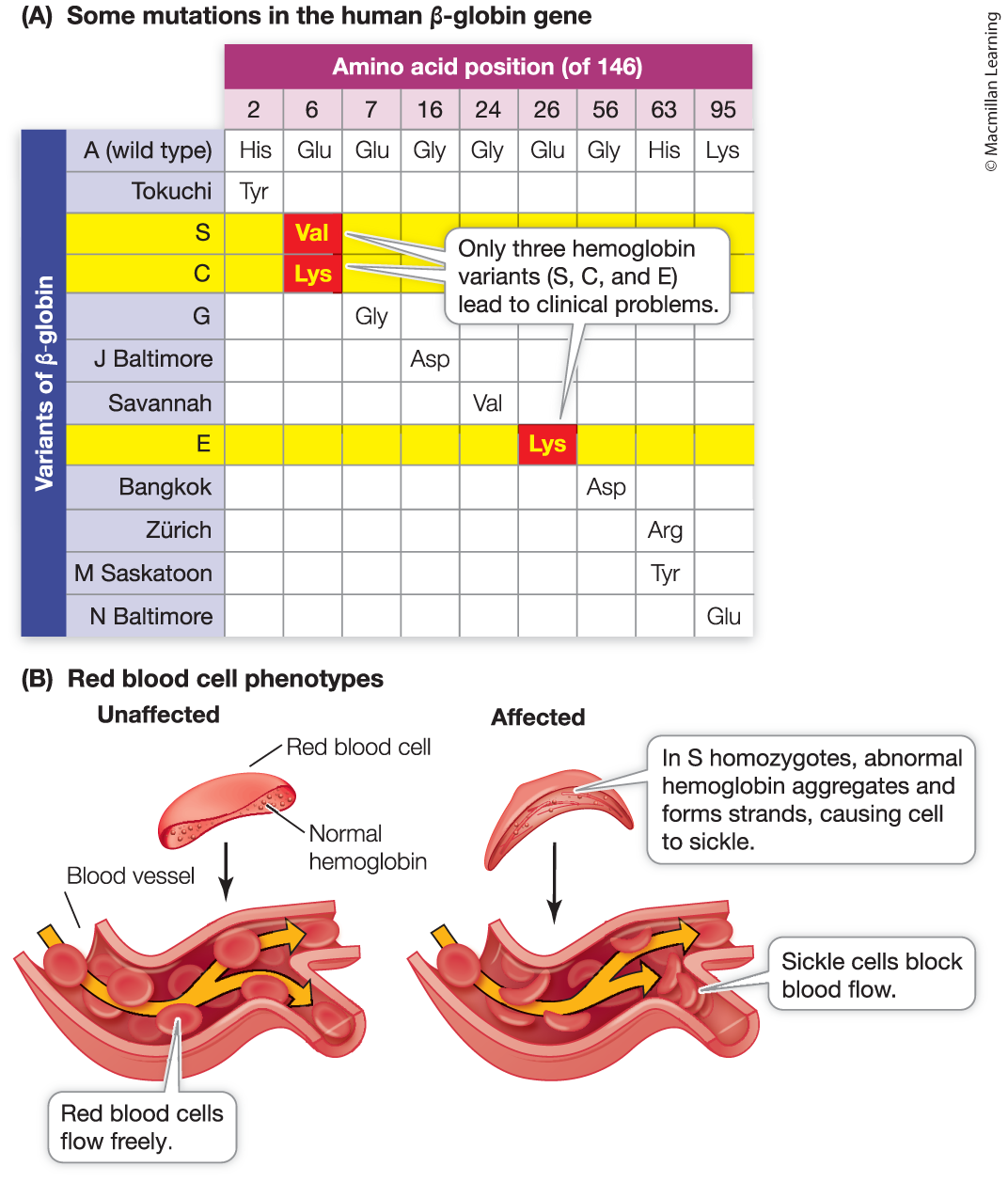
One gene-one polypeptide theory
An updated phrasing of the “one gene-one enzyme” theory following the discovery that genes could encode non-enzyme proteins
Allowed for mutations to be considered in the context of genetic and amino acid defects, such as sickle-cell disease

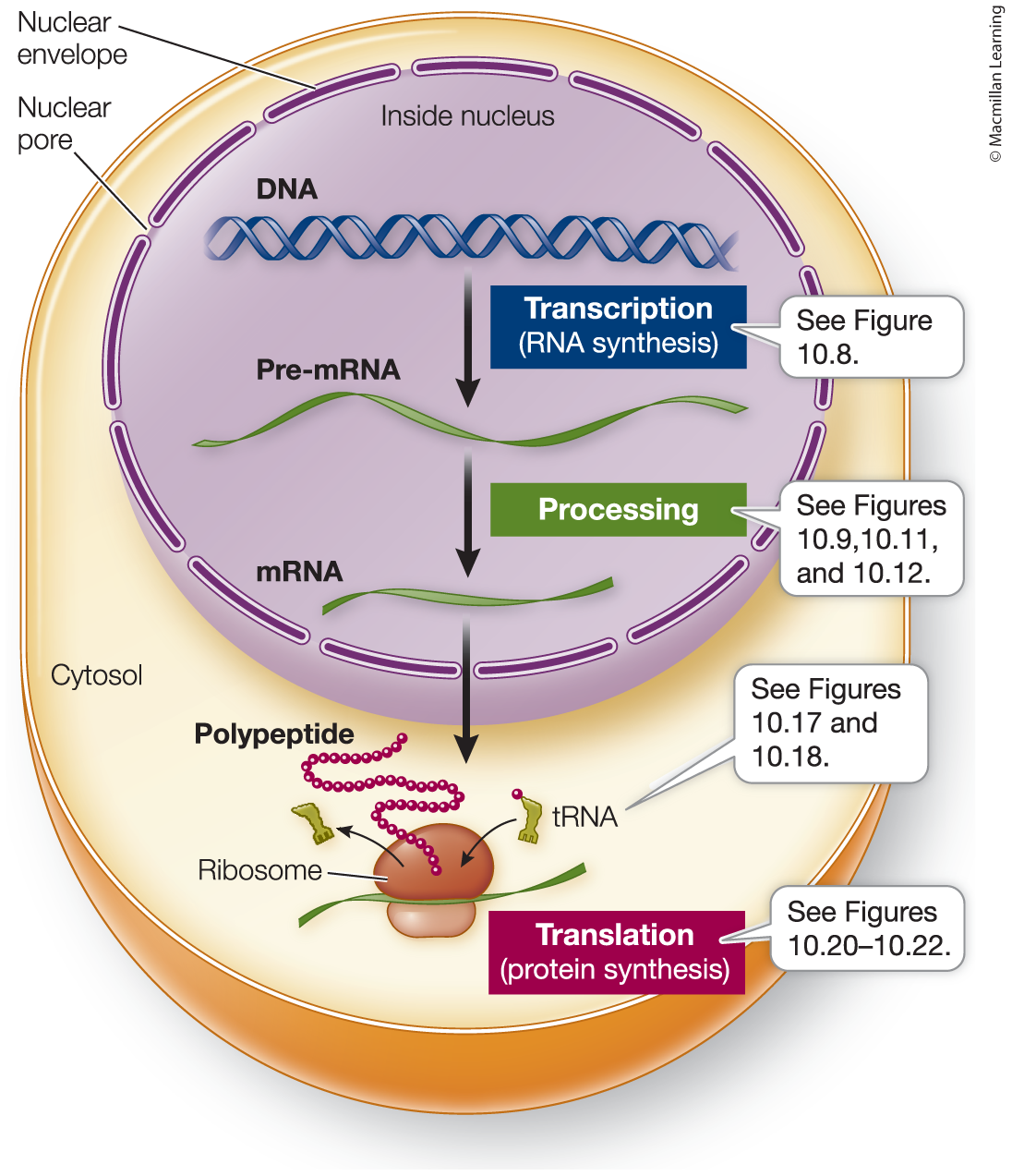
Transcription
The process of copying DNA into a complementary RNA sequence

Translation
The process of synthesizing the amino acid sequence of a polypeptide from an RNA sequence

Messenger RNAs (mRNAs)
RNA molecules that encode protein information, containing complementary information based off a DNA template strand
In eukaryotes, this is altered during processing before moving to the cytosol for translation
Makes up <5% of all RNA
Ribosomal RNAs (rRNAs)
RNA molecules that make up ribosomes alongside multiple proteins, functioning in protein synthesis
These catalyze the formation of peptide bonds between amino acids
Makes up 80% of all RNA

Transfer RNAs (tRNAs)
RNA molecules that bind a specific amino acid and recognize a specific sequence of nucleotides in mRNA
These add amino acids to a growing polypeptide chain
Makes up 15% of all RNA
RNA synthesis
Like DNA, this also includes initiation, elongation, and termination
Initiation
In RNA synthesis, this begins with a promoter being activated, signaling RNA to bind to the region as DNA unwinds to be made available to the enzyme

RNA polymerase
These synthesize RNA strands in the 5’ to 3’ direction (similar to DNA) and read in the 3’ to 5’ direction, utilizing ribonucleosides and starting with a promoter
Promoters
Special regions of DNA to which the RNA polymerase binds, signaling initiation and facilitating binding
These are bound by sigma and transcription factors, helping determine which genes are expressed at a particular time
Elongation
In RNA, this continues with strands being synthesized in the 5’ to 3’ direction and read in the 3’ to 5’ direction until termination is reached
Creates a complementary strand, but substitutes uracil (U) for thymine (T)
DNA is then rewound behind the polymerase as the RNA grows
While errors occur with few detections, harm is minimized due to lack of heredity and short lifespans
Coding regions
Sequences within a DNA molecule that are eventually translated as proteins
Prokaryotes feature one directly for mRNA without interruption
Eukaryotes feature these, but contain interruptions (introns) between these (exons)
These are not directly read by RNA polymerase but resemble it most
Template regions
Regions on the DNA molecule that are directly opposite the coding regions translated into RNA
This region is directly read by RNA polymerase, serving as a complementary strand to the coding region and RNA sequence being transcribed

Introns
Short for “intervening regions,” these are noncoding sequences present in eukaryotes
While these appear in primary mRNA transcript (pre-mRNA), these are removed after processing

Exons
Short for “expressed regions,” these are transcribed regions that are interspersed with introns
After processing of the pre-mRNA to remove introns, these are spliced together for delivery as mature mRNA
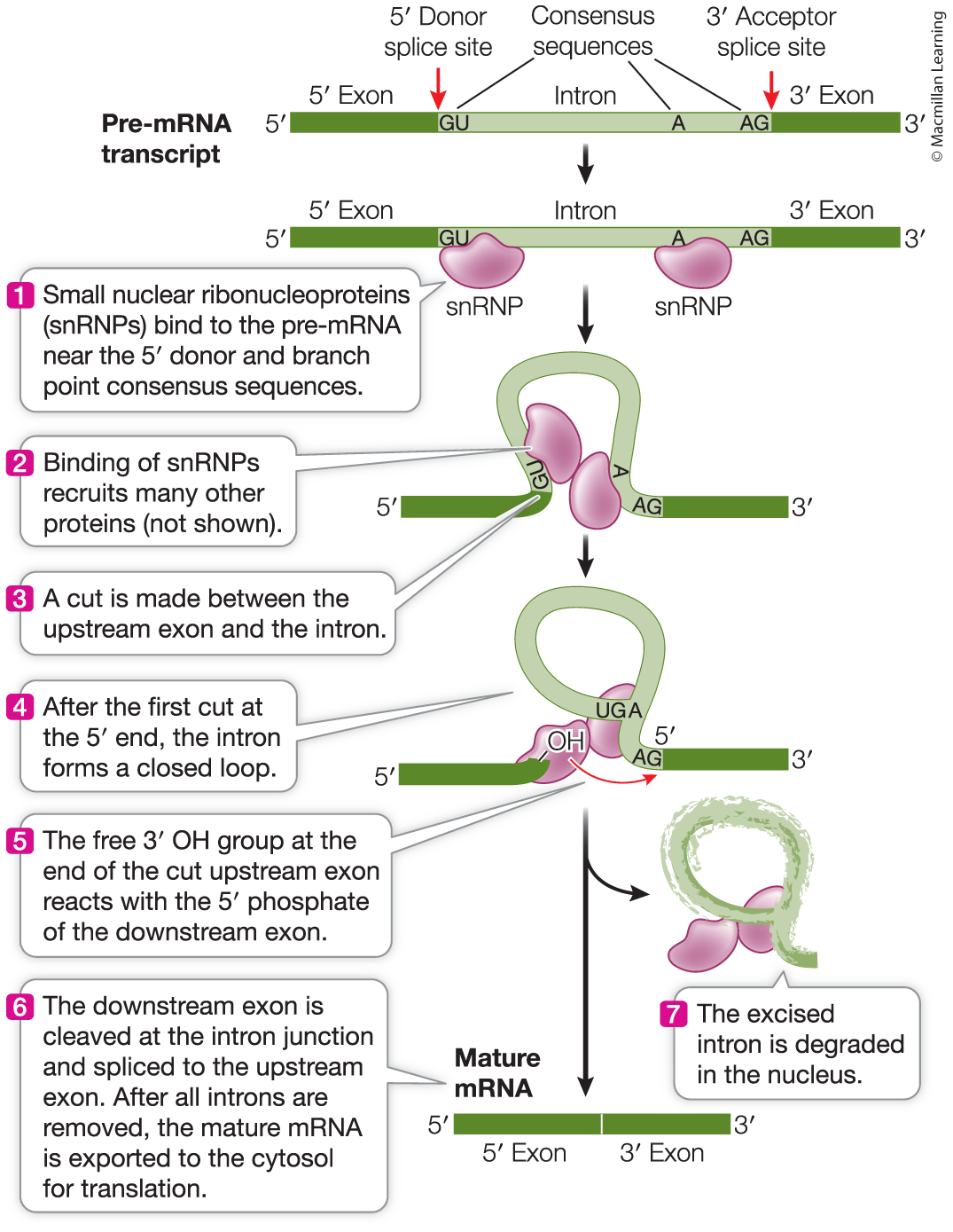
RNA splicing
The removal of introns and splicing of exons together in the processing of pre-mRNA
Requires the recognition of consensus sequences, which appear across introns

Branch point
A sequence on the interior of the intron that signals the end of an intron’s consensus sequence

Spliceosome
An RNA-protein complex that splices out introns from pre-mRNAs, composed of small nuclear ribonucleoprotein particles (snRNPs) that recognize the intron

5’ cap (G cap)
A set of methylated guanine triphosphate (GTP) added in a backward orientation to the 5’ end of the pre-mRNA, which facilitates ribosome binding for translation and defends against cytosol-linked breakdown

Poly A tail
A set of 100 to 300 adenine nucleotides added by another RNA polymerase, assisting in mRNA export, binding for translation, and molecular stability

Codons
Three nucleotides in mRNA that direct amino acid placement in polypeptide chains, related to amino acids by the genetic code
First types decoded by Marshall Nirenberg and Heinrich Matthaei utilizing an artificial known mRNA to trigger the production of radioactively-marked proteins
These are generally the same across species
Sense codons
Codons that encode amino acids, including high levels of redundancy to mitigate DNA mutations
Synonymous mutations
Mutations in a DNA sequence that, after being translated into RNA, do not alter the phenotype
Occur because of the degeneracy of the genetic code
Stop codons (nonsense codons)
Codons that do not encode amino acid information and cause termination of translation
These cause the release of the polypeptide into the cell
Start codon
The codon that initiates translation, AUG; this also codes for the amino acid methionine

Transgenic organisms
Organisms engineered to express a gene from another organism, made possible through the presence of the universal genetic code

Missense mutations
Mutations that occur when a DNA substitution encodes a different amino acid, which can cause a change in function or lose a start codon

Nonsense mutations
Mutations that result in a change from a sense to a stop codon, causing a premature termination of translation and shortened protein

Loss-of-stop mutations
Mutations that result in a change from a stop to a sense codon, resulting in additional amino acids being added
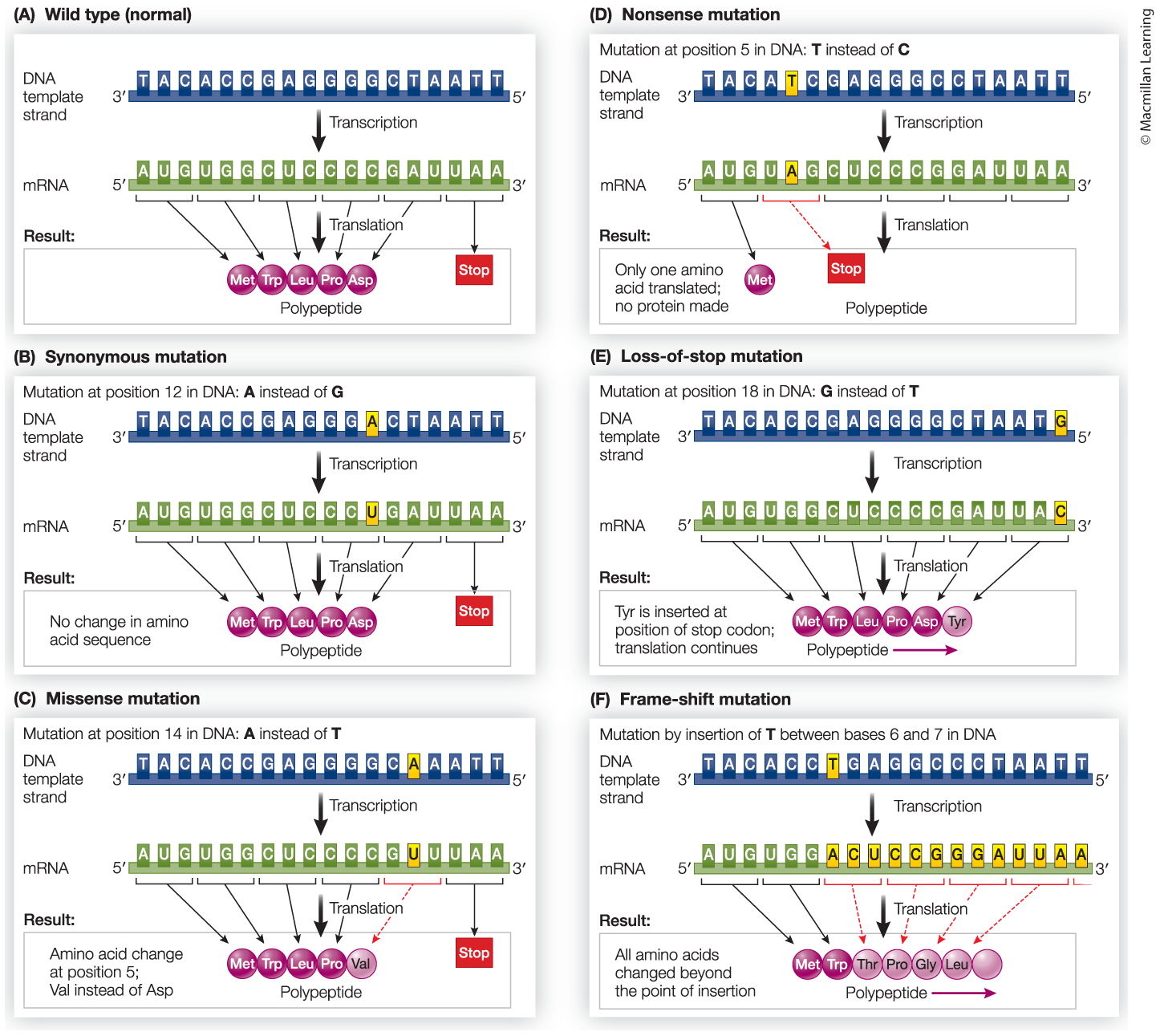
Frame-shift mutations
Mutations that result in the insertion or deletion of one or more (but not a multiple of three) base pairs in the coding sequence, leading to an altered sequence being read and a typical loss of function

Transfer RNAs (tRNAs)
RNA molecules that link the information in an mRNA codon with a specific amino acid, reading and delivering the appropriate codon to the ribosome for bond catalysis
To perform this, they covalently bond to amino acids at their 3’ end and bind to with mRNA with a semi-complimentary anticodon while not binding with the ribosome
5’ to 3’
The direction in which tRNA anticodons translate, reading mRNA in the 3’ to 5’ direction
Wobble
This is exhibited on the 3’ end of the tRNA codon to pair with more than one partner, making anticodons not strictly complimentary
Seen with the base hypoxanthine, which does this with A, C, and U to enable wider recognition

tRNA synthetases
Enzymes that catalyze bond formations between tRNA and amino acid molecule, utilizing ATP to form a high-energy bond that is later broken in the ribosome for polypeptide formation

Ribosomes
The site of mRNA translation with tRNA molecules, composed of two subunits that only come together during translation
These perform translation by moving across the mRNA towards the 3’ end
Contain the amino (A), polypeptide (P), and exit (E) sites for binding, with tRNA anticodons binding at the A site, linking the amino acid in the P site, and exiting at the E site for charge
Hydrogen bonds validate the created links with codons, ejecting defective links
Initiation complex
The combination of a charged tRNA, small ribosomal subunit, and mRNA
In prokaryotes, the ribosome directly binds to the start codon
In eukaryotes, the ribosome binds to the 5’ and moves down until reaching the start codon
This ends with the addition of methionine and the binding of the large subunit, covering the tRNA with the P site to align the second codon with the A site
Initiation factors
Proteins that aid the assembly of the initiation complex

Ribozyme
A ribonucleic acid that acts as an enzyme; rRNA in the ribosome qualifies as one of these as it catalyzes bond breakage between the tRNA and amino acid while forming a peptide bond three bases at a time

Protein release factor
This binds to a stop codon on mRNA, hydrolyzing the bond between the polypeptide chain and tRNA in the P site with the subunits subsequently separating

Polyribosome
An assembly of a strand of mRNA with multiple ribosomes producing polypeptides at the same time

Signal sequences
A sequence of amino acids that indicates the required location of the polypeptide after translation
For use in the endomembrane system, binding this to a recognizer halts translation until bound to the rough endoplasmic reticulum (RER) for protein storage while this is cleaved
For use in other organelles, another protein binds to this for direction
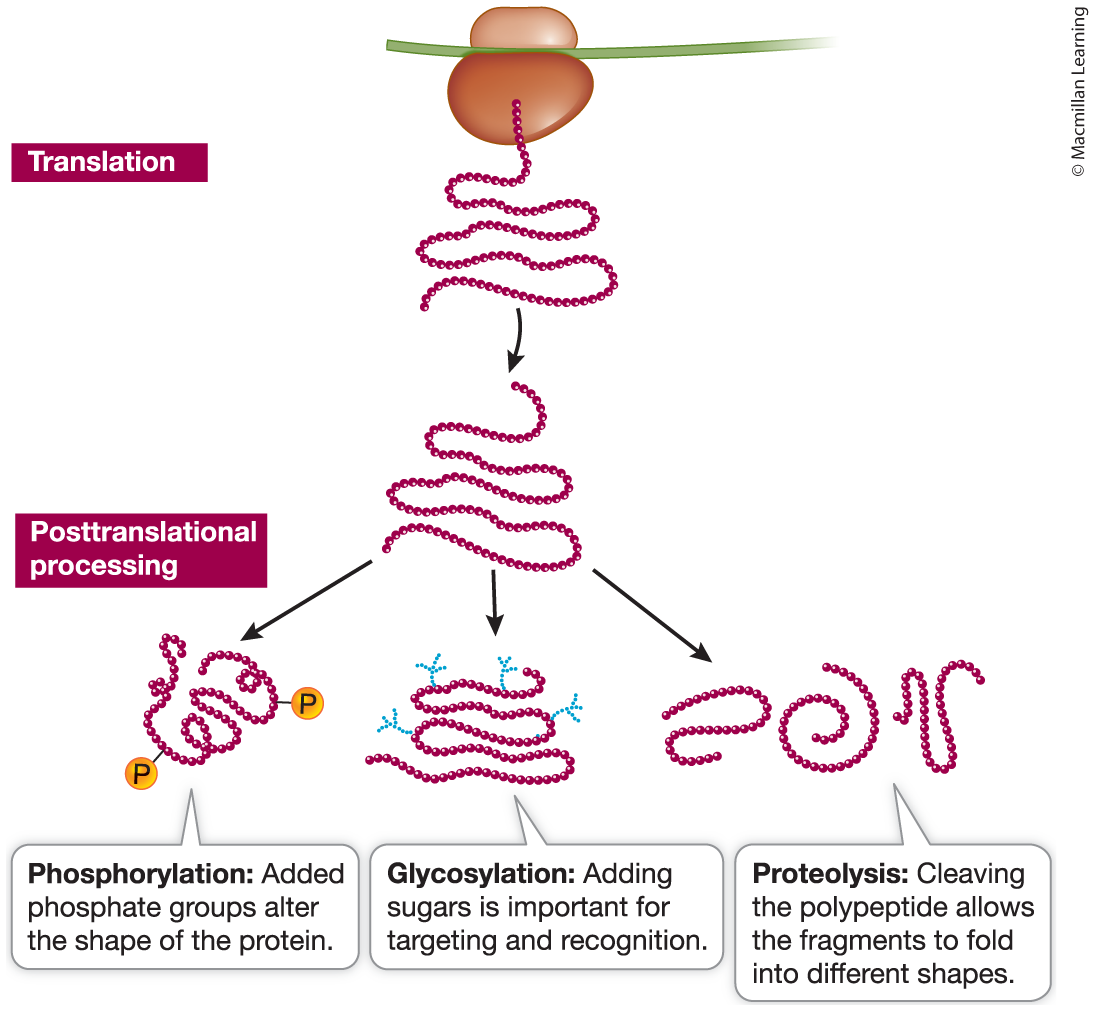
Proteolysis
A post-translational modification of a protein involving the cutting of a polypeptide chain by enzymes called proteases
Some proteins can be produced in this way before folding
Also seen with the removal of signal sequences or the initiator methionine
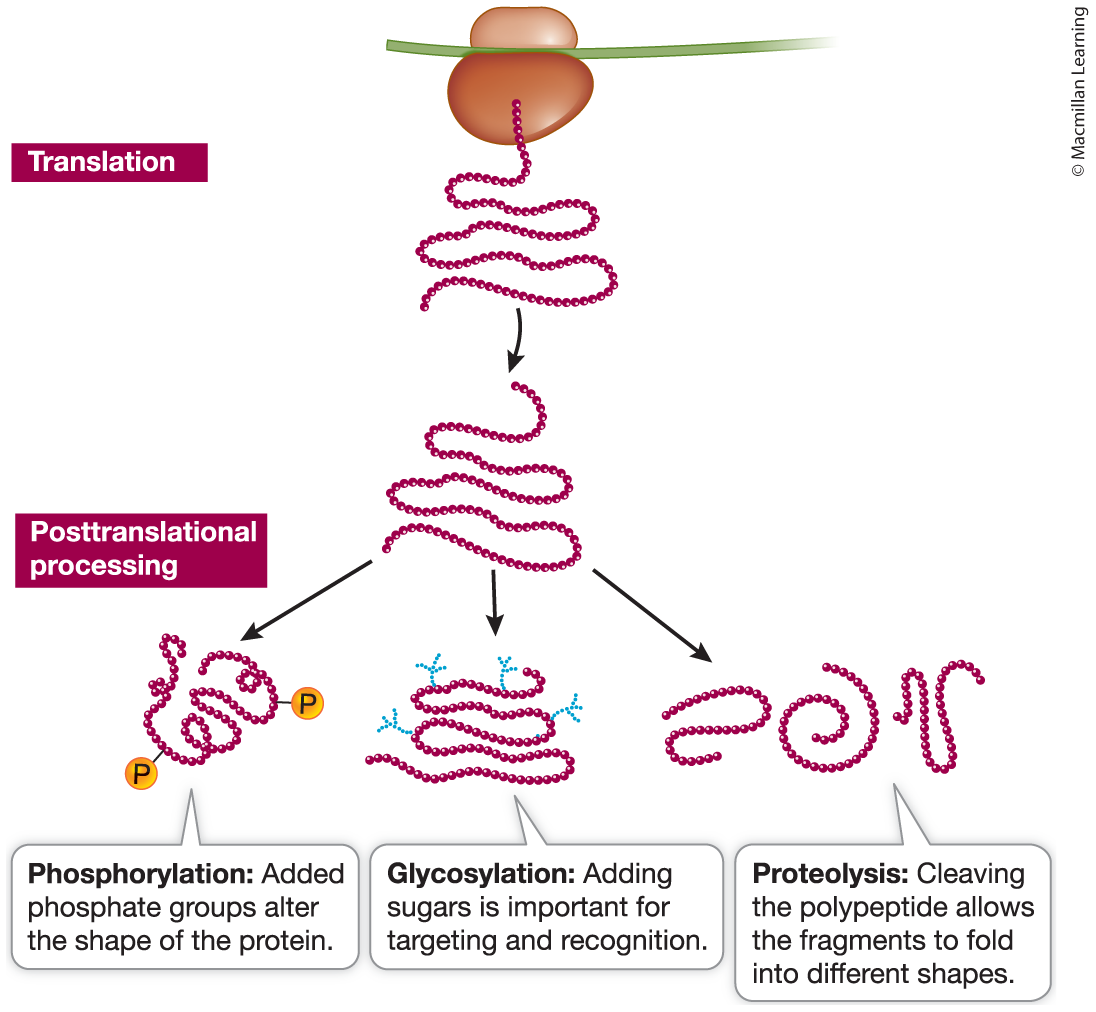
Glycosylation
A post-translational modification of a protein involving the addition of carbohydrates to form stabilized glycoproteins
These can aid in organelle and cell signalling, like on the surface of red blood cells

Photophosphorylation
A post-translational modification of a protein involving the addition of phosphate groups, catalyzed by protein kinases
These can change the conformation of the protein, exposing an enzyme’s active site or binding site for another protein
Is often reversible for protein regulation