Physics II Lab Exam Final Practice
 Call Kai
 Learn
 Practice Test
 Spaced Repetition
 Match
 Flashcards
 Knowt Play
1/39

There's no tags or description
Looks like no tags are added yet.
40 Terms
In this lab we will be looking at standing waves on a string, what property are we changing to change the number of nodes in the standing wave?
We change the frequency of the oscillator

Which picture shows a standing wave on a string with two half wavelengths
Wave 2
In last week’s lab we made three graphs with period (T) and length (L) of the pendulum. Which graph shows a proportional relationship?
T2 vs. L
Which had a large effect on the period of a pendulum (choose all that apply)
Length
Higher frequency sound waves will have _____ velocity compared to lower frequency sound waves
the same
To measure the wavelength of sound waves we will
Move the microphone back and forth
In last week’s lab when we doubled the tension in the string
The wave velocity approximately went up by 40%
Other than tension, what determines the speed of a wave on a string
String density
According to the lab manual, today we will experimentally create separated charges on
Scotch tape
In the second part of this lab that uses the computer, we will find the form of Coulomb’s Law by looking at the force between
Two charged spheres
About how long is the wavelength of a 40 kHz sound wave?
8.6 mm
How does the speed of sound coming out of the 40 kHz transducers differ from the velocity of audible sound frequencies?
The ultrasonic waves travel the same speed as audible waves
In today’s lab we will investigate electric field lines and Gauss’ Law using
A computer program
For Gauss’ law part of the lab we will
Count the number of field lines entering and exiting a “loops”
What kind of function did you see when you graphed the Coulomb’s law force as a function of distance
Inverse-square
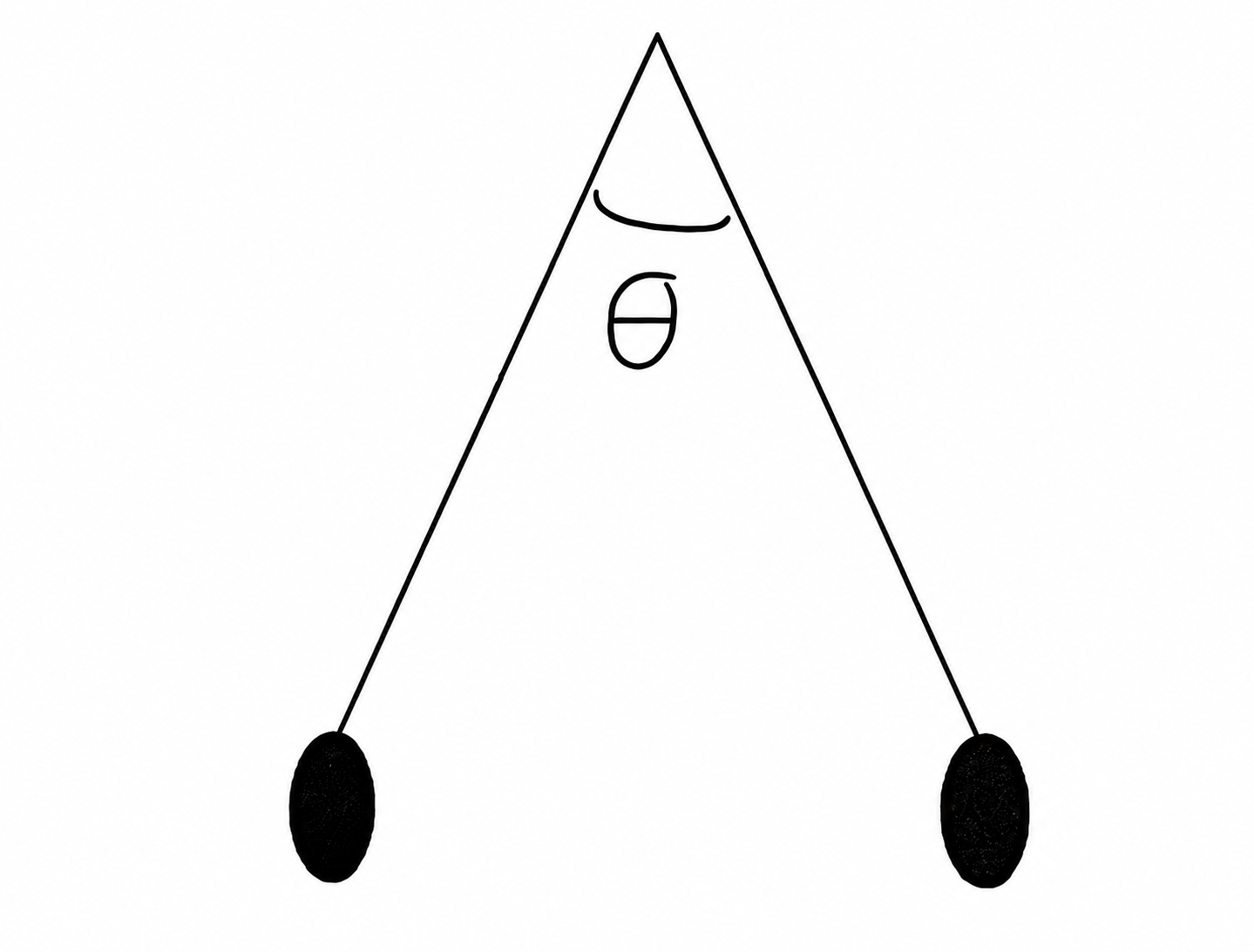
What can we conclude from this picture, if both balls are deflected sideways by the same angle
None of the above must be true (even though some of them might be)
Which anaolgy was used in the Ohm’s Law lab report to describe voltage, current, and resistance
Water flowing through a pipe
What type of relationship does Ohm’s Law predict for voltage and current through a resistor
Proportional
You have two capacitors, each of which is hooked up to a different resistor. The first capacitor discharges in 5 seconds when hooked up to the first resistor. The second capacitor discharges in 1 second when hooked up to the second resistor. Which scenario is NOT possible?
The second resistor is larger and the second capacitor is larger
A capacitor is being discharged through a resistor. After one second half of the charge is left in the capacitor. How much of the charge is left after two seconds?
¼ of it
A material is considered “Ohmic” if:
c. Both a. and b.
A light bulb heats up as current is passed through it. Compared to its resistance when cold, the resistance when hot is:
more
The objective of this lab is to measure the strength of the magnetic field of
The Earth
The device we will use to produce a controlled magnetic field is
A solenoid
The horizontal component of the magnetic field of the Earth (what we measured) inside the physics labs is about
0.25 G

Indicate the direction of the magnetic field inside the solenoid. (The heads of the arrows shown below and the part of the circular wires next to them are "closer" to you than the top and bottom parts of the circular wires shown.)
The arrow should point to the RIGHT, along the axis inside the solenoid
In today’s lab we will study how the magnetic field inside a “long” Slinky depends on: (circle all that apply
both a. and b.
In today’s lab we will determine the value of which constant
μo

According to the textbook the magnetic field inside a slinky™ is B = μ₀ n I. Which graph(s) support(s) this claim, considering both slope and intercept? (Pick as many as you like)
Top right graph
According to the textbook the magnetic field inside a slinky™ is B = μ₀ n I. If you take measurements of magnetic field at various turn densities (always using two amperes of current) and get the following graph. What is your slope-based experimentally measured in μ₀
μ₀ = slope/ I = 0.0024/2 = 0.0012 m/A
The induced emf in Faraday’s Law is proportional to
The rate of change of the flux
The orientation of the field from the induced current predicted by Lenz’ Law is orientation
Always such as to oppose the change of the flux
According to Lenz Law, a decreasing flux out of the page will result in
An induced field out of the page to replace the lost flux
What combination of solenoids will produce an increase in voltage in the secondary solenoid?
Primary N=100, secondary N=200
How many lenses are used in today’s lab?
Two
How many locations could you place a converging lens can create an image, for a given choice of separation between the source and image screen?
Two

Charges shown have ± 1.0 μC of charge. How much charge is hidden behind the blocked out region
+1μC
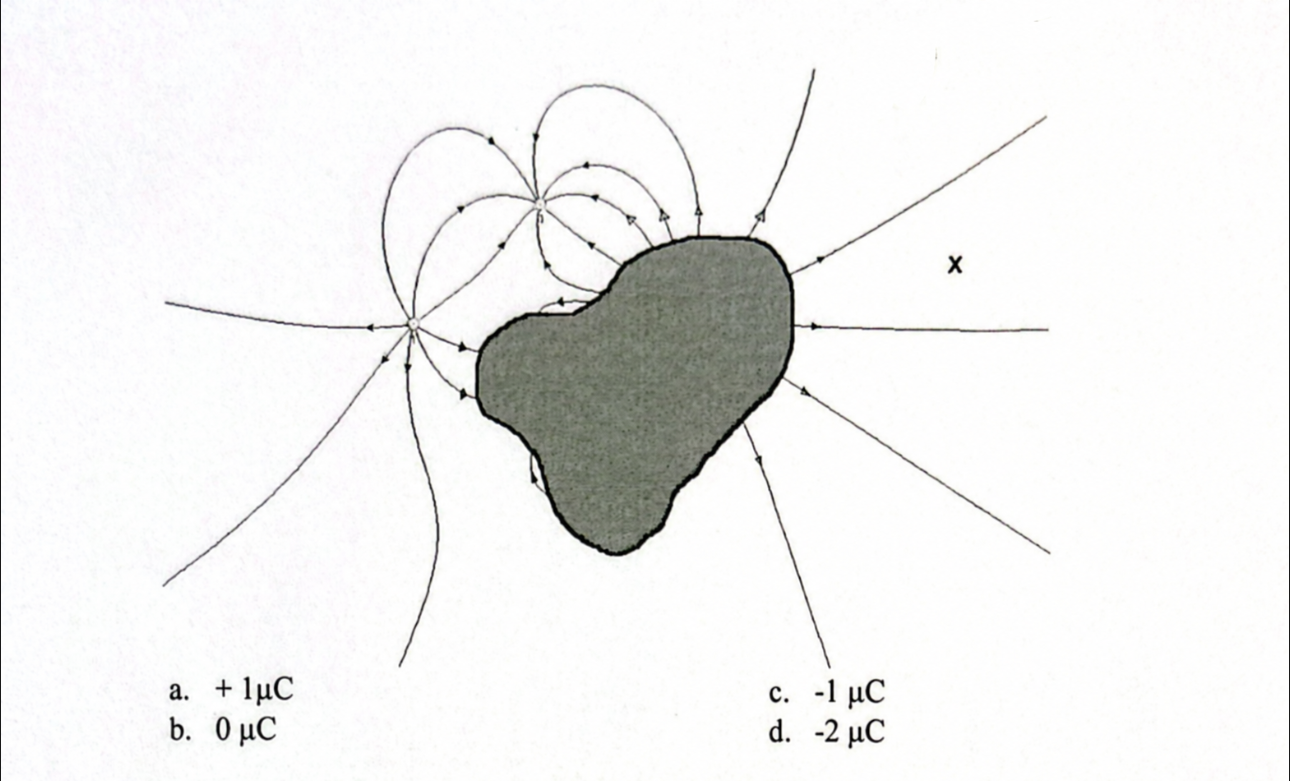
How would the total number of field lines entering the blocked out region (that is number entering minus number exiting) change if another positive charge was placed at the position marked with an “X”
The total number of field lines would remain the same
What analogy is used to describe charge leaving a capacitor in the preliminary questions?
Candy in a candy jar
The function that describes the discharge of a capacitor is ____ with time
Exponential