Review Notes: Catabolism of fatty Acids - Overview
 Call Kai
 Learn
 Practice Test
 Spaced Repetition
 Match
 Flashcards
 Knowt Play
1/10

There's no tags or description
Looks like no tags are added yet.
11 Terms
Roles of Lipids
lipids = biological molecules that are soluble in organic solvents
DONT former plymers
roles of lipids
Membrane structure
Cholesterol:
membrane structure - 95% of cholesterol is in membrane
precursor of bile acids
precursor of steroid hormones (cause of cardiovascular disease)
→ produces hormones & vitamins
Second messensgers (ex. diacylglycerol)
Produce vitamins (A,D,E, K)
very important energy stores
Fatty acids Catabolism
Triaglycerols relationship with Fatty acids
Esterification = forms TAGs from fatty acids
Lipolysis = breakdown TAGs into fatty acids
Fatty acid relationship with A-CoA
FA synthesis = uses A-CoA +ATP to form fatty acids
Beta-oxidation = breaks down FA into A-coA
A-CoA can be used in CAC to generate energy
A-CoA can be used to irreversibly form cholesterol (no pathway to break, thus excrete as bile salts to lower high cholesterol)
A-CoA can be used to form ketone bodies (reversible)

Fatty Acids
Fatty acids = hydrocarbon derivatives
4-36 carbons long (most common are C16 & C18)
amphiphatic/amphiphillic: consist of a polar head group & non-polar hydrocarbon tail
longer chain FA are amphipathic bc they contain a longer NONpolar tail
shower chain FA are amphiphilic bc they have a shorter NONpolar tail

Types:
saturated = NO double bonds (fully saturated w hydrogens)
Cis-unsaturated (most common) = double bond w hydrogens on same side of DB
assumed
trans-unsaturated = double bond w hydrogen on OPP sides of DB
MUST be told & indicated

most fatty acids are deprotonated at c1 (carboxyl group), thus have a (-) charge
FA’s are formed from TAGs via lipolysis or from A-CoA using ATP

Q.

LDL = ”bad” cholesterol that forms plaque
HDL = “good” cholesterol that helps stop forming plaque
Numbering of Fatty Acids
start numbering at carbonyl carbon (c1) → alpha → beta….
last carbon is omega

note: omega-# indicates that the DB is # carbons from the omega (last) carbon of the FA
ex. omega-3 fatty acid = 1st DB is 3C from the omega carbon
note: 1% of diet needs to be omega-3 fatty acids & we don’t need more
Q. is this an omega-9 fatty acid?

No, this is a omega-3 fatty acid
C18 with 3 double bonds, thus ∆9,12,15
note: linolenate is an essential fatty acid that we get from plants in our diet
note: most PUFA’s have NON conjugated double bonds - thus have 2+ single bonds b/w DB’s
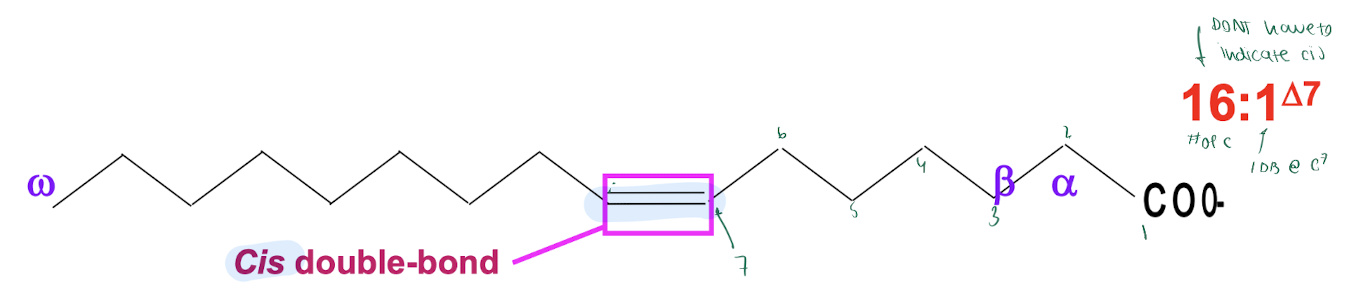
Indicating Trans vs. Cis double bonds of Fatty Acids
Cis double-bond = H’s on same side of DB
DONT have to indicate its cis
# of carbons in total : # of DB ^ ∆# of c w DB
trans double-bond = H’s on OPP side of DB
NEED to indicated its trans before ∆
# of carbons in total : # of DB trans^ ∆# of c w DB

What affects the melting point of Fatty acids?
→ length of chain & presence/absence of DB’s affect FA melting points:
longer chains have higher Mp
saturated chains have higher Mp
presence of DB’s prevents FA from coming together → decreasing van Der Waals interactions b/w chain that decreases Mp
longer chain & less DB = more solid
shorter chain & more DB = less solid

Triacylglycerols (TAGs)
Triacylglycerols = fatty acid esters of glycerol
consist of FA chains connected via ester bonds to a 3C glycerol backbone
form TAGs via esterification rxn in which the acyl group is left behind when glycerol is added to FA
purpose: TAGs/fat are our main energy store, NOT carbohydrates
fat is stored primarily in adipose tissue (also release hormone like muscle does)

Types:
Mixed TAGs = 2 diff FA attached to glycerol backbone
Simple TAGs = ALL 3 FA are identical

Role of Leptin
Leptin = monomeric protein w only alpha-helices & loops
binds to receptor in thalamus to sya you’re full
possible obesity treatment, but has little effect bc few humans have mutated leptin protein, instead we have more mutations in the leptin receptor (harder to treat)
Many foods contain TAGs: example
shows:
longer chain & less DB = more solid
shorter chain & more DB = less solid
ex. beef fat has a longer chain saturated than butter, thus its more solid
ex. olive oil has more unsaturated thus its more liquid than beef fat & butter
