CHAPTER 2 - Chemistry * level of organization
 Call Kai
 Learn
Learn Practice Test
 Spaced Repetition
 Match
Match Flashcards
 Knowt Play
1/62

There's no tags or description
Looks like no tags are added yet.
Name | Mastery | Learn | Test | Matching | Spaced | Call with Kai | Chat |
|---|
No analytics yet
Send a link to your students to track their progress
63 Terms
Chemistry
the science of the structure and interactions of matter
Matter
anyhthing that occupies space and mass
mass - amount of matter in an object (never chanes)
It composes living and non living things
All matter is composed of chemical elements
Element - cannot be chemically broken down into simpler substances
composed of identical particles called atoms
96% of the human body mas is made up of..
Carbon
Hydrogen
Nitrogen
Oxygen
Atom
the smallest unit of matter that retains the properties and characteristics of matter
atoms are electrically neutral (# of protons = # of electrons)
atoms of different elements contain diff # of protons
Atoms are defined by..
Atomic number (# of protons)
Mass number (protons + neutrons)
Isotopes
atoms of elements that differ in the number of neutrons

Ion
an atom that has gained or lost an electron

Protons
found in the nucleus and have a positive charge
p+

Neutrons
found in the nucleus and have no charge
N0

Electrons
these travel around the nucleus in orbitals (shells_ and have a negative charge (e-)
each shell holds a specific # of electrons
outermost shell = valence shell
A molecule is formed…
when 2 or more atoms are joined by a chemical bond
this can involve the same elements or different elements

Chemical bonds
these are formed to achieve complete shells of electrons and thus chemical stability
1st shell has 2 e- (nearest to the nucleus)
2nd shell has 8 e-
3rd shell holds 8 or more e- (max 18 e-)

Types of Chemical Bonds: Ionic bonds
these are formed by the transfer of electrons from one atom to another
e.g. NaCl

Type of Chemical Bonds: Covalent Bonds
these are formed by the sharing of pares of electrons between two or more atoms
Non-polar → e-'s are shared equally between atoms
Polar → e-'s are not shared equally between atoms
One atom pulls the e- towards them b/c they are more EN

Types of Chemical Bonds: Hydrogen bonds
these are formed when a hydrogen atom with a partial positive charge attracts the partial negative charge of a nearby electronegative atom
most often N or O

Chemical Reactions
these occurs when bonds are formed, broken or rearranged
Energy
the capacity to do work
two forms:
Potential Energy → energy stored by matter due to it's position
Kinetic energy → energy associated with matter in motion
Chemical energy
a form of potential energy that is stored in the bonds of compounds and molecules

Activation energy
energy required to disrupt the electrons to get the molecules to interact
aka start the reaction

Catalysts
These are enzymes that speed up reactions by lowering the activation energy

Synthesis reactions
Anabolic reactions
where two or more atoms, ions, or small molecules join together to form a larger molecule

Decomposition reactions
Catabolic reactions
where a larger molecule is broken down into smaller molecules, ions or atoms
Exergonic
a reaction where more energy is released than absorbed
Endergonic
a reaction that absorbs more energy than it releases

Exchange Reactions
this reaction involes both synthesis and decomposition
parts of two different molecules trade positions with one another
Are chemical reactions reversible?
Yes they are
they just require energy
doesn't happen often in biology
Biochemistry
the study of chemical composition and living matter
Inorganic compounds
these compounds lack carbon and are structurally simple
e.g. water, salts, acids, and bases
except CO2
Organics compounds
these compounds always contain carbon & usually hydrogen and other functional groups
formed via covalent bonds
Carbon forms 4 bonds w/ other elemenrs
built by joining monomers (small molecules) into polymers (macromolecules)
e.g. carbohydrates, lipids, proteins, nucleic acids, and adenosine triphosphate (ATP

Inorganic compounds: Water
The most abundant and important inorganic compound in all living organisms
Has many important properties:
High heat capacity - gains and loses heat very slowly
High heat of vaporization - needs a lot of energy for it to be changed from liquid to gas (needs to break hydrogen bonds first)
polar solvent - universal, can dissolve most things
formed during dehydration synthesis reactions and required in hydrolysis reactions
cushioning and lubricating effect

Inorganic Compounds: Salts, acids and bases
All of these dissociate when dissolved in water
gives rise to oppositely charged ions (electrolytes)
Salts - dissolve into + and - ions
Acids - dissolve into 1 or more H+ and 1 or more - ions (HCl → H+ + Cl-)
Bases - dissociate into 1 or more OH- and 1 or more + ions (NaOH → Na+ + OH-)

pH scale
range from 0-14
based on the relative [ ] of H+ in a solution
1 pH unit = 10x change in [H+]
ph < 7 - acidic (H+ > OH-)
ph = 7 - neutral (H+ = OH-)
ph > 7 - basic (H+ < OH-)
Buffer systems
found in the body to minimize changes in the pH of solutions
done by converting strong acids or bases into weak acids or bases
absorbs H+ or OH- so there is less from the strong acid/base

Dehydration synthesis
Monomers are joined by the removal of OH from one monomer and removal of H from the other at the site of bond formation

Hydrolysis
Monomers are released (broken apart) by the addition of water molecules
Adds OH to one monomer and H to the other
Organic Compounds: Carbohydrates
used as fuel and structural purposes such as DNA
Includes sugars, glycogen, starches, and cellulose
-composed of C, H, and O
Main source of chemical energy for metabolism
classified by # of sugar units

Monosaccharides
simplest form with one sugar molecule
general formula (CH2O)n
1:2:1 ratio of C:H:O
e.g. pentose 5C → C5H10O5

Disaccharides
consists of 2 monosaccharides (2 sugars)
formed by a dehydration synthesis
-e.g. sucrose

Polysaccharides
contains more than 2 sugars
large chains of many monosaccharides joined tgt
e.g. glycogen → storage for glucose, broken down when blood sugar needs to be adjusted
Glucose vs Fructose vs Glacatose
all these sugars have the same formula, C6H12O6
however they differe because they are bonded differently
this gives the different properties
known as isomers
Isomers
same molecular formula bonded differently
Organic compounds: Lipids
composed of C, H, and less O
Non-polar compounds and are not soluble in water (hydrophobic)
includes: Triglycerides, phospholipids, steroids
Can only dissolve in other non-polar solutions
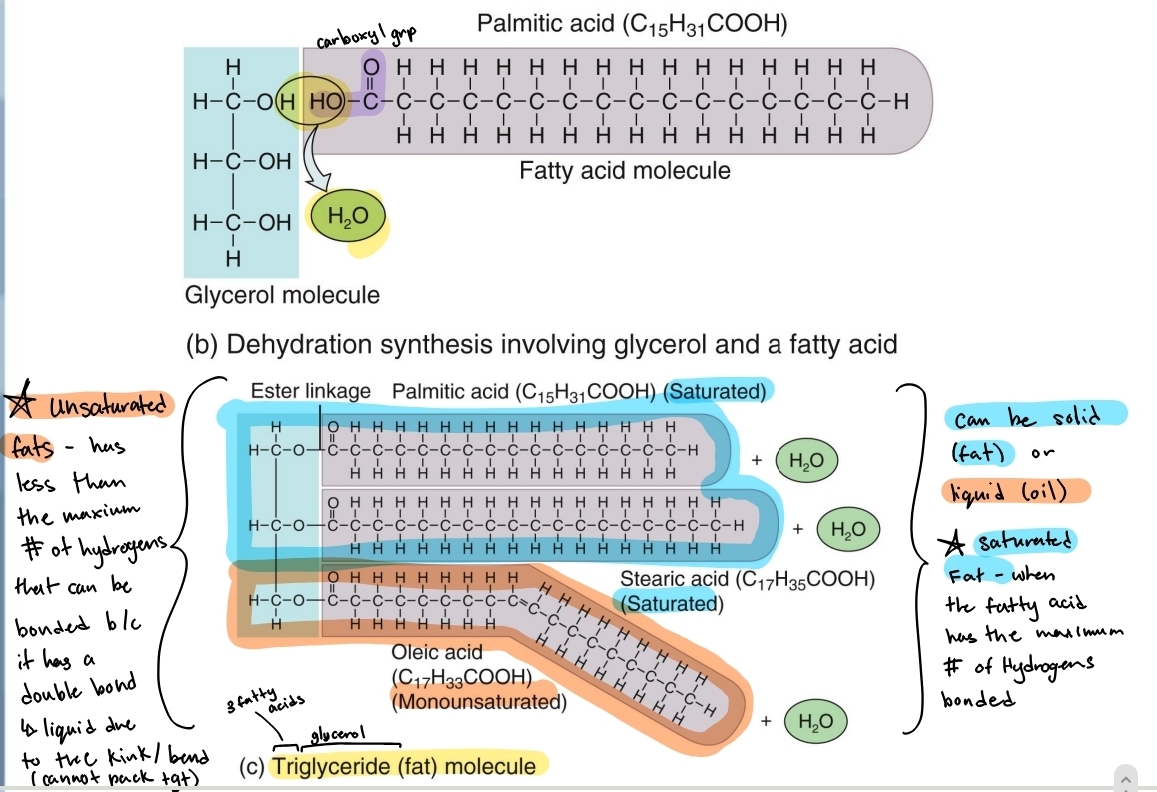
Triglycerides
these are neutral fats
composed of glycerol and 3 fatty acid chains
important for storage of energy, insulation and shock absorbtion
Can be saturated or unsaturated

Saturated fats
these fats have the maximum amount of hydrogens that can be bonded
no c-c double bond
solid fat

Unsaturated fats
these fats have less than the maximum number of hydrogens that can be bonded
bc of a c-c double bond
causes a kink/bend
makes it liquid (oil)

Phospholipids
composed of glycerol, 2 fatty acids and a phosphate grp (polar)
main component of membranes
phosphate group will interact with water (hydrophyllic)

Steroids
consists of 4 interlocking carbon rings with various side groups
includes cholesterol (important for membrane structure) and steroid hormornes
e.g. sex hormones for certain developmental characteristics
Organic compounds: Proteins
composed of C, H, O and N
can also have sulfur and phosphorous
they are polymers build from the 20 diff amino acids
can be di, tri, and polypeptides

Amino Acids
these are joined by peptide bonds (covalent bonds) formed by dehydration synthesis to make proteins
consists of an Amino group, Carboxyl group and a side chain
the side chain (r group) is the only thing that changes and gives diff chemical and physical properties to each amino acid

4 Levels of Proteins
Primary structure
Secondary structure
Tertiary Structure
Quaternary structure

Primary Structure
a linear sequence of amino acids

Secondary structure
alpha-helix or beta-pleated sheet

Tertiary structure
complex globular shape
has a 3d shape
different charged atoms hold it tgt

Quaternary structure
interaction of 2 or more polypeptides
Proteins can be classified as…
can be classified as either:
Structual (fibrous)
Functional (globular)
Structural (fibrous) protein
these proteins are:
stable and insoluble in water
provide mechanical support and give strength
e.g. collagen - holds the body tgt, Keratin - found in hair and fingernails, Elastin - gives elastic quality to connective tissue
Functional (globular) protein
these proteins are:
Less stable and hydrogen bonds break easily
Are water soluble
has an outer layer where it interacts with water
inner layer (the protein) doesn't break
Denaturing
where proteins lose it's structure and unravel, causing them to lose function if their environment changes
e.g. enzymes, important for reactions, are made of proteins and will denature

Enzymes
the biological catalysts which increase the rate of a specific chemical reaction
they react with a specific substrate and inc the rate at which the product is formed
lock and key mechanism → enzymes will only fit with specific substrates
They act to decrease the amount of activation energy needed for the reaction to proceed
does not get altered or used up
has -ase as a suffiv (lipase)
Organic Compounds: Nucleic acids
large molecules that are composed on C, H, O, N and P
made of chains of nucleotides
Nucleotides - phosphate group + 5C sugar (pentose) + nitrogenous base
2 Kinds of Nucleic Acids
DNA
RNA

DNA
Deoxyribonucleic acid
a double straned polymer (ladder-like shape), twisted into a double helix
sugar is deoxyribose (no oxygen)
Nitrogenous bases: Adenine, Thymine, Cytosine, and Guanine
Hydrogen bonds join Nitrogenous bases tgt (rungs)
Alternating sugar and phosphate molecules form the "uprights” of the ladder
RNA
Ribonucleic acid
single nucleotide chain (single stranded)
sugar is ribose (has oxygen)
Nitrogenous bases: Adenine, Uracil, Cytosine, Guanine (replaces Thymine)
several types of RNA, includes:
rRNA - ribosomal
mRNA - messenger
tRNA - transfer

Organic Compounds: ATP
Adenosine triphosphate (ATP)
the molecule the cells use (energy) to perform various types of work
e.g. muscle contraction
Consists of: Adenine, 5C sugar (ribose), & 3 phosphate groups
ATP can be broken down to adenosine diphosphate (ADP), which releases energy to be used for cellular work
Can be synthesized from ADP + P, which requires energy input provided by glucose breakdown.