5. Comitancy Testing - Clinical Binocular Vision Fall 2026
 Call Kai
 Learn
 Practice Test
 Spaced Repetition
 Match
 Flashcards
 Knowt Play
1/177

There's no tags or description
Looks like no tags are added yet.
178 Terms
What is a COMITANT deviation?
The angle of deviation is the same in all positions of gaze and with either eye fixating
What is the PD amount a deviation can differ to be considered a COMITANT deviation?
-Within 5PD for lateral deviations
-Within 5PD for vertical deviations
True or False:
Some practitioners only consider deviations
true
What is a NONCOMITANT deviation?
Angle of deviation changes in different positions of gaze and/or with either eye fixating
What is the PD amount a deviation will differ to be considered a NONCOMITANT deviation?
->5PD (lateral/horizontal) deviations
>>5PD vertical deviations
True or False:
If a deviation is NOT THE SAME at distance and near this is considered a non-comitant deviation
False -- this is d/t the AC/A ratio
Recent onset non-comitancy can represent what?
a health or life threatening situation
True or False:
Recent onset non-comitant deviations may require immediate referral
true
Identifying the characteristics of a longstanding deviation can help with what?
treatment and prognosis
What are common etiologies of non-comitant deviations?
-obstetric trauma
-idiopathic (mostly)
-CNS dysfunction
-Muscle anomalies
-Trauma
-vascular disease (older patients)
-neoplasm
-viral disease (younger patients)
-chronic disease
What are common subsets of non-comitant deviations?
-Paretic
-Mechanical Restriction
What is a PARETIC non-comitant deviation?
Neurological or innervational
What are MECHANICAL RESTRICTIONS that can lead to non-comitant deviations?
-abnormal muscles
-structural restriction
What are the 3 most common causes for ADULT non-comitant deviations?
1) Microvascular disease
2) Trauma
3) Neoplasm
What are the 3 most common causes for PEDIATRIC non-comitant deviations?
1) Congenital/developmental abnormalities
2) Trauma
3) Neoplasm
4) Infection/Inflammation
What are common symptoms of recent onset non-comitant deviations in ADULTS?
-recent onset diplopia
-discomfort
What are common symptoms of recent onset non-comitant deviations in CHILDREN?
-Child may have no complaints
-Head turn, tip, tilt can be noted
Usually, patients with a non-comitant deviation will turn their head (Towards/away from) the field of action of the paretic muscle
towards
Why do patients turn their heads towards the field of action of the paretic muscle?
In order to eliminate diplopia and put the fixating eye in the most comfortable position
What is OCULAR TORTICOLLIS?
Abnormal head posture d/t disorders of the visual pathway or another ocular cause
True or False:
If a child presents with a head turn or tilt, you need to assume a non-comitant deviation is present until proven otherwise
true
Is it possible for a patient to turn their head AWAY from the paretic muscle?
Yes -- very rare but sometimes patients do this to make diplopia worse. They can then ignore (suppress) one of the images
If a head turn is present, what is the likely etiology for this abnormal head posture?
Medial or lateral rectus palsy
If a head tilt/chin tilt is present, what is the likely etiology for this abnormal head posture?
-Vertically acting muscle palsy
-A/V pattern
-Torsional and vertical diplopia combined

What are the 2 forms of torticollis that were mentioned in this module?
-Congenital/Nonocular Torticollis
-Ocular Torticollis

What is Congenital/Nonocular Torticollis due to?
Sternocleidomastoid muscle fibrosis with tightened or shortened muscle
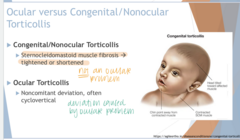
What is Ocular Torticollis due to?
Noncomitant deviation, often cyclovertical
How to differentiate ocular vs congenital/nonocular torticollis from each other?
Patch test
What is the patch test? What do the results of this test predict?
You will patch one eye of a patient w/ torticollis. If the patient remains tilted with the patch on, this is indicative of congenital torticollis. If the patient straightens their head with the patch in place, this is indicative of ocular torticollis.
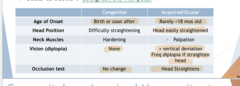
Congenital vs Acquired Torticollis
Age of onset of congenital torticollis
Birth or soon after

Congenital vs Acquired Torticollis
Age of onset of acquired torticollis
Rarely < 18 mo
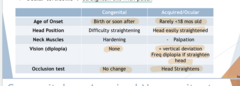
Congenital vs Acquired Torticollis
Head position of congenital torticollis
Difficulty straightening the head

Congenital vs Acquired Torticollis
Head position of acquired torticollis
Head is easily straightened

Congenital vs Acquired Torticollis
Neck muscle appearance with congenital torticollis
Hardening

Congenital vs Acquired Torticollis
Neck muscle appearance with acquired torticollis
(-) w/ palpation

Congenital vs Acquired Torticollis
Vision with congenital torticollis
No diplopia

Congenital vs Acquired Torticollis
Vision with acquired torticollis
Vertical deviation possible, frequent diplopia if head is straight
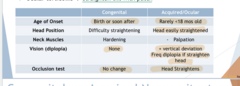
Congenital vs Acquired Torticollis
Occlusion test result of congenital torticollis
No change in head position

Congenital vs Acquired Torticollis
Occlusion test result of acquired torticollis:
Head will straighten
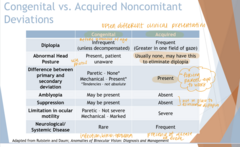
Congenital vs Acquired Non-Comitant Deviations
Diplopia with congenital non-comitant deviation
infrequent (unless decompensated)

Congenital vs Acquired Non-Comitant Deviations
Head posture with congenital non-comitant deviation
Abnormal head posture present, patient unaware
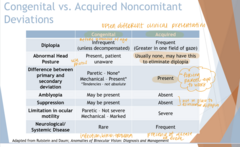
Congenital vs Acquired Non-Comitant Deviations
Is there a difference between primary and secondary deviation with a congenital non-comitant deviation?
-No difference w/ paretic cause
-With Mechanical cause a difference is present

Congenital vs Acquired Non-Comitant Deviations
Is amblyopia present with congenital non-comitant deviation
Maybe

Congenital vs Acquired Non-Comitant Deviations
Is suppression present with congenital non-comitant deviation
Maybe

Congenital vs Acquired Non-Comitant Deviations
What is the ocular motility with congenital non-comitant deviation?
-Paretic cause = not severe
-Mechanical cause = marked limitation in motility

Congenital vs Acquired Non-Comitant Deviations
Is there a neurological/systemic disease cause for congenital non-comitant deviations?
Rarely

Congenital vs Acquired Non-Comitant Deviations
Diplopia with acquired non-comitant deviation
frequently present (greater in one field of gaze)

Congenital vs Acquired Non-Comitant Deviations
Head posture with acquired non-comitant deviation
Usually no abnormal head posture; may have this to eliminate diplopia

Congenital vs Acquired Non-Comitant Deviations
Is there a difference between primary and secondary deviation with a acquired non-comitant deviation?
Present
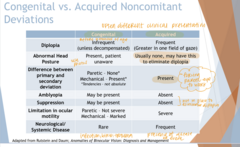
Congenital vs Acquired Non-Comitant Deviations
Is amblyopia present with acquired non-comitant deviation
No

Congenital vs Acquired Non-Comitant Deviations
Is suppression present with acquired non-comitant deviation
No

Congenital vs Acquired Non-Comitant Deviations
What is the ocular motility with acquired non-comitant deviation?
Severe limitations in ocular motility

Congenital vs Acquired Non-Comitant Deviations
Is there a neurological/systemic disease cause for acquired non-comitant deviations?
frequently
If a deviation is found to be non-comitant, what do we have to identify?
-The underacting muscle
-Determine if the muscle is paretic
If a non-comitant deviation is found to have a paretic muscle, what do we have to figure out next?
Recent onset?
What are the 3 common causes for UNDERACTING muscles?
1) Trauma
2) Mechanical
3) Innervational
Describe how trauma can be the cause of an underacting muscle
Direct injury/weakness of a muscle
Describe how the cause of an underacting muscle could be mechanical?
-Faulty insertions
-Tendon abnormalities
-Adjacent structure abnormalities
Describe how the cause of an underacting muscle could be innervational?
Impairment of the CNs
What are the 3 common causes for OVERACTING muscles?
1) Mechanical
2) Idiopathic
3) Hering's Law
Describe how the cause of an overacting muscle could be mechanical?
-Faulty muscle insertions
-Tendon abnormalities
Objective Testing for Comitancy
-Observation
-Version Testing
-Duction Testing/Forced Duction Test
-Cover Test in all Diagnostic Fields of Gaze
-Park's 3 Step
Subjective Testing for Comitancy
-Red Lens Test
-Maddox Rod Test
-Hess Lancaster Test
-Double Maddox Rod Test
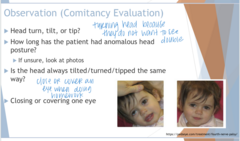
What observations can be made to make the assumption that a non-comitant deviation is present?
-Head turn, tilt, tip
-How long has the patient had anomalous head posture?
-Is the head always tilted/turned/tipped the same way?
-Closing or covering an eye

What are the tests for ocular motility that we can perform?
-Versions
-Ductions
-Forced Duction Testing

Versions are (monocular/binocular)
binocular

Ductions are (monocular/binocular)
monocular
CN III innervates which oculomotor nerves?
SR, IR, MR, IO
CN IV innervates which oculomotor nerves?
SO
CN VI innervates which oculomotor nerves?
LR

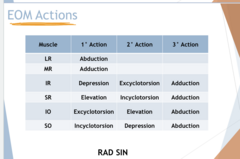
EOM ACTIONS
LR
Primary: Abduction

EOM ACTIONS
MR
Primary: Adduction

EOM ACTIONS
IR
-Primary: Depression
-Secondary: Excyclotorsion
-Tertiary: Adduction

EOM ACTIONS
SR
-Primary: Elevation
-Secondary: Incyclotorsion
-Tertiary: Adduction

EOM ACTIONS
IO
-Primary: Excyclotorsion
-Secondary: Elevation
-Tertiary: Abduction
EOM ACTIONS
SO
-Primary: Incyclotorsion
-Secondary: Depression
-Tertiary: Abduction

The recti muscles will form a ____º angle between the visual axis and the line of insertion
23

Where are the recti inserted into the globe relative to the equator?
in front of the equator

The oblique muscles will form a ____º angle between the visual axis and the line of insertion
51

Where are the oblique muscles inserted into the globe relative to the equator?
behind the equator

Can we isolate individual actions of the EOMs?
Yes -- Broad H test

Isolating Actions of Muscles w/ Broad H Test (Pic)
Isolating Actions of Muscles w/ Broad H Test (Pic)

What is the function of the physiological H pattern?
Isolates muscles and muscle pairs
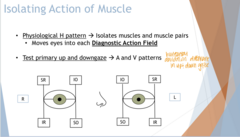
Where does the physiological H pattern move the eyes?
Into each of their diagnostic action fields

When testing primary up and downgaze on the Broad H test, what is this testing?
A and V patterns
What is Hering's Law of Equal Innervation?
Contralateral synergists are equally innervated
What is the YOKED muscle pair that will move the eyes into L gaze?
RMR and LLR
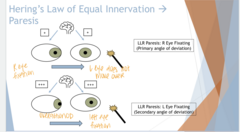
Hering's Law of Equal Innervation -- LLR Paresis (Pic)
Hering's Law of Equal Innervation -- LLR Paresis (Pic)

When there is a LLR paresis found on Broad H Test, how do we test the primary angle of deviation?
R eye is fixating (L eye is paretic)
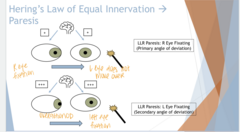
When there is a LLR paresis found on Broad H Test, how do we test the secondary angle of deviation?
L eye is fixating (L eye is paretic)

What will we likely find when there is a LLR palsy and the L eye is fixating?
There will be an overaction of the RMR
What is Sherington's Law?
Contraction of a muscle is accompanied by a simultaneous and proportional relaxation of its antagonist
When the eyes move into L gaze, what are the agonist/antagonist muscles that are innervated?
-Agonist: RMR, LLR
-Antagonist: RLR, LMR

A patient should be (corrected/uncorrected) for version testing
uncorrected

What is the function of version testing?
moves eyes binocularly into each diagnostic action field

What should be observed on version testing?
If non-fixating eye lags (UA) or excessive movement (OA)

Version Testing (Pic)
Version Testing (Pic)
You can add _____ to version testing to increase sensitivity
Hirshberg
How to add Hirshberg testing to version testing?
-Move the penlight and yourself into every DAF
-Can help make ocular misalignment/asymmetry more apparent

Versions (Pic)
Versions (Pic)