Digital Divide Week 11
 Call Kai
 Learn
 Practice Test
 Spaced Repetition
 Match
 Flashcards
 Knowt Play
1/24

There's no tags or description
Looks like no tags are added yet.
25 Terms
When do individual psychological differences become inequality?
when they are shaped by conditions people didn’t choose (earlier experiences, service design), are unevenly spread across groups/situations and it changes what people can do/get
What are the four questions every consumer asks?
Motivation: Do I want to?
Control: Can I?
Trust: Can I rely on it?
Emotion: How does it feel?
What is motivation about?
entry point for digital participation, wanting to engage with digital services
> perceived irrelevance instead of incompetence (not wanting to use AI even tho you know how to use it)
What is the expetancy-value model of motivation?
Motivation is dependent on the expected success + the value of the outcome
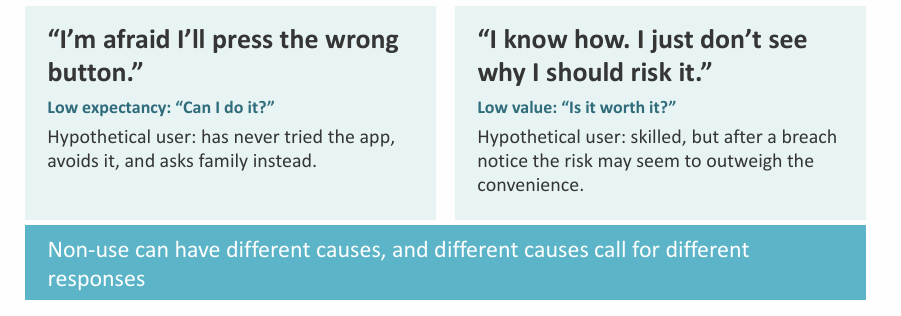
What is meant my expectancy?
“Can I do it”?
ability beliefs: current ability, do I think I’m capable of booking the flight
expectation of success: future performance of the task
What is meant by value?
“Do I want to do it? Is it worth it?”
attainment value: personal identity/goals
intrinsic value: is there value in completing the task? is it fun/enjoyable/interesting?
utility value: does it save time/costs, allows you to use new features
cost: effort, time, opportunity costs, making you feel stressed/anxious
What is the technology acceptance model?
perceived usefulness + ease of use > behavioral intention > actual use
What is the theory of planned behavior?
Attitude: overall evaluation of the act
Subjective norm: perceived social pressure from close social network
perceived behavioral control: perceived ease/difficulty of activity

How can motivation be a self-reinforcing cycle?
+ confidence: early success → positive expectancy → more use + practice → higher perceived competence
- confidence: early failure→ avoidance → less use + practice → lower perceived competence
What is “perceived control”?
= belief that you can influence/manage outcomes through your own actions/choices
What is the difference between high and low perceived control?
high perceived control: view setbacks as manageable, continue learning + solving problems
low perceived control: view setbacks as threats, leading to avoidance + withdrawal
What is learned helplessness?
develops through repeated experiences!! of uncontrollable outcomes -> “my actions don’t matter”
What is self-efficacy? Explain the difference between strong + weak self-efficacy!
belief in your own ability to perform specific actions!
strong self-efficacy: persistence, experimentation, problem-solving
weak self-efficacy: avoidance, anxiety, dependence on others
What are some sources of self-efficacy?
successfully competing tasks (first transfer that goes through)
watching others succeed (vicarious learning → seeing a friend use the app)
reassurance from others (“You can’t break it, I’m here!”)
physiological/emotional states (feeling calm, not rushed when trying)

What is the “locus of control”?
whether individuals think outcomes are because of internal forces (own actions) or external forces (factors beyond my control: systems, luck, other people)
“Do my own or others’ actions matter more?
What are the four components of the “Psychological empowerment” framework?
meaning: belief that one’s engagement has purpose (is this worth my time?)
competence: self-perceived capability to perform (Can I do this?)
self-determination: autonomy in choosing how to engage (Can I choose how to use it → forced or voluntary action)
impact: sense that actions produce visible outcomes (Does what I do make a difference?)
How does self-efficiacy, locus of control + perceived control (+ …) lead to empowerment?
OVERALL: self-efficacy + locus of control (control beliefs) = perceived control, repeated experiences of that leads to empowerment
What is trust about?
= willingness to be vulnerable with other people’s actions (these actions will do something important to you and you are not able to monitor/control it)
> turns uncertainty into willingness to act (you never have the full information so this helps you move forward faster) > e.g. agreeing to cookies/scanning payment QR-codes
How can you build/lose trust?
+design clarity/consistency (predictability + control)
+peer experience/social proof (familiarity + comfort)
-media scandals/data breaches
What is “institution-based trust”?
perception that surrounding environment makes it safe enough to act
structural assurance: laws, standards → belief that safeguards make the environment safe (system is built to protect me)
situational normality: interactions (e.g. SKKU website) feel predictable + orderly (nothing seems suspicious here)

How can you rebuild trust and on which levels?
design level: transparency and reversibility (going back to the original state of the service), clear data-use explanations
institutional level
independent certification (“I am the best company” is less credible when it comes from the company compared to when it comes from the government for example)
national privacy laws (finance- and health-related data) + security audits
What is the affect heuristic?
=mental shortcut where people judge risk/benefits of an action by relying on your current emotional reaction (good/bad feelings)
What is the difference between a positive and a negative affect?
positive: lower perceived risk/higher perceived benefit → underestimated risk when service feels safe
negative: higher perceived risk/lower perceived benefit → overestimated risk/danger when service feels unfamiliar
What is technostress?
= stress related to the use of information + communication technologies (+ exhaustion, less satisfaction, digital withdrawal) > emotional cost + digital fatigue, stress accumulates and builds up (loop)
> emotional burden, digital fatigue, feeling of safety differs from person to person/conditions
What implications does this have on a individual and a societal level?
Individual level: psychological barriers contribute to reduced participation, learned helplessness reinforces avoidance, digital stress + anxiety lowers wellbeing
Societal level: psychological = social exclusion, reduced civic participation, less market access/consumer protection, uneven digital capital distribution