Perio II, Lecture 7 - Anatomy and Flap Design (Dr. Mordini)
 Call Kai
 Learn
 Practice Test
 Spaced Repetition
 Match
 Flashcards
 Knowt Play
1/72

There's no tags or description
Looks like no tags are added yet.
73 Terms
All of the following are procedures for treatment of hard tissue EXCEPT:
A) Osseous recontouring
B) Osseous regeneration
C) Root surface debridement
D) Root removal
E) Gingivectomy
E - this is a soft tissue treatment used for excess gingiva
All of the following are indications for which procedure?
- Attachment impingement
- Lack of crown length/crown retention
- Esthetics: delayed passive eruption, irregular length of teeth
Crown lengthening
All of the following are indications for which procedure?
- For cosmetics or widen ridge in preparation for implant tx
Ridge augmentation
What are 4 anatomical landmarks that you must be carful of during perio sugery in the maxilla?
- Incisive canal (nasopalatine nerve + artery)
- Maxillary sinuses
- Infraorbital nerve
- Greater palatine artery

What are 5 anatomical landmarks that you must be carful of during perio sugery in the mandible?
- Lingual concavity
- Mylohyoid muscle
- Lingual nerve
- IAN
- Mental nerve
When performing a sinus lift, what is an important blood vessel that we do not want to harm?
Posterior superior alveolar artery (PSA)

ID the landmark to be cautious of:
Nasopalatine nerve and artery, incisive canal

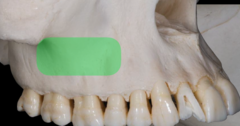
The following is the access for what structure:
Maxillary sinus

ID the landmark to be cautious of:
Posterior superior alveolar artery (PSA)

ID the landmark to be cautious of:
Infraorbital nerve

What structure should you be cautious of on the palatal side between area of the 2nd + 3rd maxillary molars when harvesting soft tissue graphs?
Greater palatine artery
What is the average depth of the palate?
12mm (5mm-17mm)

When considering an implant placement in the area of the molar/premolar region in the mandible, 66% of the populations has a ______ that may dictate the length of the implant you place
Lingual concavity
What structure should you be cautious of when doing an extraction of the mandibular 3rd molar that requires an incision distal to the 3rd molar?
Lingual nerve

T/F: The foramen's location is not constant in the horizontal or vertical planes.
True

What structure should you be cautious of if an incision is needed (or an implant) on the buccal gingival in the area of the premolars?
Anterior loop of mental nerve
All of the following are consequences of placing an implant directly onto a nerve EXCEPT:
A) Severe chronic neuropathia
B) Bleeding and ischemia of the nerve
C) Indirect pressure trauma
C - Direct pressure trauma

Damaging the sublingual arteries can result in _________ (2)
- Massive hemorrhage
- Airway obstruction

What are the 3 tests that will indicate mucogingival stress and treatment is needed?
- Roll
- Tension
- Probing beyond MGJ

Define the following:
Fold of mucosa with loose CT and muscle found at the upper and lower incisors and canine/premolar region
Frenum/frenulum
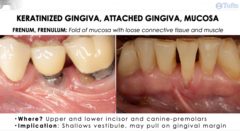
what are 2 clinical implications of the frenum/frenulum causing problems?
- Shallow vestibules
- Pull on gingival margin
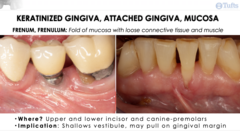
What is the primary objective of perio surgery?
- Obtain access for root instrumentation to remove bacterial biofilm and calculus on the root surfaces
i.e. gingivectomy/peridontal flap surgery

What is the secondary objective of perio surgery?
- Pocket reduction via soft and hard tissue resection or periodontal regeneration to facilitate home care and long-term professional supportive maintenance
- Ex: Soft tissue resection, osseous resection, periodontal regenerations
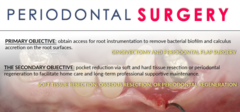
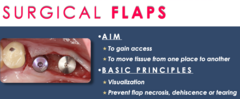
What do we aim to do in a surgical flap? (3)
- Gain access (visualization)
- Move tissue from one place to another
- Prevent flap necrosis, dehiscence, or tearing

ID the type of incision:
Scalloped
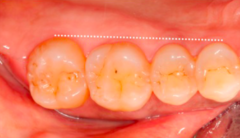
ID the type of incision:
Straight
What type of incision?
- Cutting away from tooth, so incision will face externally
- Blade positioned apical to coronal
External bevel
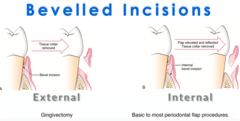
What type of incision?
- Cutting towards bone, so incision will face internally
- Blade positioned coronal to apical
Internal bevel

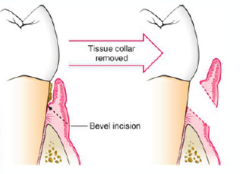
ID the incisions:
external bevel

ID the incisions:
internal bevel
A gingivecomy would indicate what type of incision?
External bevel (tissue collar removed)

Most periodontal flaps will indicate what type of incision?
Internal bevel
(flap gets elevated, reflected, tissue collar removed)

What type of incision would you do for regenerative surgery (retain all gingival tissue to maximize blood supply - primary wound closure)?
Sulcular incision

What type of incision would you do for resective surgery (pocket reduction)?
Submarginal incision


ID the incisions:
Sulcular incision
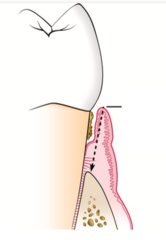
ID the incisions:
Crestal incison

ID the incisions:
Submarginal incision
What are four ways to prevent flap necrosis?
- Base > apex
- Length < base
- Axial blood supply included in base
- Handling case with care

Define the following:
Elevation of the epithelium, connective tissue, and periosteum, exposing the underlying alveolar bone
Full-thickness flap (mucoperiosteal flap)
Define the following:
Elevation of the epithelium and a portion of the connective tissue, leaving the periosteum and some connective tissue attached to the bone
Partial thickness flap (split-thickness flap):

ID the type of flap:
Full thickness flap

ID the type of flap:
Partial thickness flap
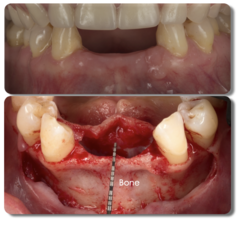
ID the type of flap:
Full thickness flap
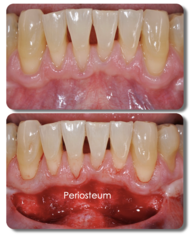
ID the type of flap:
Partial thickness flap
Resective surgery would indicate what type of flap?
Full thickness flap
Regenerative osseous surgery would indicate what type of flap?
Full thickness flap
Flap repositioning surgery would indicate what type of flap?
Partial thickness flap
Mucoginival surgery would indicate what type of flap?
Partial thickness flap
All of the following is the purpose of sutures EXCEPT:
A) Provide mechanical support to the wound until soft tissue can withstand functional forces
B) Approximation of wound edges for primary intention healing
C) Flap is positioned passively before suturing
D) Sutures should pull the flap into position under tension
D - should NOT pull flap into position

Sutures should provide ________ support to the wound until soft tissue can withstand functional forces
Mechanical

When suturing, wound edges should be approximated for ______ intention healing
Primary

A flap should be positioned _______ before suturing
Passively
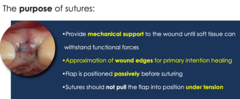
T/F: Sutures should not pull the flap into position under tension
True

When suturing, you want to pass the needle through the _______ tissue first
Mobile

Suture every ____ mm
5 mm
(Smallest number of sutures for adequate support)

t/f: suturing should start with the immobile tissue first to start with an anchor point
False, start with mobile tissue first

Suture knots should be positioned at the _________
Needle insertion point
(Knots attract bacteria that may infect wound edges)

Overly tight sutures may have what two effects?
- Local tissue necrosis
- Scarring
(Approximate, don't strangulate, the tissues)
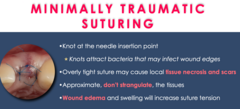
Wound edema and swelling can _____ suture tension
Increase

What type of suture?
Double stitch + deep tissue insertion = STRONG SUPPORT
Mattress suture

The horizontal mattress suture is _______ to the wound edges
Parallel

The vertical mattress suture is _______ to the wound edges
Perpendicular


ID the type of suture:
Vertical mattress suture
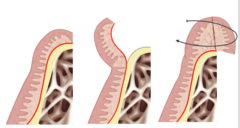
ID the type of suture:
Horizontal mattress suture
What mattress suture will result in an apically positioned flap?
Vertical mattress suture

What mattress suture will result in flap eversion/ less tension?
Horizontal mattress suture

Some complications of improper suturing include all of the following except:
A) Hematoma, infection
B) Scar formation, stitch marks
C) Wound dehiscence
D) Sufficient blood supply
E) Edema, altered healing
F) Systemic factors
G) Implant failure
D - INSUFFICIENT BLOOD SUPPLY

When suturing, too much tension can result in what?
Aggravation by post-surgical edema

When suturing, too little tension can result in?
Wound opening
When suturing, Inappropriate knot type or position can result in?
Knot away from the edges
When suturing, Sutures too close to edges can result in?
Dehiscence due to inflammation, swelling, decrease blood supply
What is the average palatal vault depth measured from the gingival margin to the midline of the palate?
A) 5mm
B) 12mm
C) 17mm
D) 20mm
B) 12mm
Which anatomical structure requires particular caution when performing a soft tissue graft in the mandibular region?
A) Greater Palatine Artery
B) Incisive Canal
C) Mental nerve
D) Infraorbital nerve
C) Mental nerve