Chapter 10 - Functions of Myuscles & The Organization of Skeletal Muscle
 Call Kai
 Learn
 Practice Test
 Spaced Repetition
 Match
 Flashcards
 Knowt Play
1/119

There's no tags or description
Looks like no tags are added yet.
120 Terms
What is the function unit of the skeletal muscle?
A sarcomere
Which filament connects across the I band and into the A band?
The thin filament (actin)
Which filament connects from the A band into the I band?
The thick filament (myosin)
Which filaments connects from the Z band and intot he thick filament.
The elastic filament (titin)

What is this process called?
A cross bridge
What happens during the cross bridge?
The myosin heads are ATP-binding sites, after hydrolysis the ATP turns into ADP + phosphate. This allows the myosin heads to bind to the actin filament.
What causes muscle relaxation?
Actin filaments relax once the sarcoplasmic reticulum reabsorbs calcium ions, causing tropomyosin in the actin filaments to become active, which prevents myosin from binding to actin.
What is sliding-filament theory?
The sliding-filament theory explains how muscles contract by describing the process in which actin and myosin filaments slide past each other, resulting in the shortening of the muscle fiber.
What is the sarcoplasmic reticulum?
Tubules that surround the myofibril and regulate calcium levels in muscle cells, playing a crucial role in muscle contraction and relaxation.
Where can t(transverse) tubules be found?
The A-band I-band junction
What do t-tubules do for the sarcomere?
They facilitate the transmission of action potentials and ensure rapid depolarization throughout the muscle fiber, allowing for synchronized contraction.
What is the contraction process called?
The sliding filament model (of contraction)
What happens during sliding filament theory?
H & I bands narrow, zone of overlap widen, Z lines move closer, and the A band remains constant
Define the neuromuscular junction
The neuromuscular junction is the synapse between a motor neuron and a skeletal muscle fiber, where the motor neuron releases neurotransmitters into the synaptic cleft to simulate muscle contraction.
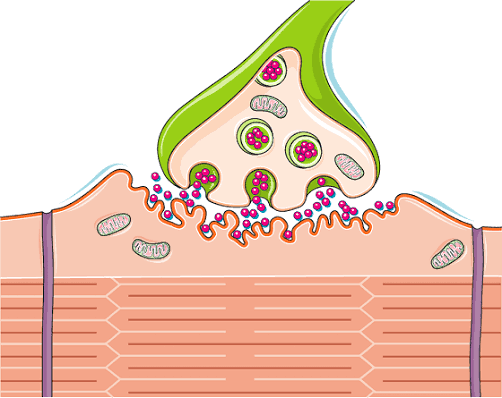
What is this process called?
The neuromuscular junction
What part of the axon terminal releases acetylcholine?
The synaptic vesicles.
Acetylcholine is a…?
A neurotransmitter
Acetylcholene allows for the release of _____ and the entrance of _____.
Potassium and sodium
Define sarcolemma
The plasma membrane of the skeletal muscle that regulates electrical signals for contractions.
What is the difference between t-tubules and the sarcolemma?
T-tubules are tubules of the sarcolemma that penetrate into the muscle fiber, allowing for efficient transmission of electrical impulses deep into the muscle, while the sarcolemma is the outer membrane that encloses the muscle fiber.
What happens once the sodium ions enter through the ion channel?
The influx of sodium ions causes depolarization of the sarcolemma, leading to an action potential that triggers muscle contraction.
What happens to acetylcholine after there is enough sodium in the cell?
Acetylcholine is broken down by the enzyme acetylcholinesterase, terminating the signal for muscle contraction and allowing the muscle to relax.
Define acetylcholinesterase?
Acetylcholinesterase is an enzyme that breaks down the neurotransmitter acetylcholine with water into acetate and choline, effectively terminating the signal for muscle contraction and facilitating muscle relaxation.
What happens after the action potential goes down the sarcolemma and into the T-tubules?
This creates excitation-contraction, which releases calcium into the muscle cell.
Is the muscle polarized or depolarized when resting?
Polarized (inside is more negative & outside is more positive) = ready to receive signal
Sodium ions rush into the cell, making the inside of the muscle cell become positive. This causes…
Depolarization. This leads to an action potential that triggers muscle contraction.
What is the third step?
Polarization: the inside of the cell is slightly negative.
Depolarization: the inside of the cell is slightly positive.
??
Repolarization: the cell returns to its original state.
Muscle contraction: this releases calcium, causing the muscle to contract
The rise of calcium in the cytosol causes…
The filaments to slide
Define terminal cisternae
The enlarged regions of the sarcoplasmic reticulum that store calcium ions and release them during muscle activation.
What is the protein that minds calcium inside the SR?
Calsequestrin
Define myofibrils. Whats important to mention about them?
Myofibrils are long, contractile fibers found within muscle cells, composed of repeating units called sarcomeres. They contain many mitochondria.
Define myofilaments
Bundles of protein filaments that are contractile proteins within myofibrils, examples are actin and myosin.
The light bands in a sarcomere are called…
I bands, which contain only thin filaments.
The dark bands in a sarcomere are called…
A bands, which contain thick filaments and overlapping thin filaments.
Where is the zone of overlap located?
The zone of overlap is located within the A band of a sarcomere, where thick and thin filaments overlap.
Tintin aids with?
Restoring resting sarcomere length and preventing excessive stretching of muscle fibers.
What surrounds the skeletal muscle?
The epimysium
What surrounds the fascicle of the muscle?
The perimysium
What surrounds the muscle fiber?
The endomysium
What is the difference between G-actin and F-actin? (In function and sturcture)
G-actin is a globular protein that serves as a single unit for F-actin, which is a filamentous polymer formed by the polymerization of G-actin monomers. Structurally, G-actin is soluble and has a globular shape, whereas F-actin forms a double-helical structure that provides strength and support for muscle contractions.
What does troponin do?
A globular protein that binds tropomyosin, G-actin, and cacium
Each myosin molecule contains…
Each myosin molecule contains a head (made of two globular subunits) and tail ( that binds to other myosin molecules)
Which part of the muscle cell store calcium?
Sarcoplasmic reticulum
Define Muscle tissue
A primary tissue consisting of three types: cardiac, smooth, and skeletal
what is important to note about muscle tissue?
Muscle cells (fibers) are specialized for contraction
What are the four common properties of muscle tissue?
Excitability (ability to send action potentials), extensibility (stretching), elasticity(ability to retract), and contractility (ability to contract)
How many types of muscle are there? Name them.
There are 3; skeletal, cardiac, and smooth
What is the inner most layer of connective tissue called in a muscle?
The endomysium surrounds individual muscle fibers. It contains capillary networks, myosatallite cells (stem cells), and nerve fibers
What is the middle layer of connective tissue called in a muscle?
The perimysium, it surrounds individual fascicles in a muscle, it includes nerves and blood vessels
What is the outer-most layeer of connective tissue called in a muscle?
The epimysium, the layer of collagen fibers that surround the whole muscle
Define myosatellite cells
Myosatellite cells are muscle stem cells located between the basal lamina and the muscle fiber membrane. They play a crucial role in muscle repair and regeneration. (they divide and make new muscle cells)
What is the difference between a tendon and an aponeurosis?
A tendon is a fibrous connective tissue that connects muscle to bone, while an aponeurosis is a flat sheet of connective tissue that connects muscles to each other or to other structures.
What are special terms that are used to describe the plasma membrane and cytoplasm of a skeletal muscle fiber?
The plasma membrane is called the sarcolemma, and the cytoplasm is known as the sarcoplasm.
What do the vascular networks in skeletal muscle do?
They deliver oxygen and nutrients, remove metabolic wastes to maintain homeostasis
Are muscle voluntary or involuntary?
Voluntary, they are stimulated by the central nervous system. Except the diaphragm, it works subconsciously
Define insertion
Insertion is the point where a muscle attaches to the bone that moves during muscle contraction.
Define agonist
An agonist is a muscle that is primarily responsible for producing a specific movement during contraction. It acts to facilitate the desired motion, often working in opposition to an antagonist muscle.
Define antagonist
An antagonist is a muscle that opposes the action of an agonist during muscle contraction, helping to control movement and provide stability.
Define origin
Origin is the point where a muscle attaches to a stable bone, typically not moved during contraction.
Skeletal cells AREN’T…
single nucleated
Where can the sarcolemma be found on the muscle fibers?
The sarcolemma is the plasma membrane surrounding muscle fibers, serving as a barrier between the extracellular environment and the interior of the muscle cell.
What is the first step leading to muscle contraction?
The first step leading to muscle contraction is the release of calcium ions from the sarcoplasmic reticulum into the muscle fiber, causing a reversal of charge.
Define sarcoplasmic reticulum
The sarcoplasmic reticulum is a specialized endoplasmic reticulum in muscle cells that stores calcium ions and releases them during muscle contraction to facilitate the contractile process.
What is calsequestrin?
A calcium-binding protein located in the sarcoplasmic reticulum of muscle cells, helping to store calcium ions and regulate their release during muscle contraction.
Define myofibril
Myofibrils are long, rod-like structures found in muscle fibers, composed of repeating units called sarcomeres, which are the basic functional units of muscle contraction.
What causes the striated look on muscle fibers?
The striated appearance of muscle fibers is due to the organized arrangement of actin and myosin filaments within the myofibrils, which form alternating light and dark bands called striations.
How many mitochondria are in a muscle fiber?
1000+
Sarcomeres are …
the smallest functional unit of a muscle fiber
What can be found inside of a sarcomere?
A bands, I bands, H band, M line, and Z lines. ALong with actin, myosin, tropinin, tropomyosin, and tinin
Define zone of overlap
The zone of overlap is the region within a sarcomere where thin (actin) and thick (myosin) filaments overlap, allowing for the cross-bridge cycling necessary for muscle contraction.
Define tinin
Titin is a large protein that acts as a molecular spring connecting to the Z line. It helps to stabilize and maintain sarcomere structure while allowing for elasticity during muscle contraction and stretching.
Define tropomysoin
Tropomyosin is a regulatory protein found on the actin filaments of muscle cells. It blocks the binding sites for myosin on actin, preventing contraction until calcium ions bind to troponin, causing tropomyosin to shift.
Define troponin
Troponin is a complex of three proteins located on the actin filaments of muscle cells. It plays a crucial role in muscle contraction by binding calcium ions, which induces a conformational change that allows tropomyosin to move away from myosin binding sites on actin.
What are the three proteinss that make up the thin filament
Actin, Troponin, and Tropomyosin
Define synaptic cleft
The synaptic cleft is the small gap between the axon terminal of a neuron and the membrane of a muscle fiber or another neuron. It is where neurotransmitters are released to transmit signals
What chemical minds to acetylcholine to stop it from sending signals?
Acetylcholinease
What is excitation-contraction coupling?
Excitation-contraction coupling is the physiological process where an electrical stimulus (action potential) in a muscle fiber leads to the release of calcium ions from the sarcoplasmic reticulum, triggering muscle contraction through the interaction of actin and myosin.
What is needed for the muscle to contract?
Calcium ions (Ca^{2+}) and ATP.
What causes the muscle to stop contracting?
Calcium gets pumped back into the sarcoplasmic reticulum, and the levels of calcium ions decrease. Troponin returns to its original position, and the active sites are recovered by the tropomyosin. Leading to relaxation of the muscle fiber.
Define cross bridge formation
Cross bridge formation occurs when the myosin heads attach to the exposed binding sites on actin filaments during muscle contraction, allowing the myosin to pull the actin and facilitate muscle shortening.
Define power stroke
The power stroke is the process during muscle contraction where the myosin head pivots and pulls the actin filament toward the center of the sarcomere, which generates tension and shortens the muscle fiber.
What causes the myosin head to be ‘cocked’ again?
The myosin head is 'cocked' again when ATP binds to the myosin head, causing it to release from the actin and hydrolyze the ATP into ADP and inorganic phosphate, which resets the position of the myosin head.
Define length-tension relationship
The length-tension relationship describes how the force generated by a muscle fiber varies with its length at the time of contraction. It illustrates that optimal overlap of actin and myosin filaments leads to maximum tension production.
Define tetanus
Maximum muscle tension, leading to completely locked muscles.
Define incomplete tetanus
Occurs when there are constant quick signal, but there is still time for a brief break for the muscle to partially relax. (on a chart it would look like waves")
Define complete tetanus
Occurs when there are constant quick signals sent by the nerves, but there is no period for the muscle to take a break. The calcium ions stay high, which continues cross bridges until the muscle fatigues.
Define a motor unit
A motor unit consists of a motor neuron and all the muscle fibers it innervates, functioning together to produce muscle contractions.
Different motor units fire at different times, which allows for the muscles to take turns rotating through contraction cycles, this is called…
Motor unit recruitment
What is the relationship between the number of fibers in a motor unit and the precision of body movements?
Less fibers per motor unit provide more precision, and more fibers give less precision but more force in movements
Define concentric contractions
Muscle tension is greater than the resisting force. This means the muscle shortens.
Define eccentric contractions
The force from the muscle is less than the resisting force meaning the muscle lengthens.
Define isometric contractions
The force from the muscle is equal to the resisting force. This means the muscle does not move.
Which contraction produces more force?
Eccentric contractions because the cross bridges are stretched to their max but they are still attached. (causing the muscle to lengthen)
Which contraction uses the most energy?
Eccentric contractions use the most energy during muscle activity as they lengthen under tension.
The heavier the load, the longer it takes for movement to occur. True or false?
True
The load must exceed the tension before shortening can occur. True or false?
False
What helps muscle relaxation and the return to resting length?
Elastic forces (titin and tendons), opposing muscle contractions, and gravity
What is the relationship between the load and speed of muscle contraction?
Heavier the weight, the slower the action will happen and vice versa.
What is the difference between concentric and eccentric contractions?
In eccentric contractions, the muscle lengthens, allowing the muscle’s force to exceed the resisting force. In concentric contractions, the muscle shortens while exerting force.
What energy is needed for contractions?
ATP and sugar (glucose/glycogen)