Skeletal Muscles and Actions
 Call Kai
 Learn
 Practice Test
 Spaced Repetition
 Match
 Flashcards
 Knowt Play
1/69

Earn XP
Description and Tags
Vocabulary flashcards covering the names, locations, and actions of human skeletal muscles as presented in the lecture notes.
70 Terms
Frontalis
Action: Elevates eyebrows; wrinkles skin of forehead horizontally
Origin : Epicranius aponeurosis
Insertion : skin of eyebrows
Nerve : facial nerve

Occipitalis
Action : pulls scalp posteriorly
Origin : occipital bone
Insertion : Epicranial aponeurosis

Epicranius
An aponeurosis connecting the frontalis and occipitalis to form the occipitofrontalis.

Orbicularis oris
Action: Closes and protrudes lips as in kissing
Origin: maxilla and mandible
Insertion: skin and connective tissue of lips

Zygomaticus major
Action: pulls the angle of mouth superiorly and laterally as in smiling
Origin : zygomatic bone
Insertion: lateral muscle fibers of corner / angle of mouth

Buccinator
Action : Presses cheeks against teeth and lips as in whistling, blowing, and sucking.
Origin : molar regions of maxilla and mandible
Insertion : Orbicularis oris muscle and connective tissue of cheek/ lips

Platysma
Action : Draws outer part of lower lip inferiorly and posteriorly as in pouting and depresses mandible
Origin : connective tissue of deltoid and pectoralis major muscles
Insertion : Mandible, skin and connective tissue inferior to mouth

Orbicularis oculi
Action : Closes eye
Origin : orbital portions of the frontal bone and maxilla
Insertion : skin of the orbital area and eyelids

Corrugator supercilii
Action : Draws eyebrow inferiorly and wrinkles skin of forehead vertically as in frowning.
Origin: medial supraorbital margin of frontal bone
Insertion: skin of medial eyebrows

Masseter
Action: Elevates mandible as in closing mouth.
Origin : Zygomatic arch
Insertion: Angle and lateral surface of ramus of mandible

Temporalis
Action : Elevates and retracts mandible
Origin : lateral surface of skull
Insertion: Coronoid process of the mandible

Digastric
Action : Elevates hyoid bone and depresses mandible
Origin : anterior belly, anterior inner margin of the mandible ; posterior belly , into mastoid notch, medial to the mastoid process
Insertion : connective tissue to the hyoid bone

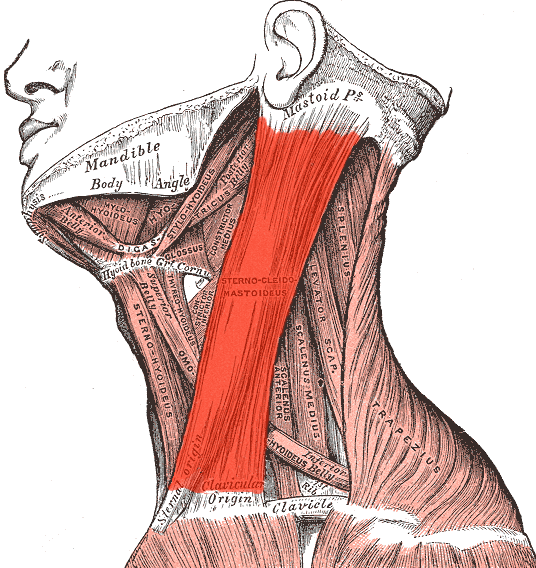
Sternocleidomastoid
Action : Acting together, flex cervical vertebral column and head.
Origin : Manubrium of sternum, medial portion of clavicle
Insertion: Mastoid process of temporal bone
Iliocostalis (lateral) group
Action : Acting together, muscles of each region (cervical, thoracic, and lumbar) extend and maintain erect posture of vertebral column of their respective regions.
Origin: Posterior surfaces of ribs ; portions of sacrum and ilium
Insertion : Transverse processes of inferior cervical vertebrae; posterior surfaces of ribs

Longissimus (intermediate) group
Action : Acting together, longissimus capitis muscles extend head; acting together longissimus cervicis and both longissimus thoracic muscles extend vertebral column of their respective regions.
Origin : transverse process of vertebrae usually several vertebrae inferior to insertions
Insertion: mastoid process; transverse process of vertebrae; medial posterior portions of ribs in thoracic area

Spinalis (medial) group
Action: Acting together muscles of each region (cervical, thoracic and lumbar) extend vertebral column of their respective regions.
Origin : Spinous process of superior lumbar, thoracic, and inferior cervical vertebrae
Insertion : Spinous process of thoracic and cervical vertebrae in skull

Diaphragm
Action: Contraction causes it to flatten and increase size of thoracic cavity resulting in inhalation; relaxation causes it to move superiorly and decrease the size of the thoracic cavity resulting in exhalation.
Origin: Xiphoid process of strenum, lower ribs and costal cartilages , lumbar vertebrae
Insertion: Central tendon of diaphragm

External Intercostals
Action : Contraction causes ribcage to expand and increase the size of the thoracic cavity resulting in inhalation.
Origin: lower edge of rib superior to its insertion
Insertion: upper edge of rib inferior to its origin

Internal Intercostals
Action: Contraction draws adjacent ribs together to decrease the size of the thoracic cavity resulting in exhalation.
Origin: upper edge of rib inferior to its insertion
Insertion: lower edge of ribs, superior to its origin, deep to the insertion of the external intercostals

Rectus abdominis
Action : Flexes vertebral column and compresses abdomen.
Origin: superior aspect of pubic bones
Insertion: Costal cartilages of inferior ribs

External oblique
Action: Acting together, compress abdomen
Origin: inferior eight ribs
Insertion: iliac crest, pubic tubercle , and línea alba

Internal oblique
Action : Acting together, compress abdomen.
Origin: iliac crest and inguinal
Insertion: inferior three to four ribs, línea alba , and pubic bone

Transversus abdominis
Action : Compresses abdomen
Origin : Inferior six costal cartilages, thoracolumbar fascia, iliac crest, and inguinal ligament
Insertion : Linea alba and pubic bone

Pectoralis minor
Action: Fixator of scapula
Origin: Anterior part of ribs 3-5
Insertion: Carcoid process

Serratus anterior
Action: Fixator of scapula prime mover of scapula in protraction; assists in superior rotation of scapula
Origin: first nine ribs
Insertion: Medial border of scapula

Trapezius
Action: Fixator of scapula.
Origin: external occipital, protuberance and cervical vertebrae
Insertion: lateral clavicle

Levator scapulae
Action :Fixator of scapula.
Origin: transverse process of C1/C4
Insertion: Superior angle of scapula

Rhomboid major
Action : Fixator of scapula.
Origin: Spinous processes of T2-T5 major
Insertion: medial border of scapula

Rhomboid minor
Action : Fixator of scapula.
Origin: C7- T1 minor
Insertion: Medial border of scapula

Pectoralis major
Action: adducts and medially rotates arm.
Origin: Medial clavicle, sternum, costal cartilages 1-7
Insertion: Greater tubercle and lateral lip of intertubercular sulcus of humerus

Latissimus dorsi
Action: Extends, adducts and medially rotates arm.
Origin: iliac crest ,spinous processes of lower thoracic and all lumbar vertebrae
Insertion: Floor of inter-tubercular sulcus of the humerus

Deltoid
Action : Abducts arm
Insertion: Acromion and spine of scapula; lateral clavicle
Origin: deltoid tuberosity of humerus

Supraspinatus
Action : Assists deltoid muscle in abducting arm.
Origin: Supraspinous fossa of scapula
Insertion: Greater tubercle of humerus

Infraspinatus
Action: Laterally rotates arm
Origin: Infraspinous fossa of scapula
Insertion: Greater tubercle of humerus

Subscapularis
Action: Medially rotates arm.
Origin: Subscapular fossa of scapula
Insertion: Lesser tubercle of humerus

Biceps brachii
Action : Flexes forearm.
Origin: Supraglenoid tubercle ( long head) and coracoid process (short head)
Insertion: Radial tuberosity

Brachialis
Action: Flexes forearm.
Origin: Distal half of the diaphysis of the anterior humerus
Insertion: Coronoid process of ulna

Brachioradialis
Action: Flexes forearm.
Origin: Ridge proximal to the lateral condlye of the distal humerus
Insertion: Distal radius proximal to the styloid process

Triceps brachii
Action: Extends forearm.
Origin: infraglenoid tubercle ( long head) posterior , proximal diaphysis ( lateral head); most of posterior diaphysis (medial head )
Insertion: Olecranon process

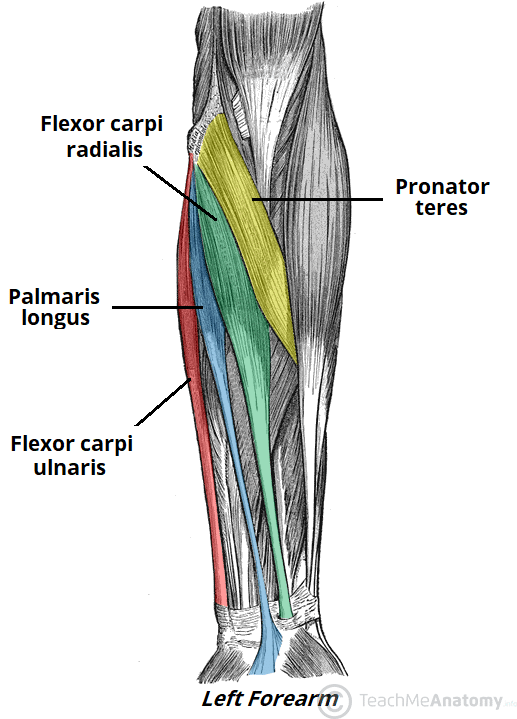
Pronator teres
Action : Pronates forearm.
Origin: media epicondyle of humorous, coronoid process of ulna
Insertion: lateral surface of radius
Supinator
Action: Supinates forearm.
Origin: lateral epicondyle of humorous, area of the radial notch of ulna
Insertion: Anterior / lateral area of proximal third of radius, distal to tuberosity

Palmaris longus
Action : Flexes hand at wrist joint.
Origin: Epicondlye of humerus
Insertion: Flexor retinaculum and surrounding connective tissue in palm of hand
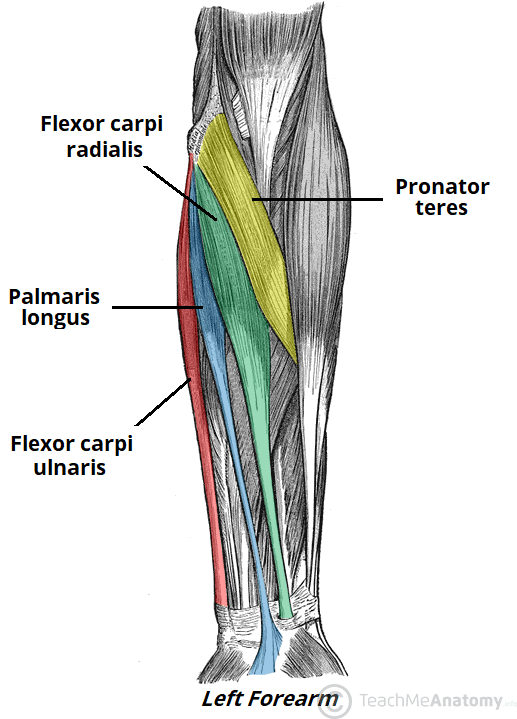
Flexor carpi radialis
Action: Flexes and abducts hand at wrist joint (radial deviation).
Origin: Medial epicondyle of humerus
Insertion: second and third metacarpals

Flexor carpi ulnaris
Action : Flexes and adducts hand at wrist joint (ulnar deviation).
Origin: Medial epicondyle of humerus, medial olecranon process of ulna
Insertion: Pisiform , hamate, fifth metacarpal

Extensor digitorum
Action :Extends hand at wrist joint.
Origin: lateral epicondyle of humorous
Insertion: posterior phalanges of fingers 2-5

Extensor carpi radialis longus
Action :Extends and abducts hand at wrist joint (radial deviation).
Origin: lateral lower diaphysis of humerus
Insertion: Second metacarpal

Extensor carpi ulnaris
Action : Extends and adducts hand at wrist joint (ulnar deviation).
Origin: lateral epicondyle of humerus, lateral proximal ulna
Insertion: Fifth metacarpal

Psoas Major
Action: Part of iliopsoas that flexes thigh.
Origin: lateral side and transverse process of T12 and lumbar vertebrae
Insertion: lesser trochanter of the femur

Iliacus
Action:Part of iliopsoas that flexes thigh.
Origin: iliac fossa
Insertion: lesser trochanter of the femur

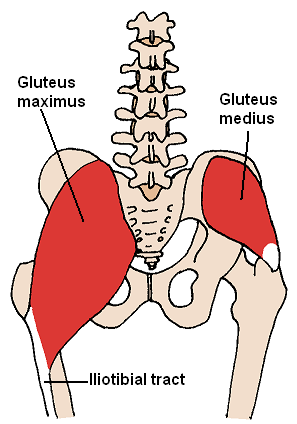
Gluteus maximus
Action: Extends thigh.
Origin: posterior and lateral portions of the ilium, sacrum, and coccyx
Insertion: gluteal tuberosity of femur and iliotibial tract

Gluteus medius
Action : Abducts thigh.
Origin : between posterior and interior gluteal lines on the outer surface of ilium
Insertion: greater trochanter a femur
Tensor fascia lata
Action : Abducts thigh.
Origin: Iliac crest and anterior superior iliac spine
Insertion: iliotibial tract, the thickened portion of the fascia lata, which itself insertion into the proximal, lateral tibia

Adductor longus
Action :Adducts thigh.
Origin: body of pubis
Insertion: línea áspera

Adductor magnus
Action :Adducts thigh.
Origin: ischial tuberosity, ischial ramus , inferior ramus of pubis
Insertion: Línea áspera and adductor tubercle of femur

Gracilis
Action : Adducts thigh.
Origin: body and inferior ramus of pubis; ischial ramus
Insertion: medial surface proximal tibia

Quadriceps femoris
Muscle group where all four heads (rectus femoris, vastus lateralis, vastus medialis, vastus intermedius) extend leg. Extends the leg and flexes the thigh

Sartorius
Action: Flexes leg.
Origin: Anterior superior iliac spine
Insertion: proximal portion of medial condlye of the tibia

Hamstrings
Muscle group comprising the biceps femoris, semitendinosus, and semimembranosus that flexes leg. It extends the thigh and flexes the leg

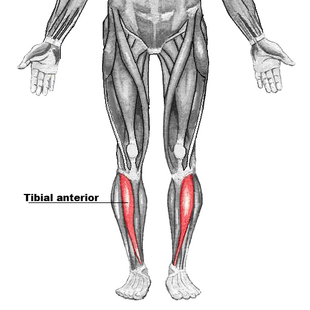
Tibialis anterior
Action : Dorsiflexes foot.
Origin: lateral condlye and proximal diaphysis of the tibia
Insertion: Medial cuneiform bone and first metatarsal
Extensor digitorum longus
Action : Dorsiflexes foot.
Origin: lateral condyle of the tibia and proximal portion of the fibula
Insertion: phalanges and connective tissues of toes 2-5

Tibialis posterior
Action : Plantar flexes foot.
Origin: proximal tibia, fibula, and interosseous membrane
Insertion: Metatarsals 2-4

Fibularis longus
Action: Plantar flexes foot.
Origin: proximal lateral fibula
Insertion: Medial cuneiform bone and first metatarsal

Fibularis brevis
Action :Plantar flexes foot.
Origin: distal fibula
Insertion: fifth metatarsal

Gastrocnemius
Action: Plantar flexes foot.
Origin: medial and lateral condlyes of the femur
Insertion: posterior calcaneus

Soleus
Action: Plantar flexes foot.
Origin: Head of fibula, proximal tibia, and interosseous membrane
Insertion: posterior calcaneus

Flexor Hallucis Longus
Action : Dorsiflexes big toe.
Origin : posterior fibula and interosseous membrane
Insertion: distal phalanx of great toe

Tendons
A tough flexible band fibrous connective tissue that connects skeletal to bone
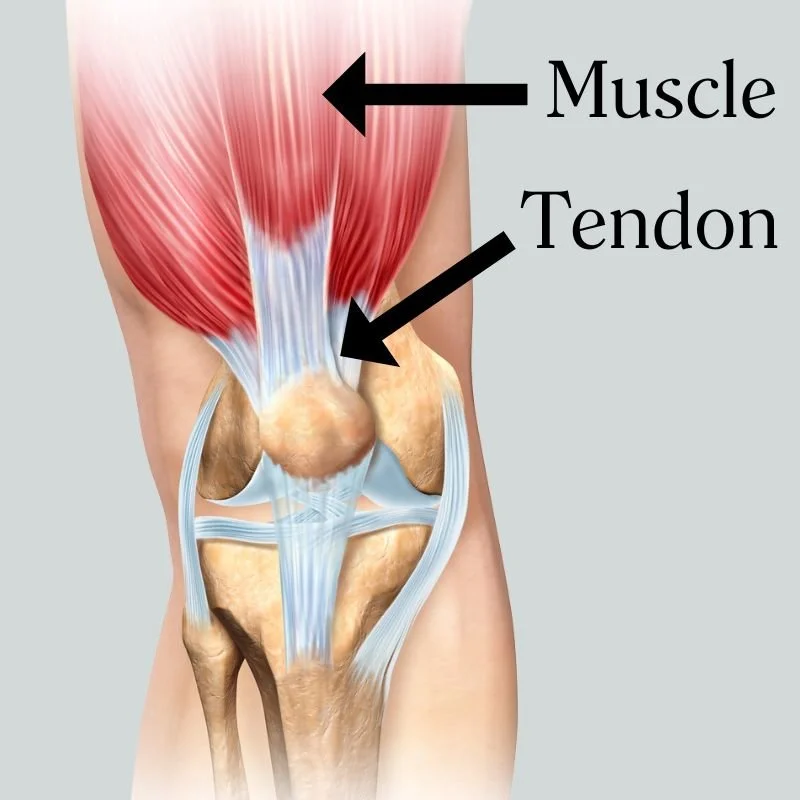
Patellar tendon

Calcaneal Tendon

IT Band
