Fed docs
 Call Kai
 Learn
Learn Practice Test
 Spaced Repetition
 Match
Match Flashcards
 Knowt Play
1/22

There's no tags or description
Looks like no tags are added yet.
Name | Mastery | Learn | Test | Matching | Spaced | Call with Kai | Chat |
|---|
No analytics yet
Send a link to your students to track their progress
23 Terms
Discuss the purpose of our license and its structure
Gives us permission to operate the reactor/facility!!!!!
Specifies all the things we are subject to and limits us.
license 112
Strucure: What they have found (that we are doing things according to the law and regulations) (we comply with requirements etc from Atomic Energy act and10 CFRs)
It is renewed to read as follows (lists substances we can and cannot have& how to use, as well as other conditions and requirements)
The license is deemed to contain and is subject to conditions of 10 CFR Parts 20, 30, 50, 51, 55, 70 and 73 and the Act and rules and regulations of the commission.
max power lev, ts(appendix), phys security plan
License is now effective as of date of issuance
What does the license tell us?
We follow the various acts and federal regulations, and don’t pose a health or other type of danger to the public, and are technicaly and financially capable of operating a reactor.
materials we can have
conditions specified in 10 CFR Parts 20, 30, 50, 51, 55, 70 and 73
Tech specs
max power level
We are subject to physical security plan
What does our license say about possession of radioactive materials?
Posses, use, but not separate in connection with operation of the facility: (CFR70)
up to 3600 g of contained u235 less than 20% enriched in form of TRIGA fuel
up to 16 g of contained u235 of any enrichment as fission chamber or fission foils
(NOT TO USE) up to 40 g U235 enriched to less than 20% as demountable triga fuel element 2898
can recieve, possess, and use but not separate special nuclear material as may be produced by operation of the facility.
From CFR 30
1.64 Curie AmBe source
to receive, possess, and use, but not separate, in connection with operation of the facility, such byproduct material as may be produced by operation of the reactor.
What does our license say about maximum power?
The licensee is authorized to operate the facility at a steady-state power level not in excess of 250 kilowatts (thermal) as specified in the Technical Specifications.
Discuss the purpose of our tech specs and their strucure
They are limits we must follow to keep our lisence, operate safely, etc etc.
Chapter 1 and 6 (definitions and administrative controls) don’t share this structure, but the rest have applicability that gives how it applies, the objective that says what the specification’s intention is, the specification, and then the basis.
2=Safety limits and limiting safety system
3=Limiting Conditions of Operation
4=Surveillance requirements
5=Design Features
Discuss how license and tech specs are related
TS is appendix of license
Be able to discuss specifications of each chapter of TS including select parts of chap 6 (list each chapter focus and do 10 random pulls in TS cards)
y/n
Discuss 10CFR50 and 10 CFR 55
10 CFR 50: DOMESTIC LICENSING OF PRODUCTION AND UTILIZATION FACILITIES
10 CFR 55: Operator licenses
Contents and applicability of: 10 cfr 50.54 x,y
Conditions of Licenses:
x: A licensee may take reasonable action that departs from a license condition or a technical specification (contained in a license issued under this part) in an emergency when this action is immediately needed to protect the public health and safety and no action consistent with license conditions and technical specifications that can provide adequate or equivalent protection is immediately apparent.
y: Licensee action permitted by paragraph (x) of this section shall be approved, as a minimum, by a licensed senior operator, or, at a nuclear power reactor facility for which the certifications required under § 50.82(a)(1) have been submitted, by either a licensed senior operator or a certified fuel handler, prior to taking the action.
Contents and applicability of: 10 CFR 50.59
Changes, Tests, and experiments
This section applies to each holder of an operating license issued under this part or a combined license issued under part 52 of this chapter, including the holder of a license authorizing the operation of a nuclear power reactor that has submitted the certification of permanent cessation of operations required under §50.82(a)(1) or §50.110, a reactor licensee whose license has been amended to allow possession of nuclear fuel but not operation of the facility, or a non-power production or utilization facility that has permanently ceased operations.
A licensee may make changes in the facility as described in the final safety analysis report (as updated), make changes in the procedures as described in the final safety analysis report (as updated), and conduct tests or experiments not described in the final safety analysis report (as updated) without obtaining a license amendment pursuant to Sec. 50.90 only if:
An amendment to the technical specifications incorporated in the license is not required, and
The change, test, or experiment does not meet any of the criteria in paragraph (c)(2) of this section
A licensee shall obtain a license amendment pursuant to Sec. 50.90 prior to implementing a proposed change, test, or experiment if the change, test, or experiment would:
Result in more than a minimal increase in the frequency of occurrence of an accident previously evaluated in the final safety analysis report (as updated);
Result in more than a minimal increase in the likelihood of occurrence of a malfunction of a structure, system, or component (SSC) important to safety previously evaluated in the final safety analysis report (as updated);
Result in more than a minimal increase in the consequences of an accident previously evaluated in the final safety analysis report (as updated);
Result in more than a minimal increase in the consequences of a malfunction of an SSC important to safety previously evaluated in the final safety analysis report (as updated);
Create a possibility for an accident of a different type than any previously evaluated in the final safety analysis report (as updated);
Create a possibility for a malfunction of an SSC important to safety with a different result than any previously evaluated in the final safety analysis report (as updated);
Result in a design basis limit for a fission product barrier as described in the FSAR (as updated) being exceeded or altered; or
Result in a departure from a method of evaluation described in the FSAR (as updated) used in establishing the design bases or in the safety analyses.
The provisions in this section do not apply to changes to the facility or procedures when the applicable regulations establish more specific criteria for accomplishing such changes.
The licensee shall maintain records of changes in the facility, of changes in procedures, and of tests and experiments made pursuant to paragraph (c) of this section. These records must include a written evaluation which provides the bases for the determination that the change, test, or experiment does not require a license amendment pursuant to paragraph (c)(2) of this section.
The licensee shall submit, as specified in § 50.4 or § 52.3 of this chapter, as applicable, a report containing a brief description of any changes, tests, and experiments, including a summary of the evaluation of each. A report must be submitted at intervals not to exceed 24 months. For combined licenses, the report must be submitted at intervals not to exceed 6 months during the period from the date of application for a combined license to the date the Commission makes its findings under 10 CFR 52.103(g)
The records of changes in the facility must be maintained until the termination of an operating license issued under this part, a combined license issued under part 52 of this chapter, or the termination of a license issued under 10 CFR part 54, whichever is later. Records of changes in procedures and records of tests and experiments must be maintained for a period of 5 years.
Contents and applicability of: 10 CFR 55.13
General exemptions:
The regulations in this part do not require a license for an individual who --
(a) Under the direction and in the presence of a licensed operator or senior operator, manipulates the controls of --
(1) A research or training reactor as part of the individual's training as a student, or
(2) A facility as a part of the individual's training in a facility licensee's training program as approved by the Commission to qualify for an operator license under this part.
(b) Under the direction and in the presence of a licensed senior operator, manipulates the controls of a facility to load or unload the fuel into, out of, or within the reactor vessel.
Contents and applicability of: 10 CFR 55.53
Conditions of licenses:
(a) Neither the license nor any right under the license may be assigned or otherwise transferred.
(b) The license is limited to the facility for which it is issued.
(c) The license is limited to those controls of the facility specified in the license.
(d) The license is subject to, and the licensee shall observe, all applicable rules, regulations, and orders of the Commission
(e) If a licensee has not been actively performing the functions of an operator or senior operator, the licensee may not resume activities authorized by a license issued under this part except as permitted by paragraph (f) of this section. To maintain active status, the licensee shall actively perform the functions of an operator or senior operator on a minimum of seven 8-hour or five 12-hour shifts per calendar quarter. For test and research reactors, the licensee shall actively perform the functions of an operator or senior operator for a minimum of four hours per calendar quarter.
(f) If paragraph (e) of this section is not met, before resumption of functions authorized by a license issued under this part, an authorized representative of the facility licensee shall certify the following
That the qualifications and status of the licensee are current and valid; and
licensee has completed a minimum of 40 hours of shift functions under the direction of an operator or senior operator as appropriate and in the position to which the individual will be assigned. The 40 hours must have included a complete tour of the plant and all required shift turnover procedures. For senior operators limited to fuel handling under paragraph (c) of this section, one shift must have been completed. For test and research reactors, a minimum of six hours must have been completed.
g) The licensee shall notify the Commission within 30 days about a conviction for a felony.
(h) The licensee shall complete a requalification program as described by § 55.59.
(i) The licensee shall have a biennial medical examination.
(j) No alchohol within the protected area of power reactors, or the controlled access area of non-power reactors. No illegal drugs. No operating while under the influence or otherwise impaired by alchohol or drugs, including prescription or over the counter.
(k) Each licensee at power reactors shall participate in the drug and alcohol testing programs established pursuant to 10 CFR part 26. Each licensee at non-power reactors shall participate in any drug and alcohol testing program that may be established for that non-power facility.
(l) The licensee shall comply with any other conditions that the Commission may impose to protect health or to minimize danger to life or property.
What requirements are you required to perform quarterly? annually? biennially?
Biennial means a 24-month period.
● Requal cycle means a 24-month period beginning on July 1 and ending on June 30 two years later, and refers to the continuous, two-year cycle the Requalification Program operates on [RP §2].
● Annual means a 12-month period beginning on July 1 and ending on June 30 the following year. Requirements that are described as annual, yearly, or per year are the same [RP §2].
● Semesters and quarters:
. - The Fall Semester comprises the First Quarter (July 1 to September 30) and the Second Quarter (October 1 to December 31) [RP §2].
. - The Spring Semester comprises the Third Quarter (January 1 to March 31) and the Fourth Quarter (April 1 to June 30) [RP §2].
![<p>Biennial means a 24-month period.</p><p>● Requal cycle means a 24-month period beginning on July 1 and ending on June 30 two years later, and refers to the continuous, two-year cycle the Requalification Program operates on [RP §2].</p><p>● Annual means a 12-month period beginning on July 1 and ending on June 30 the following year. Requirements that are described as annual, yearly, or per year are the same [RP §2].</p><p>● Semesters and quarters:</p><p>. - The Fall Semester comprises the First Quarter (July 1 to September 30) and the Second Quarter (October 1 to December 31) [RP §2].</p><p>. - The Spring Semester comprises the Third Quarter (January 1 to March 31) and the Fourth Quarter (April 1 to June 30) [RP §2].</p>](https://assets.knowt.com/user-attachments/532db414-66b4-43a2-8b76-81f326c8e7f1.png)
What counts as performing licensed duties?
The following activities qualify as performing licensed duties:
● Acting as operator of record.
● Acting as senior operator of record.
● Anything for which the SOP requires a licensed operator, such as the insertion or removal of experiments from the reactor core.
● Acting as the SRO in the facility during a startup checklist.
● Maintenance on the reactor control systems, such as replacing a control rod motor or adjusting limit switches per SOP 34.
● Fulfilling the role of Handler, RO, or SRO as required by SOP 35 during fuel handling.
● Participating in emergency drills in the facility.
● Taking or giving operating exams.
● Other activities approved by the Director.
63.6.3 Activities that do not qualify as actively performing licensed duties include:
● Acting as the second person in the facility, i.e., warm body, unless also performing other activities that would qualify.
● Attending requal meetings or completing the requal homework.
● Performing checklists or maintenance not requiring a licensed operator.
● Being the fuel handling Helper.
● Participating in training or outreach.
An operator may receive credit for licensed hours while supervising licensed duties performed by someone who may not perform licensed duties (e.g. trainees or operators who are out of requal). However, at least 1 hour of licensed duties per quarter must be performed by the operator themselves.
If an operator does not complete four hours of licensed duties in one quarter, the operator is out of requal at the beginning of the next quarter. The operator shall perform six hours of operating the reactor [RP §5] under the direction of a licensed operator per §63.17 to get back into requal. The six hours shall all be completed within one requal quarter.
What qualifies as a reactivity manipulation?
The following activities qualify as a reactivity manipulation:
● Reactor startup from shutdown to criticality at any power.
● Increasing or decreasing reactor power by at least 0.25 mW [10 CFR 55.59(c)(3)(i)(E)].
● Reactor shutdown from a critical condition.
● Moving a fuel element (if licensed).
● Removal or insertion of a control rod from the core for inspection.
● Others specifically approved by the Director.
63.7.3 An operator receives credit for reactivity manipulations while supervising reactivity manipulations performed by someone who may not perform licensed duties (e.g., trainees or operators who are out of requal).
63.7.4 In general, the SRO of Record cannot receive credit for reactivity manipulations performed by, or under the supervision of, a separate RO of Record. However, in the case of fuel movement by an individual who is not licensed or not in requal, the Senior Reactor Operator in the Reactor Bay supervising the movement receives credit for the reactivity manipulation.
63.7.5 If an operator does not complete ten reactivity manipulations in a year, the operator is out of requal at the beginning of the next year. The operator shall perform six hours of operating the reactor [RP §6] under the direction of a licensed operator per §63.17 to get back into requal. The six hours shall all be completed within one requal quarter.
Why is the E-plan important for our facility?
establish guidelines and designate areas of responsibility for the RRR staff should an emergency occur at the RRR that might affect the health and safety for Reed employees or the public. The RRR Emergency Plan identifies the Offsite Support Organizations that may be activated if required. IT keeps us safe and prepared for emaergencies
Who is EC and what are they responsible for during the emergency?
The person in charge of handling emergencies when they come up. Usually staff member w/most seniority. The Emergency Coordinator is determined by who has the most experience in emergency preparedness. Unless there is a reason to not follow, the hierarchy is as follows:
Director
Reactor Operations Manager
Radiation Safety Officer
Supervisors
Senior Reactor Operators
Reactor Operators
Other reactor staff
The Emergency Coordinator is responsible for (and has ultimate authority over) on-site activities and personnel during an emergency, making sure emergency procedures are being used as necessary, and:
protecting Reed Personnel and visitors
placing the reactor in a safe shut down condition
terminating or minimizing release of radioactive materials
assessing severity of emergency event
authorizing reentry following evacuation of facility
authorizing exposures in excess of 10 CFR 20
notifying gov. agencies of classified event, and first person on ENCL if necessary
terminating emergency
planning or conducting protective and recovery actions
Services available in an emergency, when, and why contact them: On campus
ENCL, ROC, Public Affairs, RSO, CSOs
Services available in an emergency, when, and why contact them: Off campus
Firefighting
Ambulance
Emergency Medical Services
Hospitals
Hazmat
April Sims from EHS
Radiological monitoring and assessment
police protection
NRC
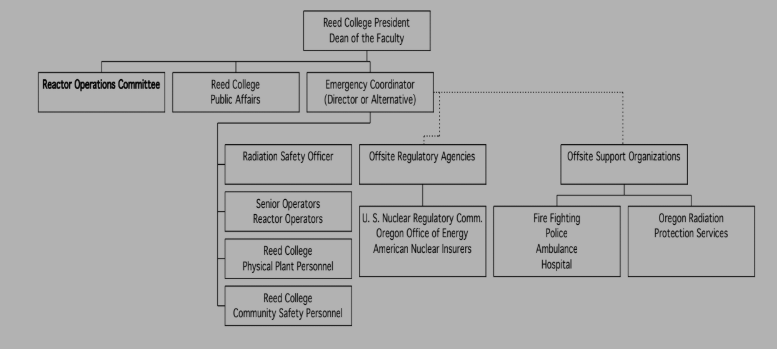
What is the purpose of each service on this diagram?
RSO and Department of energy emergency response personnel can provide support in health physics matters
Individuals on the RRR staff may be assigned duties and responsibilities during the course of an emergency event. All RRR personnel shall receive basic instruction in radiation safety and emergency procedures on an annual basis.
Reactor Operations Committee : The Reactor Operations Committee is the Review and Audit organization for the RRR. It provides a source of expertise available to the RRR during emergencies. It will review and audit emergency preparedness under this plan.
3.1.7 Reed College Public Affairs Office: The Reed College Public Affairs Office shall handle all official news releases concerning emergency events at the RRR.
3.1.8 Reed College Community Safety: Reed College Community Safety personnel may be called to provide the RRR security assistance, emergency radio communications, and traffic control as necessary. Reed Community Safety personnel shall receive annual training in RRR emergency procedures.
3.1.9 Reed College Physical Plant Personnel: Reed College Physical Plant Personnel may be called to provide assistance with electrical, plumbing, or structural problems encountered during an emergency.
3.1.10 Portland Fire Bureau: The City of Portland Fire Bureau shall serve as the primary fire-fighting agency. The fire fighters are trained annually in their role in RRR emergency procedures.
3.1.11 Portland Ambulance Service: The City of Portland operates a coordinated Emergency Dispatching System through the #911-all emergency number, and shall provide emergency medical assistance and ambulance service for the RRR as required.
3.1.12 Hospital Support: Local area hospitals shall provide medical facilities and care for contaminated injured individuals and for individuals suffering from acute radiation exposure.
3.1.13 State of Oregon Department of Energy: The State of Oregon Department of Energy has statutory responsibility for the coordination of all state and local emergency response to an accident at the RRR. Radiological monitoring and assessment, and health physics expertise are deployed as part of the response upon being notified of an event at the RRR. State personnel write the State's RRR Response Plan with input from the RRR.
3.1.14 Offsite Law Enforcement Agencies: The Portland Police Bureau (PPB) is the primary offsite agency for facility security assistance, emergency radio communications, traffic control, and riot control as necessary. PPB officers and personnel are trained annually in Emergency Response to RRR alarms. The PPB is notified in all cases involving RRR security, and any other requests for assistance may be made by the person acting as EC or by Reed Community Safety. Additional offsite assistance is available from the Multnomah County Sheriff's Office and the Oregon State Police as requested by the Portland Police Bureau.
3.2.1 U.S. Nuclear Regulatory Commission Notification of an incident to the U.S. Nuclear Regulatory Commission shall be in accordance with the requirements of 10 CFR 20 and other applicable regulations. The NRC shall be notified within 60 minutes of the declaration of a Notification of Unusual Event or Alert. The NRC should be notified within 60 minutes of any event that may attract the attention of the public or of the media. Notification of the NRC is the EC’s responsibility.
3.2.2 State of Oregon Department of Energy Oregon Department of Energy shall be notified any time an Offsite Support Organization is activated for a radiological incident. Notification of an incident to the Oregon Office of Energy, Salem, Oregon, shall be in accordance with the regulations specified in Oregon Regulations for the Control of Radiation and other applicable State Regulations. Notification of the Oregon Department of Energy is the EC’s responsibility.
3.2.3 Local Government Agencies Notification of local government agencies shall be EC’s responsibility. This notification may be under the responsibilities of the State of Oregon Emergency Response Personnel in which case RRR personnel shall respond to State instructions. The City of Portland and Multnomah County shall be notified of any incidents which may have caused or threaten to cause an uncontrolled release of radioactive materials that results in a projected offsite dose of 1 rem Deep Dose Equivalent (DDE) or 5 rem thyroid Committed Dose Equivalent (CDE). There are no credible emergencies that would result in a release with projected offsite doses of 1 rem DDE of 5 rem CDE to the thyroid.
3.2.4 American Nuclear Insurers (ANI) ANI shall be notified as soon as possible after declaration of an Alert, as required by their contract. Notification of ANI shall be the EC’s responsibility.
3.2.5 Dean of Faculty The EC shall inform the Dean of Faculty when notifications to the U.S. NRC, State of Oregon Department of Energy, ANI, or any other local agencies as the result of Emergency Plan activation.
When and how would you contact each of them?
Discuss different emergency classifications. What falls into each category as per the e-plan?
Notifiation of Unusual Event:
Initiated by human or natural causes that makes significant potential for hazard that was previously non-existent. Time to take precautions and prevent escalation. No radiation release requireing offsite responses.
a) Report or observation of a severe natural phenomenon affecting the reactor site.
b) Receipt of a bomb threat affecting the reactor facility that did not manifest in the presence of a bomb in the reactor.
c) Credible security threat affecting the reactor facility that did not manifest in the presence of a security threat within the reactor facility.
d) A fire or explosion within the reactor facility not extinguished within 15
minutes.
e) Actual or projected radiological effluent at the site boundary which is calculated (or measured) to result in either of the following conditions:
1. A Deep Dose Equivalent (DDE) of 15 mrem received in a period of 24 hours or less.
2. A Committed Effective Dose Equivalent (CEDE) of 15 mrem based on exceeding 100 Effluent Concentrations (EC) for radionuclides other than noble gases or exceeding 50 EC for noble gases over a period of 24 hours or less.
Alert:
No credible accidents attributable to the reactor or its operation are postulated which can cause emergency conditions beyond the Reactor Bay or Control Room due to any operation or natural phenomenon. Therefore, Alert conditions can only be reached due to security breaches.
a) An intruder gained entry to the reactor facility.
b) A bomb was located in the reactor facility.
Site Area emergency and General Emergency:
No credible accidents attributable to the reactor or its operation are postulated which can cause emergency conditions beyond the Reactor Bay or Control Room; therefore, this emergency class is not addressed in this plan.
Discuss how we maintain emergency preparedness
Training: Edrill and refamiliarize with emergency procedures annually as part of requal. Also related emergency services (fire, CSOs, etc)
Conduct of Drills and Exercises: E-drills and testing phone numbers (Tab S of EIPs)
Critique of drills to evaluate eplan and procedures, and report back to ROC
Review and update Eplan based on drill results or changes in facility and shall be audited annually by ROC. Distribute applicapble portions to other orgnizations. Approval by NRC before implementation
Surveillance of emergency equipment semiannually, fire extinguishers annually, and pool lovel bimonthly.
Keep inventory o emergency supplies and equipment
Imspect and cal detectors and dosimeters annually and keep some for emergencies