Alkenes UNIT 10 reagants + products

0.0(0)
Studied by 0 people
call kaiCall Kai
Locked
learnLearn
examPractice Test
spaced repetitionSpaced Repetition
heart puzzleMatch
flashcardsFlashcards
GameKnowt Play
Card Sorting

1/10

encourage image

There's no tags or description

Looks like no tags are added yet.

Last updated 11:39 PM on 7/26/26
Name
Mastery
Learn
Test
Matching
Spaced
Call with Kai
Chat

No analytics yet

Send a link to your students to track their progress

11 Terms

1
New cards

Alkene → O3 (Me2S workup)

Split the alkene and form two carbonyls; make sure to keep the hydrogen (aldehyde) and R groups (keytone) in
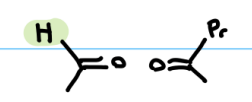
<p>Split the alkene and form two <mark data-color="yellow" style="background-color: yellow; color: inherit;">carbonyls</mark>; make sure to keep the hydrogen (aldehyde) and R groups (keytone) in</p>
2
New cards

Alkene → O3 (H2O2, 1. NaOH 2. H2O workup)

Split the alkene and from carbonyls as usual; but instead of a aldehyde it’s carboxyllic acid and keytone
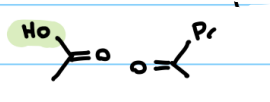
<p>Split the alkene and from <mark data-color="yellow" style="background-color: yellow; color: inherit;">carbonyls</mark> as usual; but instead of a aldehyde it’s carboxyllic acid and keytone</p>
3
New cards

Alkene → OsO4 (1. what addition and what reaction 2. products)

Syn Dihydroxylation; Make sure that the alcohols are added to the same side, whether it be wedge, dash, or in-plane (replacing the alkene with two alcohols on the same side)
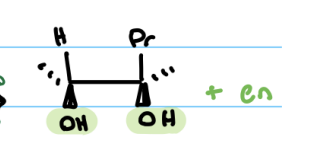
<p>Syn Dihydroxylation; Make sure that the alcohols are added to the same side, whether it be wedge, dash, or in-plane <mark data-color="yellow" style="background-color: yellow; color: inherit;">(replacing the alkene with two alcohols on the same side)</mark></p>
4
New cards

Alkene → H2 + metal workup like Pd/c (1. what addition and what reaction 2. products)

Syn Hydrogenation (replacing the alkene with two hydrogens on the same side)
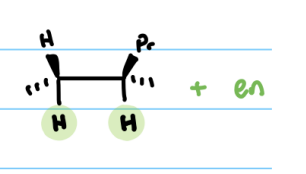
<p>Syn Hydrogenation (<mark data-color="yellow" style="background-color: yellow; color: inherit;">replacing the alkene with two hydrogens on the same side)</mark></p>
5
New cards

Alkene → mcPBA (1. what addition and what reaction 2. products)

  1. Mostly depends on the weak as O—O bond

  2. Creates an epoxide either on the page, wedge, or dash

  3. By epoxide, I specifically mean triangle with OXYGEN
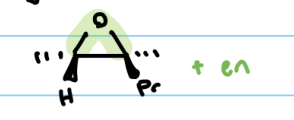
<ol><li><p>Mostly depends on the weak as O—O bond </p></li><li><p>Creates an <mark data-color="yellow" style="background-color: yellow; color: inherit;">epoxide either on the page, wedge, or dash</mark></p></li><li><p>By epoxide, I specifically mean triangle with OXYGEN</p></li></ol><p></p>
6
New cards

Alkene → Br2 with an H2O workup (1. what addition and what reaction 2. products)

Halohydrin:

  1. first the alkene goes away and becomes a Bropoxide

  2. the Water is added on most substituted carbon given its a weak nucleophile with a Bromine + charge; which means with work up the alcohol is added to the most substituted side of the alkene and Br is on the least substituted

  3. MAKE SURE ITS ANTI so if the OH is on the plane, the Br is facing the other direction, if OH is on a dash then Br is on a wedge vice versa
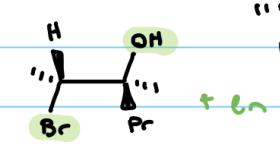
<p>Halohydrin:</p><ol><li><p>first the alkene goes away and becomes a Bropoxide </p></li><li><p>the Water is added on most substituted carbon given its a weak nucleophile with a Bromine + charge; which means with work up the <mark data-color="yellow" style="background-color: yellow; color: inherit;">alcohol is added to the most substituted side of the alkene and Br is on the least substituted</mark></p></li><li><p>MAKE SURE <mark data-color="yellow" style="background-color: yellow; color: inherit;">ITS ANTI</mark> so if the OH is on the plane, the Br is facing the other direction, if OH is on a dash then Br is on a wedge vice versa </p></li></ol><p></p>
7
New cards

Alkene → Br2 (1. what addition and what reaction 2. products)

  1. Halogenation

  1. the Br’s are anti to each other, but mostly the same as when its Br2 + H2O
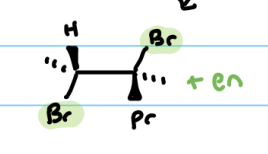
<ol><li><p>Halogenation</p></li></ol><ol start="2"><li><p>the Br’s are anti to each other, but mostly the same as when its Br<sub>2 </sub>+ H<sub>2</sub>O</p></li></ol><p></p>
8
New cards

Alkene → 1. BH3 2. H2O2, NaOH H2O (1. what addition and what reaction 2. products)

  1. This is also where the weakass O—O comes in

  2. The end result will have an Hydrogen from the BH3 on the most substituted carbon and an alcohol on the least substituted (H and OH syn)

  3. Make sure the Alcohol has the same chemistry as the BH2
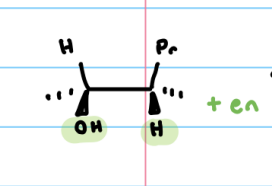
<ol><li><p>This is also where the weakass O—O comes in</p></li><li><p>The end result will have an Hydrogen from the BH3 on the most substituted carbon and an alcohol on the least substituted <mark data-color="yellow" style="background-color: yellow; color: inherit;">(H and OH syn)</mark></p></li><li><p>Make sure the Alcohol has the same chemistry as the BH2 </p></li></ol><p></p>
9
New cards

Alkene → dilute H2SO4 + H2O (1. what addition and what reaction 2. products)

  1. Alcohol added to the most substituted carbon, H added to the least (mainly because the H2O is a weak nucleophile and needs a stable carbocation as its electrophile)

  2. The hydrogen and OH stereochemistry is independent of each other because the H is added through acid-base and OH is through SN1
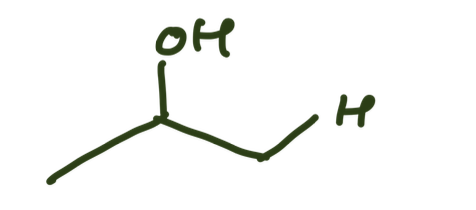
<ol><li><p>Alcohol added to the most substituted carbon, H added to the least (mainly because the H2O is a weak nucleophile and needs a stable carbocation as its electrophile) </p></li><li><p>The hydrogen and OH stereochemistry is independent of each other because the H is added through acid-base and OH is through SN1</p></li></ol><p></p>
10
New cards

Alkene → HX (1. what addition and what reaction 2. products)

X on the most substituted; H on the least
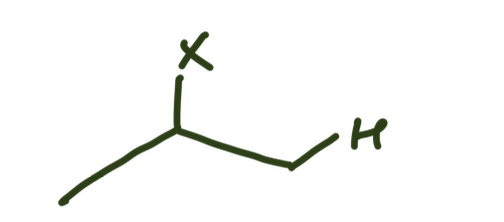
<p>X on the most substituted; H on the least</p>
11
New cards

other reagant that acts like H2SO4

TsOH



