4.2 Haplotypes, population structure, and linkage
 Call Kai
 Learn
 Practice Test
 Spaced Repetition
 Match
 Flashcards
 Knowt Play
1/24

Earn XP
Description and Tags
exam 2
25 Terms
Haplotypes
linked combinations of SNPs that tend to be inherited together on a piece of DNA
As generational time passes, it will get shorter and shorter until equilibrium
Recombination
does not always happen at the same place
overtime these —- events happening to chromosomes will cause the ‘blocks’ to shrink over generations
part of DNA repair pathways in addition to meiosis
equilibrium point
a theoretical state where allele and genotype frequencies in a population remain constant from one generation to the next
average human haplotype block size
5-100kilobases (~60kb average point estimate)
Why do we need many SNPs across the whole genome (autosomes + sex chromosomes)
Population structure is complex, need broad coverage to confidently reconstruct haplotypes
Why are SNPs in a haplotype called "linked"
Because they're often inherited together as a unit

What are the haplotypes in this example alignment?
A) C-T-G, G-C-C, and T-T-A
B) A-T-G, C-A-T, A-C-G
C) C-T-T, A-T-T, C-T-G
D) G-C-C, T-C-C, A-C-C
E) C-T-G, A-T-A, T-T-C
A) C-T-G, G-C-C, and T-T-A

sub-haplotypes
new mutations arise after some time of segregating along a chromosome
haplotype group
a group of individuals of a species that shares a haplotype(s)

Based on what we’ve discussed today, which one of these scenarios represents more recent population admixture (mating) between the blue and red groups?
a) Left (Top)
b) Right (Bottom)
b) Right

Admixture (gene flow)
is the transfer of DNA between different populations/closely related species via recombination
recombination has not had a chance to break up the admixed haplotype blocks yet (tracts to be long)
find smaller haplotype blocks because recombination has broken these regions down

Polymorphisms
can use the shared variants to figure out the overall relationship between individuals in the populations and the populations themselves
Recombination is a factor
The specific combination of shared —- allows us to understand when in time they happened as well
Chromosome Linkage
the tendency for genes located physically close to one another on the same chromosome to be inherited together during cell division
test cross
a breeding method used to determine the unknown genotype (genetic makeup) of an organism that shows a dominant physical trait (phenotype)

iclicker
A)
Crossing Over
have similar DNA sequences; homologous chromosomes exchange parts of their DNA during Meiosis 1
also serves as a checkpoint to make sure each chromosome is paired up before the chromosomes divide
creates recombinant chromosomes
Recombination Frequencies
between two genes that are correlated with their distance from each other on a chromosome (helps maps chromosomes) aka the measure of how frequently recombination occurs between 2 loci
far apart = more likely
close together = less likely and can be 0 in very few cases
Recombination Frequency formula
Recomb.Freq. = recombinants/total offspring
1 Map Unit (M.U.) or centiMorgan = 1% Recombination Frequency
can be affected by chromosome size
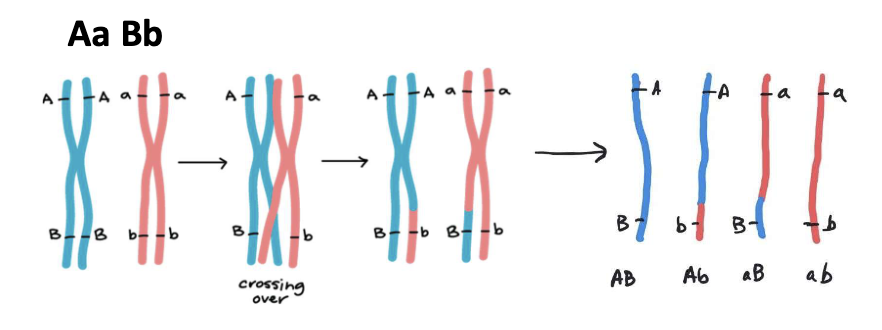
Unlinked loci follow Independent Assortment
Loci that are on separate chromosomes will assort independently
DNA sequences far apart on the same chromosome assort independently due to recombination

Linked loci travel together during meiosis
DNA sequences close together on the same chromosome
Genetic Linkage
the tendency for genes located close together on the same chromosome to be inherited together during meiosis
complete linkage; RF = 0 (no recombinant gametes are produced)
partial linkage: 0 < RF < 50% (some recombinant gametes are produced, but fewer than you would expect)
unlinked: RF are = 50%
Linked: RF <50%
Homologous Recombination
During Prophase I, homologous chromosomes are paired together tightly through a process called synapsis
Homologous regions of chromatids are cut (“restricted”) and pasted (”ligated”) back together
results in the exchange of DNA between homologous chromosomes

How many recombination events (crossovers) occurred to produce these gametes?
a. 0
b. 1
c. 2
d. 3
e. 4
b. 1

How many recombination events (crossovers) occurred to produce these gametes?
a. 0
b. 1
c. 2
d. 3
e. 4
c. 2

Single Crossover vs. Double Crossover
Single crossover: 1x
Double crossover: 2x
Recombination will always extend to the terminal end of the chromosome