Week 3 - Chemistry of Life, Cell Structure & Functions, & Cell Metabolism
 Call Kai
 Learn
Learn Practice Test
 Spaced Repetition
 Match
Match Flashcards
 Knowt Play
1/57

There's no tags or description
Looks like no tags are added yet.
Name | Mastery | Learn | Test | Matching | Spaced | Call with Kai | Chat |
|---|
No analytics yet
Send a link to your students to track their progress
58 Terms
What are macromolecules?
Carbohydrates
Proteins
Fats
Nucleic Acids
What are carbohydrates?
Macronutrient made of monosaccharides
Composed of C, H, & O
Used for energy
Simple CHO: Glucose
Complex CHO: Fiber, Starch
What are proteins?
Macronutrient made of amino acids
Composed of C, H, O, & N
Structural and functional purposed to the body
What are the 2 types of amino acids?
Essential
Cannot be produced by the body
Required intake via diet
Non-essential
Can be produced by the body
Not entirely dependent on dietary intake
What is a nitrogen balance?
The balance or protein intake meeting excretion
Proteins contain nitrogen
Neutral balance
Intake = Excretion
Positive
Intake > Excretion
Required for growth
Negative
Intake < Excretion
Starvation
What are fats?
Macronutrient made up of fatty acids
Used for structural functions and stored energy
3 types
Triglyceride
Glycerol + 3 fatty acid chains
Phospholipid
Glycerol & phosphate head + 2 fatty acid chains
Steriod/Cholesterol
Complex structure
What are the types of triglycerides?
Saturated
Solid at room temp
No double bonds
Polyunsaturated
Liquid at room temp
Double bonds
What are nucleic acids?
Biomolecules that store and express genetic information in all living cells and viruses
DNA and RNA
Composed of nucleotides (C, H, O, N, & P)
Blue-print for protein synthesis
What is intracellular and extracellular?
Intra
Substances contained within the cell wall
Extra
Substances found outside the cell wall
Mostly fluid
What are 2 types of cell membranes?
Plasma Membrane
Separates the internal environment of the cell from the external environment
Membranous Organelles
Enclose and compartmentalize specific structures within a cell, creating a specialized environment for different cellular functions
What is a phospholipid bilayer?
A double layer of lipid molecules that forms the fundamental protective barrier of all living cells
Hydrophilic head on the outside
Hydrophobic tail on the inside
Selectively permeable barrier
What is the difference between hydro and lipo?
Hydro = water
Lipo = fat
What is the purpose of cholesterol in the lipid bilayer?
Contribute to the fluidity and strength of the membrane
What is the purpose of proteins in the lipid bilayer?
Transporters/Integral Membrane proteins (passive & active diffusion)
Identifiers (unique cell markers)
Receptors
Connectors (allows cells to bind)
What is cytoplasm
Gelatinous fluid within cells
Helps maintain volume and shape of cells
Facilitated transport of substances within the cell
Site of numerous crucial functions
What are organelles?
A tiny, specialized structure inside a cell that performs a specific job
Membranous & Non-membranous
What are the membranous and non-membranous organelles?
Membranous
Nucleus
Mitochondria
Endoplasmic Reticulum
Golgi Apparatus
Lysomes
Non-Membranous
Ribsomes
Cytoskeleton
Centrosomes
What is the nucleus?
Control centre of the cell
Contains the cells genetic material (DNA) which codes for all proteins in our body
Chromatin threads in non-dividng cells
Chromosomes in early stages of cell division
Enclosed by a double membrane called the nuclear envelope and contains nuclear pores

What is the endoplasmic recticulum?
Continuous network of membrane action as a crucial site for production of proteins and steroids
Rough ER
Characteristics: Surface is covered in ribosomes
Functions: Production of proteins
Smooth ER
Characteristics: Surface lack ribosomes
Functions: Production of lipids, cholesterol, and steroids

What are ribosomes?
Found on the ER
Non-membranous structure
Large subunit and small subunit
Each composed of RNA bonded to protein (rRNA)
Synthesize proteins by translating the genetic code on mRNA into amino acid sequence

What is the Golgi apparatus?
Membranous organelle that functions to process, modify, and package proteins and lipids
Consists of a series of stacked flattened membrane-bound sacs called cisternae

What are lysomes?
Membrane-bound organelles that contain enzymes capable of breaking down proteins, carbohydrates, lipids, and nucleic acids

What is the mitochondria?
Organelle in which ATP generation occurs
Converts glucose and oxygen into energy (ATP) through aerobic respiration
Contain their own DNA
Folds (cristae) within the inner mitochondrial membrane increases surface area for chemical reactions

What is the cytoskeleton?
Internal supporting framework of cell that is composed of tiny, flexible fibres and rigid, rod-like pieces
Provides shape and support
Holds organelles in place
Assists in cell signalling and movement
What are centrosomes?
An organelles that acts as the primary microtubule-organizing centre playing a major role in cell division
The control centre for the cytoskeleton
Centrioles:
Central component of centrosomes
Highly active in cell division

What are 3 types of cell extensions?
Microvilli
Present in the small intestine as they increase surface area enhancing absorption of nutrients
Cilia
Present in respiratory passages for movement of mucous out od the airways
Flagella
Used for cell motility in sperm
What is membrane transport?
Transportation through the cell directly through phospholipid bilayer or by proteins
Passive Transport
No energy
Follows concentration gradient
Active Transport
Requires energy
Against concentration gradient
What are examples of passive transport?
Simple diffusion
Osmosis
Facilitated diffusion
Filtration
What are examples of active transport?
Pumps
Endocytosis
Exocytosis
What is diffusion?
Passive transport
Solutes move from an area of high concentration to an area of low concentration until they are evenly spread out
Concentration gradient
Involves a permeable membrane
What can and cant get thorough a phospholipid bilayer
Can
Small unchanged molecules
Can’t
Large uncharged molecules
Ions
What is osmosis?
The spontaneous movement of solvent molecules through a semipermeable membrane from a region of lower solute concentration to a region of higher solute concentration
Concentration gradient
What effect does osmosis have on cells?
Changes cell volume and shape by moving water across the cell membrane depending on the surrounding solution's concentration
Hypo
Cell swells
Cell concentration is higher than the fluid
Isotonic
Balances
Hyper
Cell shrinks
Cell concentration is lower than the fluid
What is facilitated diffusion?
A type of passive transport that moves polar molecules and ions across a cell membrane with the help of specialized transport proteins
Concentration gradient
Use of transport channel or carrier protein
Selectively permeability

What is channel-mediated passive transport?
A type of facilitated diffusion where specific ions or polar molecules move down their concentration or electrochemical gradient through water-filled protein pores across a cell membrane
Creates a hydrophilic tunnel
Only one type of solute
Open and closes in response to a specific stimulus

What is carrier-mediated passive transport?
The movement of specific polar molecules or ions across a cell membrane down their concentration gradient with the help of specialized transmembrane carrier proteins, requiring zero cellular energy
Carriers attract and bind to the solute, change shape, and release the solute out the other side of the carrier
Reversible depending on concentration gradient

What is the active transport process?
Require the expenditure of metabolic energy by the cell
Pumps
Against the concentration gradient
Vesicles
Endocytosis (bring into the cell)
Exocytosis (remove from the cell)
What are active transport pumps?
Sodium Potassium
Uses ATP to push Na+ out/bring K+ in against the concentration gradients
Calcium
Uses ATP to push Ca out of the cell against the concentration gradient
What is endocytosis and exocytosis?
Endo
Phagocytosis
Cell eating
Pinocytosis
Cell drinking
Exo
Cells transport molecules out of the cell by secreting them in membrane-bound vesicles that fuse with the plasma membrane releasing its contents to the exterior of the cell

What are the types of cell metabolism?
Metabolism
Sum of all chemical reactions that occur within the cells of a living organisms
Catabolism
Breaking down molecules for energy
Anabolism
Building complex molecules needed by cells
What are enzymes?
Catalysts for cellular reactions
Make them easier/brings extra energy/reduces energy required
Does not change in reaction and can be reused
Often, multiple are needed in sequences
End in “ase”

What is catabolism?
Cellular respiration
Metabolic process in cells that converts chemical energy from nutrients (primarily glucose) into ATP, which cells use for energy to perform life functions
3 chemically linked pathways
Glycolysis
Citric acid cycle
Electron transport system (ETS)
What is glycolysis?
First series of chemical reactions in carbohydrate catabolism
Takes place in the cytoplasm
Anaerobic
Glucose → Pyruvate and small amount of ATP

What is the citric acid cycle (Kreb’s Cycle)?
Second series of chemical reactions in the process of glucose metabolism
Takes place in the mitochondria
Pyruvate → small amount of ATP, CO2, H2O, FAD (FADH)
Also produces highly charged electrons

What is the Electron Transport System?
Charged electrons flow through the mitochondria, pulled by O2, to make massive amounts of ATP
If O2 is unavailable process breaks down, bogs down Kreb’s cycle
What is the Lactic Acid Cycle?
A metabolic pathway where lactate produced by muscles during rapid exercise is converted back into glucose by the liver
Occurs when not enough cellular oxygen to run Citric Acid Cycle + Electron Transport System
Occurs in cytoplasm
Pyruvate + NAD = very low yield ATP
Byproducts: lactic acid (cramps), ketones (with diabetes)
What is a rough summary of cellular respiration?
Process for producing energy (ATP)
Glycolysis
Takes place in the cytoplasm
Anaerobic
Glucose → Pyruvate and small amount of ATP
Citric Acid Cycle + Electron Transport System
Takes place in the mitochondra
Needs pyruvate + oxygen → lots of ATP
Byproducts: CO2, H2O, and Hear

What is cellular growth and reproduction?
Most fundamental of all living functions
Constitute the cell life cycle
Growth
Depends on the use of genetic information in DNA to make the structural and functional proteins needed for cell survival
Reproduction
Ensures that genetic information is passed from one generation to the next
What is protein synthesis?
The process cells use to build proteins
Transcription
Translation
DNA (genes) contains the “blueprints” for synthesizing specific proteins
RNA are a copy of these plans/blueprints
How do different organelles contribute to protein synthesis?
Nucleus
Part of DNA “unzips”, binds with RNA
Transcription (copy), becomes mRNA, leaves nucleus
Cytoplasm
mRNA binds with Ribosome
tRNA brings in amino acid
Translation: mRNA uses code to build protein in ribosome
ER/Golgi Apparatus
Ribosomes bind to ER
More complex protein synthesis occurs, leaves via Golgi
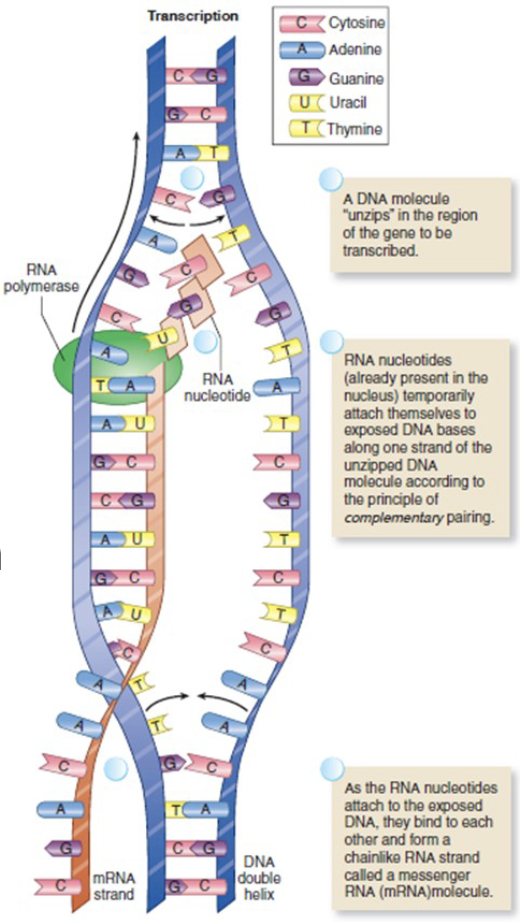
What is transcription?
Process in which DNA molecule is used as template to form mRNA, thus making a temporary “working copy” of the gene
Occurs in the nucleus
Segment of DNA “unzips”
An RNA copy of unzipped segment is made
the RNA copy is mRNA
What is translation?
Occurs in the cytoplasm
mRNA binds with ribosome
tRNA brings in amino acid
mRNA uses code to build protein chain (polypeptide)

What are the end stages of protein synthesis?
Once translation is complete, polypeptide chains are combined with others in the ER to make larger and more complex proteins
There are further refined and then distributed via the Golgi Apparatus
What is the life cycle of cells?
G1 Phase
G0 phase (Non-dividing cells)
S Phase
Interphase
G2 Phase
Cell Division
Prophase
Metaphase
Anaphase
Telophase
Cytokinesis

What are chromosomes?
Thread-like structures made of tightly wound DNA and proteins that live inside cell nuclei and carry your genetic blueprint
Each chromosome has one centromere (specialized region of a chromosome that holds sister chromatids together and helps direct cell division) and two chromatids one of the two identical halves of a replicated chromosome
During cellular replication, the cell duplicates its genetic material
What is mitosis?
1 cycle of cellular division resulting in 2 identical copies of the parent cells
Interphase
Not always considered part of mitosis
Cell grows, produces more organelles to accommodate its size
Prophase
DNA organizes into chromatids
Two new chromosomes replace each original chromosome
Nuclear envelope begins to breakdown
Centrioles begin to create spindles
Metaphase
Centrioles arrange condensed chromosomes along the midline of the cell
Spindles attach to chromosomes via centromeres
Anaphase
Sister chromatids separate, with each half moving to the opposite end of the cell
Ensures each daughter cell will receive an identical set of chromosomes
Cleavage furrow begins to form
Telophase
Nuclear envelope begins to form around genetic material
Chromosomes unravel back into DNA strands
Cytokinesis: Division of cytoplasm and it’s contents
Results in 2 identical daughter cells
What is meiosis?
2 cycles of cellular division resulting in 2 daughter cells with 50% of genetic material
Reproductive cells (gametes) only
Allows for genetic variability
Results in haploid cells

What are the key difference with meiosis?
Prophase I
Crossing over of genetic material happens, allowing for variability
Metaphase I
Homologous pairs of chromosomes line up in pairs, not single file
Anaphase I
Full pairs of chromosomes pulled to opposite ends of the cells, not individual chromatids