Chapter 15: Metabolism Basic concept and design
 Call Kai
 Learn
 Practice Test
 Spaced Repetition
 Match
 Flashcards
 Knowt Play
1/23

There's no tags or description
Looks like no tags are added yet.
24 Terms
What are the three stages of the generation of energy from food?
large molecules are broken down into smaller molecules (digestion)
small molecules processed into molecules of metabolism (acetyl CoA)
ATP produced from complete oxidation of acetyl CoA
What is energy required for?
power muscle contraction, cell movement, biosynthesis
What do phototrophs do?
obtain energy by capturing sunlight
What do chemotrophs do?
obtain energy through oxidation of carbon fuels
What are metabolic pathways?
the way molecules are synthesized or degraded stepwise in a series of reactions and are highly regulated into large complexes
What is the currency of life and how can it be formed?
ATP can be formed by oxidation of carbon fuels
what is metabolism?
a series of linked reaction that convert a specific reactant to a product (entire set is intermediary metabolism)
What is the pathway for glucose metabolism?
glucose → pyruvate (in 10 steps)→ anaerobic (lactate) or aerobic (acetyl CoA)
How do catabolic pathways work?
combust carbon fuels to synthesize ATP or ion gradients
How do anabolic pathways work?
Use ATP and reducing power to make large biomolecules
What are amiphibolic pathways?
Can function anabolically or catabolically (regulated irreversible reactions are distinct)
What is the criteria for metabolic pathways?
individual reaction must be specific
must be thermodynamically stable (unfavorable can be favorable with coupling)
Why is ATP hydrolysis exergonic?
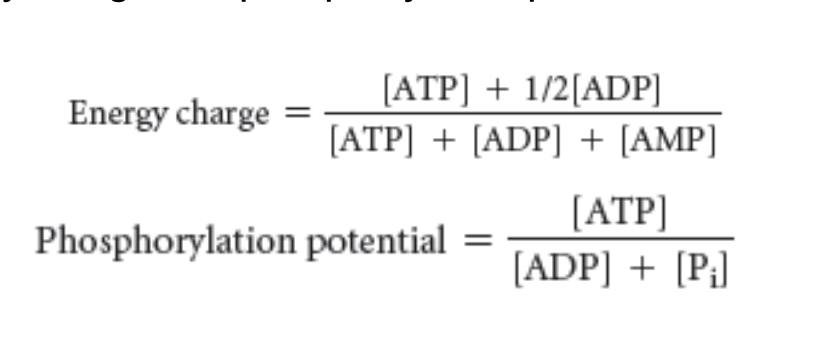
The two phsphoanhydride bonds are unstable so when they break energy is released→ used to power cellular function (delta -G)
What is phosphoryl transfer potential?
the standard free energy of hydrolysis to allow molecules to transfer phosphoryl groups to acceptor molecules (ATP has high potential)
Why does ATP have high phosphoryl-transfer potential?
charge repulsion
resonance stability
increase in entropy
stabilization by hydration
what can generate ATP from ADP
creatine phosphate for a short burst of activity
Why are phosphate and its esters important?
1.Phosphate esters are thermodynamically unstable, yet they are kinetically stable.
2.Phosphate esters are stable because the inherent negative charges resist hydrolysis.
3.Because phosphate esters are kinetically stable, they are ideal regulatory molecules, added to molecules by kinases and removed by phosphatases.
what oxidizes and accepts to form H2O?
carbon atoms are oxidized to yield CO2 and electrons accepted by O2 to form H2O
more reduced carbon=more free energy released
What are the two characteristics of activated carriers?
kinetically stable without catalysts
metabolism of activated is with small amount of carriers
What are common activators?
ATP for phosphoryl groups, NAD+ and FAD carry activated electrons from oxidation of fuels. NADP+ for reductive biosynthesis
What is coenzyme A?
CoA is activated carrier of acyl groups ad is exergonic bc thioester is unstable
What vitamin serves as a coenzyme?
Vitamin B
How are metabolic processes regulated?
amount of enzymes
catalytic activity (covalent modification)
accessibility of substrates (opposite reactions in diff compartments)
enzyme activity