CELL 201 Lecture 16 Cell Adhesions and Extracellular Matrix
 Call Kai
 Learn
 Practice Test
 Spaced Repetition
 Match
 Flashcards
 Knowt Play
1/81

There's no tags or description
Looks like no tags are added yet.
82 Terms
Cell recognition and adhesion
Help cells form precise patterns needed for development and function.
Epithelial tissue
Sheets of polarized cells with distinct functional domains at opposite ends.

Connective tissue
Loosely organized tissue whose cells attach to one another, a scaffold, or both.
Adhesion receptor dynamics
Adhesion proteins are continuously recycled, even if cells remain attached.
What are the specialized adhesion receptors animal cells use to attach to one another?
transmembrane proteins

transmembrane proteins
extracellular domains that interact with neighboring cells.
classes of cell-cell adhesion receptors
•immunoglobulin superfamily (IgSF)
•cadherins
•selectins
•integrins
Immunoglobulin Superfamily (IgSF)
A receptor family encoded by hundreds of genes
some involved in cell-cell interactions.
Cadherins
calcium dependent
around 100 different genes
Selectins
Calcium-dependent
lectins that bind sugars;
only 3 genes (E,L,P)
Integrins
Heterodimers composed of an alpha and a beta subunit.
18 alphas and 8 betas
Homophilic interactions
Interaction between identical receptors on neighboring cells.
e.g. cadherins
sometimes IgSF
Heterophilic interactions
Interaction between cells with different receptors
e.g selectins and integrins
sometimes IgSF and cadherins
How does leukocytes rolling occur?
When P- and E-selectins are presented on the surface of endothelial cells.
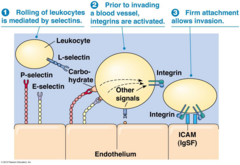
What do interactions between selectins and glycosylated receptors on the leukocyte activate?
signaling cascades that lead to integrin activation
what can activated integrins interact with and what does it cause?
receptors on a target tissue or matrix elements
firm attachment which allows cell invasion into tissue
What are cell-cell junctions and what type of association are they?
Specialized structures where two cells join
long-term associations.

Animal cell junction types
Adhesive junctions
tight junctions
gap junctions
adhesive junctions
attaches cells to things

tight junctions main function, intermembrane features, and associated structures
seals spaces between cells
membranes joined along ridges
transmembrane junctional proteins, actin
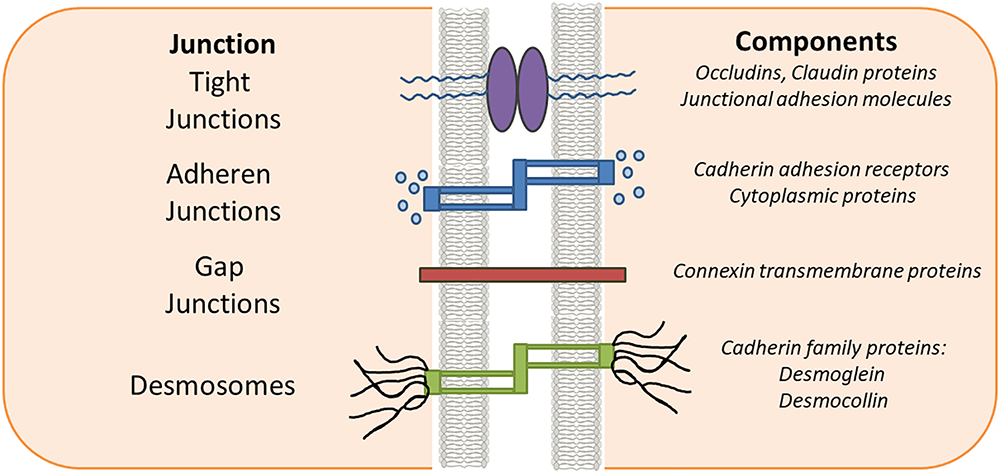
gap junctions main function, intermembrane features, and associated structures
connects cells for exchange of ions and molecules
connexons
connexins that align with other connexins to form channels

Plasmodesmata
Specialized structures connecting plant cells.
what are the 4 subcategories of adhesive junctions
focal adhesion
hemidesmosome
adherens junction
desmosome
focal adhesion main function, intermembrane features, and associated structures
Cell-ECM adhesion
localized points of attachment
actin microfilaments
hemidesmosome main function, intermembrane features, and associated structures
Cell-basal lamina adhesion
localized points of attachment
intermediate filaments
Adherens junctions main function, intermembrane features, and associated structures
cell-cell adhesion
continuous zones of attachment
actin microfilaments
desmosome main function, intermembrane features, and associated structures
cell-cell adhesion
localized points of attachment
intermediate filaments
adhesive junctions are formed by_____
cadherins protruding from outer surface of cell
What is another function of adhesive junctions?
can anchor cytoskeleton to cell surface via intracellular attachment proteins
2 main types of intracellular attachment proteins
adherens junctions
desmosomes
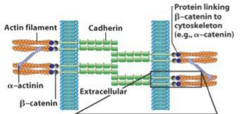
Adherens junctions sites are____
cadherin-mediated junctions that bridge actin cytoskeleton from two cells
What is another function of adherens junctions?
can act as signaling hubs where actin dynamics are modulated
What protein binds to the cytoplasmic tail of the cadherin?
β-Catenin

what does α-catenin bind?
binds β-catenin and recruits actin.

Desmosomes
Button-like points of strong adhesion between adjacent cells in a tissue

desmosome core
the extracellular space between the two connected cells
What are the 2 Desmosomal cadherins that the desmosome core consists of?
Desmocollin and desmoglein
how do desmocollin and desmoglein interact?
interact heterophilically across the intercellular space (between 2 cells)
linker proteins connect their cytosolic domains to intermediate filaments

What is the function of the inner plaque in desmosomes?
plakophilin (Pkp) and plakoglobin (Pg) connect cadherin’s cytoplasmic tails to desmoplakin
What does desmoplakin (Dp) do after the cytoplasmic tails of cadherins are joined?
binds to the intermediate filaments (tonofilaments)

What do tight junctions form?
Continuous belts around apical cell ends
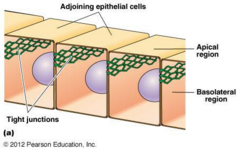
What do tight junctions block?
lateral movement of lipids and proteins in the PM
Tight junctions contain several major transmembrane proteins such as:
occludin
junctional adhesion molecules (JAMs)
claudins

What do claudins do?
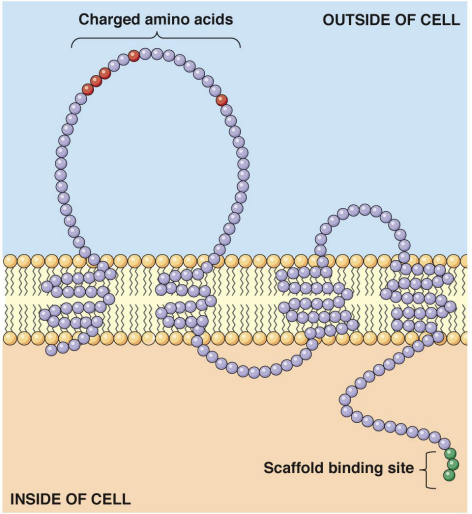
claudins on adjacent cells interlock and form a tight seal

what is the function of the extracellular loops of claudins?
form ion-selective pores to allow passage of specific ions
Paracellular transport
Movement of ions between cells.
Gap junctions
region where the plasma membranes of cells are aligned and brought into contact with a very small gap between
connexons and what they are made of?
protein channels between the cells that connect the gap in gap junctions
6 connexin proteins

T/F different tissues have different types of connexins that all function differently
F, they all function the same way
T/F Each connexon has a channel about 5 nm wide, which allows proteins, nucleic acids, and organelles through
F, the channels are 3nm wide, and are too small to let any of the above through
What are the different forms of tissues in animal cells that the ECM takes on?
bone - rigid ECM
cartilage - matrix materials, more flix
connective tissue - gelatinous and has interspersed fibroblast cells
What are the 3 classes of molecules that the ECM consists of?
structural proteins
protein-polysaccharide complexes (proteoglycans)
adhesive glycoproteins (fibronectins and laminins)
What do structural proteins provide?
Collagens and elastins that provide strength and flexibility.
What do proteoglycans provide?
provide structure to the matrix.
What do adhesive glycoproteins allow?
allow cells to attach to the matrix.
Collagen
Forms fibers with high tensile strength
how is collagen produced?
produced by several types of cells in connective tissues including fibroblasts.
How is procollagen formed?
Three α chains assemble into a triple helix in the ER lumen
have short nonhelical sequences at both ends

procollagen peptidase function
Cleaves secreted procollagen molecule
nonhelical sequences are removed
results in collagen molecule
How is Collagen fiber formed?
collagen molecules spontaneously assemble into fibrils th fibers.

Full collagen fiber formation steps
3 α chains form triple helix called procollagen, has nonhelical sequences at both ends
procollagen is secreted out of the cell and is cleaved by procollagen (removes both nonhelical ends)
resulting collagen molecules spontaneously associate into fibrils then fibers
What provides elasticity to the ECM?
stretchable elastic fibers primarily composed of elastins
What is the composition and crosslinking of elastin?
rich in glycine and proline
lysine residues form crosslinks through oxidative deamination
How do elastin fibers provide elasticity to the ECM?
Stretch under tension and recoil to their original state when tension is released.

What are collagen and elastin fibers embedded in?
a gel-like network of proteoglycans, which are proteins modified with lot of glycosaminoglycans
What are Glycosaminoglycans (GAGs) and what do they form?
Large carbohydrates with repeating disaccharide units
form hydrophilic gels when combined with proteins, allowing them to hold large amounts of water.
what can GAGs also provide?
rigidity and resistance to compression
Relate bones to GAGs
low GAG content
high calcium phosphate crystal + collagen content
= hard
Relate eyes to GAGs
high GAG content
low collagen content
= soft jelly
what do adhesive glycoproteins reinforce?
direct links between the ECM and PM
What do adhesive glycoproteins have + function
multiple domains
bind molecules in the ECM and receptors on membranes
what are the most common types of adhesive glycoproteins?
Laminins and Fibronectins
Where are laminins found?
basal lamina
what is the basal lamina structurally and where is it?
thin sheet of specialized extracellular material
underlies epithelial tissue to separate them from connective tissues
What does the basal lamina do?
structural support + permeability barrier
How can cells alter the properties of the basal lamina?
by secreting enzymes that catalyze changes in the lamina
Matrix metalloproteinases (MMPs)
Metal-dependent enzymes
locally degrade ECM, allowing cells to pass through.
how are MMPs important to leukocytes and cancer?
allow for leukocytes to invade injured tissues
may allow for cancer cells to spread
Integrins
large family of cell surface receptors
bind to fibronectins or laminins
what do humans deficient in B4 integrins develop?
junctional epidermolysis bulbosa
Focal adhesions
Clustered integrins link ECM to actin through talin, vinculin, and α-actinin.
Anchorage-dependent growth
Cells require ECM attachment to divide; cancer cells can bypass this requirement.