Mobility
 Call Kai
 Learn
 Practice Test
 Spaced Repetition
 Match
 Flashcards
 Knowt Play
1/52

There's no tags or description
Looks like no tags are added yet.
53 Terms
What is mobility?
Purposeful and coordinated movement.
Anatomical Component
__ - Reduces friction between the bones.
Cartilage
Anatomical Component
__ - Maintain posture and generate heat.
Muscles
Anatomical Component
__ - Allow for flexibility and movement of bones.
Synovial joints
Anatomical Component
__ - Provide a solid and stable framework; produce red blood cells.
Bones
Anatomical Component
__ - Provide for connections of muscles and bones.
Ligaments and tendons
Anatomical Component
__ - Control contraction and relaxation of muscles; coordinate balance and movement.
Nerves
Body Mechanics
__ - Wide base of support.
Base
Body Mechanics
__ - Push & pull, don’t lift.
Push & pull
Body Mechanics
__ - Use large muscle groups.
Use
Body Mechanics
__ - Keep back straight.
Keep back
Body Mechanics
__ - Avoid twisting.
Avoid
Body Mechanics
__ - Keep load close to the body.
Keep
What is immobility?
Inability to move on your own.
What are these assessment of:
History of M/S problems
Risk factors for M/S problems
ADL’s
Balance, posture, alignment
Any M/S signs or symptoms
Assessment of Mobility
What are these factors of:
Developmental considerations
Physical health
Mental health
Lifestyle
Attitude and values
Fatigue and stress
External factors
Factors affecting Movement and Alignment
What medical tool is use to assist and prevent fall?
Gait belt
True or False:
When using a walker, you should move your weak foot before your good foot.
True, the weak foot should move before good foot.
Which range of motion:
with help or assist from nurse or therapist.
Passive ROM
Which range of motion:
on your own.
Active ROM
What can you do to prevent patient falls?
Call bell in reach
Meaningful rounds
Educate patient
Use gait belt
What should you do if a patient falls?
Stay with the patient and call for help
Do not move the patient until the nurses assess for injury
Safety assist patient up
Obtain orthostatic VS
Document
Bone Cells
__ - Absorbs excess bone during remodeling phase of bone healing.
Osteoclasts
Bone Cells
__ - Builds bone.
Osteoblasts
Bone Cells
__ - Keeps bone maintained.
Osteocytes
Complication of fractures
__ - no surgery needed.
Closed Reduction
Complication of fractures
__ - need surgery.
Open Reduction
Complication of fractures
__ - break through skin.
Open fracture
Complication of fractures
__ - contain with with skin.
Close fracture
True or False:
Kids heals slower than adults from fracture.
False, kids heals faster from fracture.
Which level of mobility assist:
Client extends arm and reaches across midline to shake hands with nurse
Client moves self from semi-reclining position to sitting on edge of bed and maintains for at least 2 min
Equipment Needed:
Mechanical lift
Slide boards
Number of personnel needed:
Two or more personnel
Level 1 Maximum Assist
Which level of mobility assist:
While seated at edge of bed, client places feet on floor
Client extends one leg out, flexes ankle and points toes; repeat with other leg
Equipment Needed:
Mechanical sit-to-stand lifts
Ambulation assistive devices
Number of personnel needed:
Two or more personnel
Level 2 Moderate Assist
Which level of mobility assist:
Client can raise self from a seated position using assistive device (cane or bed rail)
Client can maintain standing position for at least 5 seconds
Equipment Needed:
Gait belt
Ambulation assistive devices
Number of personnel needed:
One to two personnel
Level 3 Minimal Assist
Which level of mobility assist:
Client can march in place
Client can step forward and backward
Equipment Needed:
None
Number of personnel needed:
Zero to one personnel
Level 4 No Assist

Which bed position:
Lying on abdomen with the head turned to one side; hips are unflexed
Advantages:
Allows for full extension of the hip and knee joints to prevent contractures
Promotes drainage of secretions
Prone

Which bed position:
Lying flat on the back, possibly with knees bent.
Advantages:
Enables visualization of the client for examination
Supine or dorsal recumbent
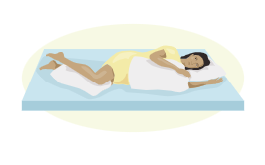
Which bed position:
Side-lying; the hips and knees are flexed with a pillow separating the knees/legs.
Designated as left lateral or right lateral depending on which side of the client is in contact with the bed.
Advantages:
Promotes spinal alignment
Reduces pressure on the sacrum and heels
Lateral

Which bed position:
Semi-seated or reclined position with the head of the bed elevated 45°; knees may be flexed.
Semi-Fowler’s: Head of the bed is elevated 15° to 30°.
High-Fowler’s: Head of the bed is elevated 60° to 90°.
Advantages:
Promotes lung expansion
Fowler
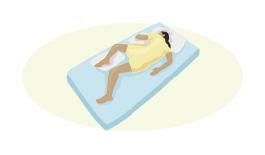
When bed position:
Placed between the prone and lateral positions, with the top leg flexed up toward the chest and supported with a pillow; the bottom arm is placed to the side of the torso, not underneath.
Advantages:
Reduces pressure on the sacrum and hips
Promotes drainage of secretions
Lateral semi-prone recumbent
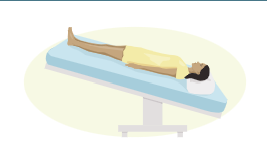
When bed position:
Lying flat on the back, with the foot of the bed above the head of the bed.
Reverse Trendelenburg: The foot of the bed is lower than the head of the bed.
Advantages:
Promotes venous return
Promotes drainage of the lower lobes of the lungs
Trendelenburg
Spinal curve disorder:
__ - curves to the side instead of running straight down the middle. When viewed from the back, it often forms an "S" shape or a "C".
Scoliosis
Spinal curve disorder:
__ - An excessive roundness or hunch in the upper back (thoracic spine).
Kyphosis
Spinal curve disorder:
__ - An exaggerated inward "swayback" curve in the lower back (lumbar spine).
Lordosis
Which type of movement:
Bend; reduce the angle between the bones
Flexion
Which type of movement:
Straighten the limb
Extension
Which type of movement:
Move away from baseline
Abduction
Which type of movement:
Bring closer to baseline
Adduction
Which type of movement:
Turning to face backward
Pronation
Which type of movement:
Turning to face forward
Supination
Which type of movement:
Circular motion
Circumduction
Which type of movement:
Side-to-side
Rotation
Which type of movement:
Turn inward
Inversion
Which type of movement:
Turn outward
Eversion