Neck anatomy
 Call Kai
 Learn
 Practice Test
 Spaced Repetition
 Match
 Flashcards
 Knowt Play
1/237

There's no tags or description
Looks like no tags are added yet.
238 Terms
location of the C-spine
between the base of the skull and the thoracic spine
the c spine is ____ in size comparison to the thoracic and lumbar
smaller
most C-spine vertebra have a ____ spinous process
bifid (except C1)
Atlas (C1)
articulates with the skull base
atlanto-occipital joint
circular shape with no body or spinous process
ant. and post. arches: tubercle
sides: lateral masses
receives the dens of C2

what is 1?
anterior arch

what is 2?
anterior tubercle
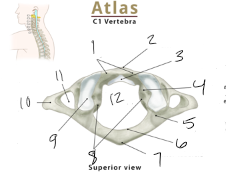
what is 3?
articular surface for dens of axis

what is 4?
transverse ligament tubercle
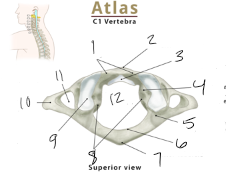
what is 5?
groove for the vertebral artery

what is 6?
posterior arch

what is 7?
posterior tubercle
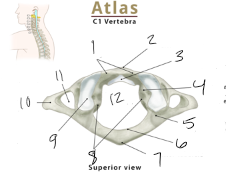
what is 8?
lateral mass

what is 9?
superior articular facet

what is 10?
transverse process

what is 11?
transverse foramen

what is 12?
vertebral foramen
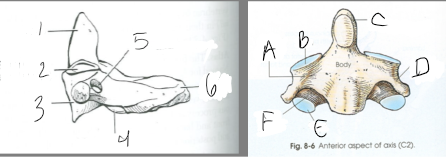
axis (C2)
forms pivot for rotation of the atlas and head
long body extending upward forming dens (odontoid)
thick, bifid, spinous process
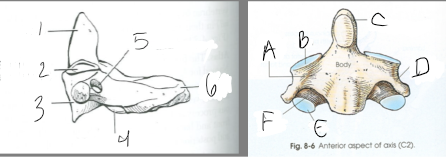
what is 1?
dens

what is 2?
superior articular facet

what is 3?
body

what is 4?
inferior articular facet

what is 5?
transverse foramen

what is 6?
spinous process

what is A?
superior articular process
what is B?
facet (superior)

what is C?
dens (odontoid process)

what is D?
transverse process
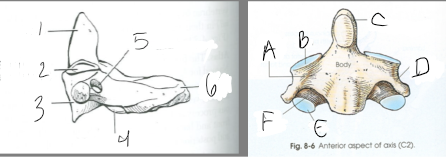
what is E?
facet

what is F?
inferior articular process

what is A?
dens

what is B?
transverse process of C1

what is C?
lateral mass of C1

what is D?
inferior articular surface of C1

what is E?
left Z joint

what is F?
body of C2

what is G?
right superior articular surface of C2

what is H?
anterior arch

what is pink?
anterior tubercle of C1
what is blue?
dens
C3-C6 vertebrae
has body and vertebral arch which surrounds spinal cord: vertebral foramina
bifid spinous processes
C7 vertebrae
also known as vertebral prominens
has longer, single spinous process

what is A?
dens

what is B?
body of C3
what is C?
intervertebral disc space
location of the hyoid bone
below the mandible at C3; U shaped
has ligaments that attach to the larynx (voice box)
function of the hyoid bone
used for tongue movement and swallowing

what is green?
hyoid bone
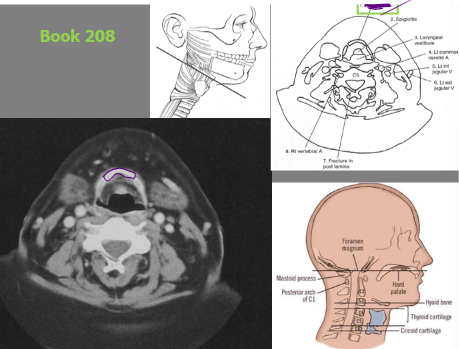
what is purple?
hyoid bone

what is the arrow pointing to?
hyoid bone
location of the larynx
appears from C3-C6
part of airway in anterior neck; 4.5 cm long
function of the larynx
air passageway
contains laryngeal cartilages interconnected by ligaments in muscles aiding in voice production
location of thyroid cartlage
just inferior of the hyoid bone
largest of the cartilage structures in the larynx
U-shaped
open posteriorly
anterior surface forms the “adam’s apple”
laryngeal prominence (C4)

what is the blue arrow pointing to?
hyoid bone
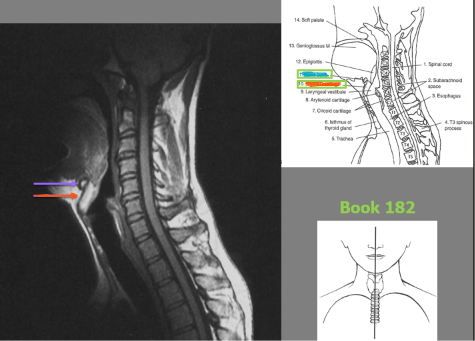
what is the orange arrow pointing to?
thyroid cartilage
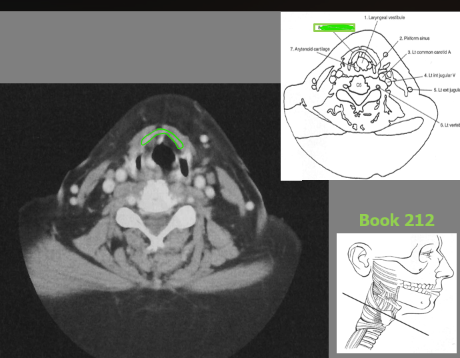
what is lime green?
thyroid cartilage

what is red?
thyroid cartilage
location of the epiglottis
spoon-shaped cartilage; inferior part anchors to the thyroid cartilage. superiorly extends upwards adjacent to hyoid bone
posterior to hyoid bone
function of the epiglottis
closes to the opening to the larynx when drink or food is moved down the pharynx

what is green?
hyoid bone

what is blue?
epiglottis

what is orange?
thyroid cartilage

what is yellow?
epiglottis

what is purple?
epiglottis
location of cricoid cartilage
single cartilage inferior to the thyroid cartilage
wraps around the airway; ring is wider posteriorly
posterior may be visible on axial without anterior portion

what is red?
hyoid bone

what is yellow?
epiglottis

what is green?
cricoid cartilage

what is blue?
thyroid cartilage
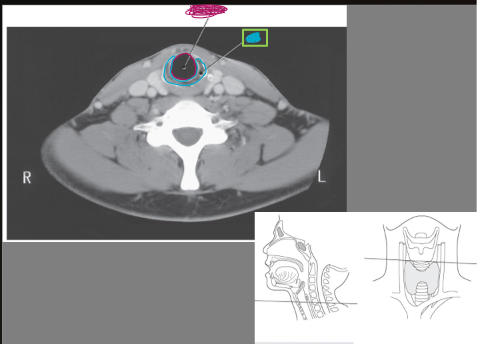
what is pink?
larynx
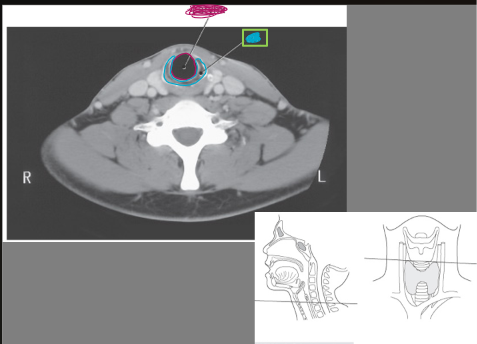
what is blue?
cricoid cartilage

what is pink?
epiglottis

what is purple?
hyoid bone

what is blue?
thyroid cartilage

what is green?
cricoid cartilage
location of arytenoid cartilage
rest on the posterior cricoid processes
two pyramid-shaped cartilages
function of arytenoid cartilage
vocal cord attachment

what is blue?
arytenoid cartilage

what is green?
arytenoid cartilage

what is purple?
thyroid cartilage

what is green?
arytenoid cartilage

what is blue?
cricoid cartilage
location of vestibular folds (false vocal cords)
mucous membrane structures just superior to the glottic space
protect the airway
no role in voice production
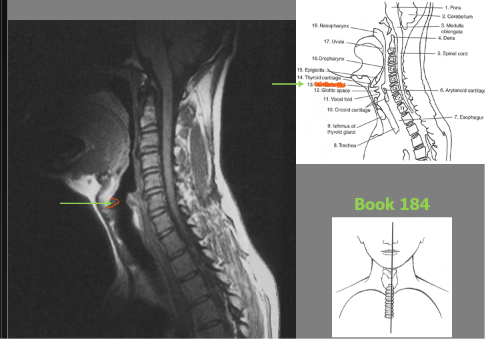
what is orange?
vestibular fold
location of the vocal cords (vocal folds)
ligaments that extend between arytenoid cartilages and thyroid cartilages
covered by mucous membrane
function of the vocal cords (vocal folds)
muscles move the cartilage changing tension on the ligaments
aids in voice production
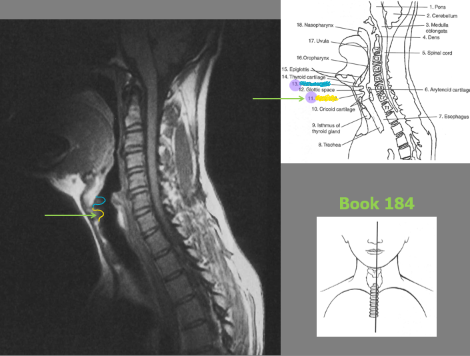
what is blue?
vestibular fold

what is yellow?
vocal fold
location of the glottic space (ventricle)
space within the larynx
between vocal and vestibular folds

what is green?
glottis/glottic space

what is pink?
vestibular folds
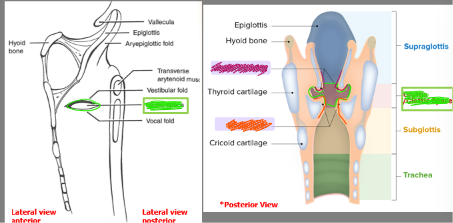
what is orange?
vocal folds

what is yellow?
vestibular fold

what is blue?
glottic space

what is orange?
vocal fold
location of the pharynx
tubular structure- extends base of the skull to C6 and becomes continuous with the esophagus
lies next to the bodies of the vertebra
nasopharynx
oropharynx
laryngeal pharynx
function of the pharynx
serves both respiratory and digestive
location of the nasopharynx
posterior to the nasal cavity; extends from base of skull to the soft palate
1st section of the pharynx

what is yellow?
nasopharynx
location of oropharynx
posterior to the oral cavity; soft palate to the epiglottis
2nd section of the pharynx
what is the uvula
free edge of soft palate that hangs in the back of throat