Lecture 3 - Cognitive Communication Assessment
 Call Kai
 Learn
 Practice Test
 Spaced Repetition
 Match
 Flashcards
 Knowt Play
1/29

There's no tags or description
Looks like no tags are added yet.
30 Terms
Acute care factors that may influence your assessment (other than the injury)
Sleep Disturbance
Insomnia
Day/Night Reversal
Pain
Effects of pain
Effects of pain meds
Infections
Pneumonias, UTI
Can impact on participation and alertness
Medications
Can have potential side effects (drowsiness, confusion, dry mouth)
Delirium
Hypo/hyperactive delirium
Stress & Emotion
Priorities and responsibilities of the acute care SLP (general)
You may be the first SLP to assess a patient after their brain injury
Assessment and management of swallowing tends to take priority in acute care – however, we must screen communication to the best of our ability
Make sure they can communicate basic needs
Your documentation may be a source of information for other SLPs (and health care professionals) beyond the hospital stay
We must consider what communication and swallowing follow up our patient requires after their discharge from hospital
Make sure they don’t fall through the cracks
We want to do our best to make sure our patient’s basic communication and swallowing needs are met while in hospital
During the Acute Ax what should you do
Make observations
Is patient in bed/chair
Lines or feeding tubes
Supplemental oxygen
Restraints
Record all in notes
Obtain consent
From patient, family, or substitute decision maker
Consider PGT (public guardian trustee) if needed
Optimize Environment
Turn off TV/music
Turn on light
Pull curtains
Limit visitors
Optimize Patient
Reposition – ask for help!
Glasses
Hearing aids
Rancho Levels 2-3
Generalized and localized response
Very low level of alertness
Minimally responsive
Ax is largely informal
Can do western neurosensory stimulation profile
Cognitive-Communication Assessment
Wakefulness – are they awake, duration
Can they been woken? Stimuli needed?
Eye Tracking – horizontal/vertical, keep stimuli relevant
Responsiveness to stimuli – general or localized
Localized = direct attention to it
Command following – what cues/supports needed
Verbalizing or vocalizing – spontaneous or to command
* Can reliable yes/no response system be established?
Not ready for swallow assessment
Low cognitive level
For Family and Staff
Encourage oral care
Provide education on brain injury recovery
Suggest family bring in photos and familiar objects
Photos of 1-2 people
Educate family on simple communication strategies
Refer to Rancho levels
What is the Western Neurosensory StimProfile
used in acute care or slow stream rehab
Clinical evaluation for slow-to- recover patients
33 items across arousal & attention, expressive communication, and responses to auditory, visual, tactile, olfactory stimulation
Maximum score 113, based on types and timeliness of responses
Types of responses:
Undifferentiated: same or similar responses to all stimuli e.g. generalized body movement, increased respiration, eye blinking, reflexive posturing
Differentiated: specific to the stimuli e.g. head turn to stimulus, movement of body part touched or named
No response within 20 seconds
Delayed more than 5 seconds after stimulus
Cued with repetition, modeling, tactile cue, guided movement
Rancho Level 4
confused and agitated
More aware
Very confused and scared
Still mainly informal assessment
May be resistant to being “tested”
May or may not be ready for swallow assessment
Pulling out feeding tube is often though
Often demonstrate responsive behaviours
Cog-communication ax
Attention – Consider focused/sustained attention, duration and key distractors.
Orientation – To place, time, reason for admission
Can they follow commands? Respond to questions? Consider consistency, accuracy and processing speed.
Consider ability to express basic needs, social greetings and participation in simple conversation.
Determine any strategies that may help manage responsive behaviours related to poor communication or swallowing.
Responsive behaviours = yelling, swearing, hitting, eloping
In response to basic needs not being met
May need restraints for safety
Do family and staff education
Explaining clinical behaviours
Not intentional responsive behaviours
Memory book
Collaborate with team members to develop plan to manage responsive behaviours related to impaired communication or swallowing
Educate family and staff that behaviours are part of brain injury recovery process (not intentional)
Rancho Levels 5-6
Confused inapprorpriate and confused approrpraite
Decrease in responsive behaviours
Still confused and impaired
Improving attention and participation
Cog comm ax
Attention - consider sustained and selective
Orientation & Insight – consider insight into impairments
Improving and emerging
Most focused on physical impairments
Memory – recall of recent events (food eaten at breakfast, therapist’s names, etc)
Ask simple questions
Verbal Output – conversation, picture description
Auditory Comprehension/Processing – ability to follow commands/directions, need for repetition/rephrasing
Screen for language or motor speech impairments
Social Communication – consider affect, eye contact, turn taking
Use of screening tools – to identify any potential areas of communication impairment
Can do a little bit of everything (formal, informal, facility screening tools)
Use of formal assessment tools, as appropriate
If there’s time
Quick aphasia battery
Language RBANS?
Often appropriate for swallowing assessment
Start discharge planning discussions
Discharge from acute care planning
Transfer to rehab
Participation better, showing improvement
Team decision
Team Input:
Readiness for rehabilitation requires input from all team members
Types of rehab
Criteria for Acceptance
Demonstrate improvement
Demonstrate carry-over
Have rehab goals
PO diet or G-tube
Cannot go with an NG tube
Patient and family consent
Patient and family need to provide consent
Can make some choice as to what facility they go to
Educate on it
Application submitted
Team applies to rehab
Await acceptance and bed availability
TOA upon transfer
Other Discharge Planning
Home/LTM
Be sure to recommend/arrange follow up SLP services, if needed
Home Care – services can be limited
Private – insurance may cover
Outpatient Rehab – wait lists and availability vary
Transfer to another hospital (repatriation)
Be sure to provide TOA (Transfer of Accountability) to receiving SLP
Inpatient rehab assessment priorities
Patient is still trying to learn about their injury -> understanding their ABI
Understand the complexity
Understanding ABI recovery
The nature of recovery
Speaking with nurses/team about ADLs
We are part of a larger team
Education materials
Printed
Better able to understand these at this time
Safest discharge and outpatient treatment
Context is critical
Chart Review
Interview with caregiver (when you have consent)
Pre-injury abilities
Current strengths
Be strength focused
Current needs
What are their priorities
Determine if aphasia is present – caseload priority and management
If present it is a priority
Future needs due to short Length of Stay
Education
What is FIM?
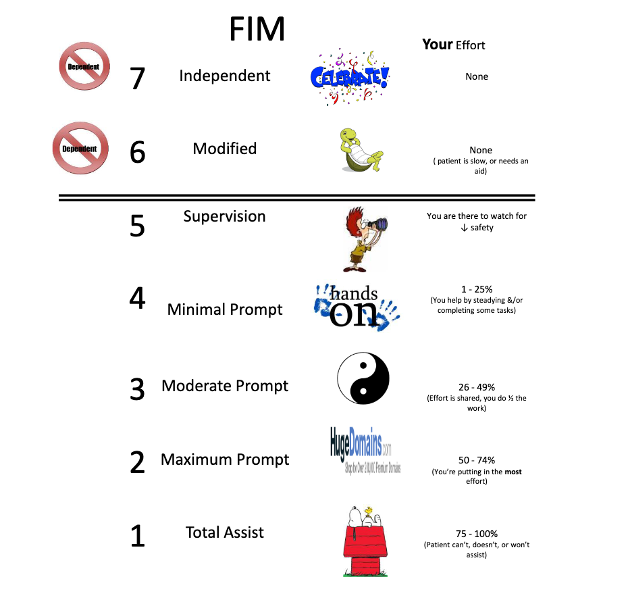
Gives you information which allows you to prioritize, educate, and make clinical decisions re: patient care
Every patient is rated on the activities that they can do
Allows you to enter FIM (Functional Independence Measure) data that is sent to the gov’t and is used to make decisions re: length of stay, staffing, patient gains, efficiency of service, funding, etc
NOTE: Improvement by only one number (e.g. from 3-4) is a statistically significant change
SLPs are responsible for scoring and entering:
COMPREHENSION
EXPRESSION
READING
WRITING
on admission and discharge
Part of a comprehensive, inter-professional set of assessment scores
Can be “tricky” to translate to communication as FIM is motor-biased
7 point scale
7 = independent
1 = total assist
We do the language part
Determines LOS
Err on the side of lower
Pros of Formal Assessment
same stimuli (rollercoaster) but a VERY different experience
Can compare abilities across pts
Compare across groups of pts
increase your clinical knowledge
measureable change
Common administration
common dialogue/terms
recognized by insurance companies
Cons of formal assessment
People don’t like being tested
Anxiety-provoking
Impact on performance?
Same questions repeatedly by multiple staff members
What is the day? Year?
What happened to you?
Draw this cube / clock
Nonfunctional!
What about pre-injury skills?
Individualized?
Is the test structure itself compensating for any deficits?
Leave something for community SLP
Deficit level, not Activity/Participation
Often no “real world” Q’s
Challenging to make relevant/ meaningful
Test anxiety impacts performance
People tend to Focus on the score, not the impact
Cognition (deficit level) → attention assessment components
Overall (WFL, mild, mod, severe)
Patient Report “insert patient quote”
Others’ Report “insert family quote”
Tools Used (check all: informal, TEA, APT, Trails B, other)
Focused (ignore background distractions)
Can they focus on a task, ignore background sounds?
Sustained (concentration, caveat re setting)
Divided (walking & talking, )
Alternating (multiple people conversation, etc.)
Additional Assessments:
TAP - Test of Attentional Performance
TEA - Test of Everyday Attention
Stroop Colour and Word Test
Frontally mediated
Trails Making Test B
PASAT - Paced Auditory Serial
Addition Test
Cognition (deficit level) → memory assessment components
Overall (WFL, mild, mod, severe)
Patient report “insert patient quote”
Others’ Report (family, care team, other)
Tools Used (informal, GOAT, Rivermead, BSRT)
Immediate (grocery word list)
Working (digit span backwards, rearranged word list: alphabetical, or small to big, etc.)
Semantic (long term, personal milestones, world facts)
Delayed (prompt - grocery list)
Additional (orientation)
Assessment:
RBANS – Repeatable Battery for the Assessment of Neuropsychological Status
RBMT - Rivermead Behavioural Memory Test
BNT - Boston Naming Test
Semantic knowledge
RIPA - Ross Information Processing Ax
BSRT - Babcock Story Retell Test
Questionaires!
Self insight is vunerable in TBI
Self score and have someone else score
Cognition (deficit level) → EF assessment components
Overall (WFL, mild, mod, severe)
Patient Report
Others’ Report (family, care team, other)
Tools Used (check all: informal, FAVRES, TOPS, SCATBI, RIPA-2, BADS, BCAT-VTPJ )
Initiation
Insight
Levels of self Awareness:
1) No awareness of deficits “Are you having any difficulties?” “Nope.”
2) Intellectual – able to recognize impairment (physical first, often not cognitive issues) “This arm doesn’t work”
3) Emergent – can detect deficits as they happen in the moment “Wow, I’m having trouble with figuring this out”
4) Anticipatory – can predict difficulties due to deficits “I will write things down so I don’t forget
Self-Monitoring (how did you do on that task?)
Planning / Goal Setting
Idea Generation (ANT, FAS)
Flexibility / Cognitive Shift (pros & cons, different perspectives)
Verbal Reasoning
Verbal Problem-Solving
Assesment:
PCRS - Patient Competency Rating Scale
Patient
Relative
Clinician
AQ - Awareness Questionnaire
Patient
Relative
Clinician
SADI – Self Awareness of Deficits Interview
Verbal Fluency Assessment
Animal naming test -> typical is 20
Phonemic naming test
Verbal Reasoning and Problem Solving
IFCI – Inpatient Functional Communication Interview
TOPS – Test of Problem Solving
FAVRES – Functional Ax of Verbal Reasoning & Executive Strategies
RIPA (Ross Information Processing Ax)
MCLA – Measure of Cognitive-Linguistic Abilities
SCATBI – Scales of Cognitive Abilities for TBI
MIRBI – Mini Inventory of Right Brain Injury
Cognition (deficit level) → Emotion assessment components
Overall (WFL, mild, mod, severe)
Patient Report
Others’ Report
Impulse Control
(lability, outburst)
Motivation / Energy
Mood
Assessments:
La Trobe Communication Questionnaire
Profile of Pragmatic Impairment in Communication
Adapted Kagan Scales
Social Communication Skills Questionnaire
Social Skills Questionnaire for Traumatic Brain Injury
Modified Pragmatic Rating Scale
ASHA FACS
Communication (WHO activity level) → verbal expression assessment
Overall (WFL, mild, moderate, severe, NA)
Patient Report
Others’ Report
Tools Used (BNT, TAWF, BDAE fables & cookie theft, ALFA, SCCAN, Brisbane, Mount Wilga)
Discourse -> how are they expressing themselves (down the list = less structured)
1. Story Retell
Aesops fables
2. Narrative
Cookie theft or BCAT Kitchen Task
3. Procedural (organization, sequencing)
Tell me how to …
4. Story Generation
5. Opinion / Explanation
Try to get them to argue the other side
6. Verbal Problem Solving and Reasoning (lost item)
Importantly, in the inpatient setting, you’re part of a team that is determining peoples’ CAPACITY to understand information and make decisions for themselves re: current and future needs
Always ask “real world” and personally/contextually relevant questions as part of your sessions
7. Topic Maintenance (verbosity, paucity)
8. Turn-Taking (interrupt, etc)
9. Breakdown / Repair (recognize, clarify, explain, etc)
10. Other
Word Finding
Confrontation (fluency in conversation, pausing)
Generative (brainstorming skills)
Writing (reminder notes, email, Ennis Weir Critical Thinking)
Short reminder notes
Writing emails
Difficulty isn’t likely the spelling or grammar, it’s the “soft skills”
Texting & short forms
Cognitive component e.g. Ennis Weir, complaint letter
Communication (WHO activity level) → verbal comprehension assessment
Overall (WFL, mild, moderate, severe, NA)
Patient Report
Others’ Report
Tools Used: check all: DCT, SRT, RCBA-2, SCCAN, TAPS, RIPA-2, Brisbane, Mount Wilga, SCOLP, )
Auditory
1. Processing Speed (SCOLP)
Speed and capacity
2. Processing Capacity (SRT)
Buy in for output
Also what order
All over the place in recall?
Abstraction / Complexity
New Learning (Woodcock-Johnson, CLQT)
Reading (informal, DCT, Nelson-Denny)
Communication (WHO activity level) → pragmatics assessment
Overall (WFL, mild, moderate, severe, NA)
Patient Report
Others’ Report
Tools Used: check all: informal, Faux Pas Test, TASIT, DCT)
Eye Contact (too much/little)
Facial Expression (flat, animated)
Gestures (giving, receiving)
Proxemics (intimate, personal, social, public)
Inferencing (indirect, “read-between-lines”)
Social judgment (jokes, lying, sarcasm, theory of mind, etc.)
Humor
Sarcasm
Perspective taking
Can do BIRT – social communication questionnaire
Communication (WHO activity level) → reading assessment
Health literacy
Can use the patient bill of rights and responsibilities
Vision
Patient-centred?
Health Literacy
What is needed now?
Education from staff?
Medication labels?
In the future?
Return to school? Work? Demands?
Language vs. cognition (amount, duration, fatigue, complexity, recall over days/weeks, interest, distraction)
Function (WHO participation level) assessment components
A. Family
B. Daily Routines (ADLs, iADLs)
C. Technology/Digital (social media, phone/text, internet)
D. Hobbies (recreation, joy, spare time, fun)
E. Community (friends, strangers, services)
F. Academics (accommodations, academic/ family/ peer/ social supports, consultation)
G. Work (required roles, responsibilities, accommodations, supports, incremental increases in responsibility/time/scope/level/independence, etc.)
H. Additional
What is the goal of community based assessment/rehab
Goal: to help people return to pre-injury roles and re-establish identity and well being after an injury
Role is the goal
Re-establish identity
What is the CCCABI
Cognitive Communication CHECKLIST for Acquired Brain Injury
screening tool
can be helpful for providing info to families and clients about the SLP role
identifies communication concerns
What is the FAVRES
Functional assessment of verbal reasoning and executive strategies
standardized on ABI population
assesses a variety of functions
requires processing of real likfe amounts of info
predicts return to work
What is the RBANS
Repeatable Battery for Assessment of Neuropsychological Status
Broad neurocognitive screening measure, extensive norms, not just TBI; used by SLP, neuropsych; used later in recovery
inpatient or community based
later stages of recovery
What is the PRS
Pragmatics rating scale
1-5 scale for a variety of pragmatic skills
inpatient rehab and up
What is the LCQ
La trobe communication questionnaire
self rating and other rating
inpatient rehab
what is the SCATBI
Scales of Cognitive Ability for Traumatic Brain Injury (SCATBI)
Standardized cognitive battery that is fairly widely used during middle stages of recovery by SLP, OT (takes much longer than the RBANS but is not just a screening measure)
What is the DCT
Discourse Comprehension Test
inpatient rehab
What is the cognitive communication screen used for
bedside screening tool
collection of subtests, tasks and observation
acute care