15-16. Hypothalamus & Limbic System
 Call Kai
 Learn
 Practice Test
 Spaced Repetition
 Match
 Flashcards
 Knowt Play
1/40

There's no tags or description
Looks like no tags are added yet.
41 Terms
hypothalamic sulcus
shallow groove separating medial hypothalamus from thalamus
periventricular, middle, lateral
3 mediolateral zones for hypothalamuc nuclei; m→l 1. regulates endocrine hormone release from anterior pituitary gland, 2. regulates vasopressin & oxytocin release from posterior pituitary gland, 3. integration
periventricular
most medial hypothalamic mediolateral zone that regulates endocrine hormone release from anterior pituitary gland; contains neurons projecting to median eminence
middle
hypothalamic mediolateral zone that regulates vasopressin & oxytocin release from posterior pituitary gland
lateral
mediolateral zone responsible for integration, separated from medial zone by fornix
fornix
C-shaped tract connecting limbic system
anterior
hypothalamic a→p zone dorsal & rostral to optic chiasm including preoptic area (GnRH, dimorphism, sleep, urination, thermoreg); principal nucleus for circadian rhythms
middle
hypothalamic a→p zone between optic chiasm and mamillary bodies; includes infundibular stalk & a&p pituitary nuclei
posterior
hypothalamic a→p zone including mamillary bodies
infundibular stalk
connects pituitary gland to ventral surface of the hypothalamus
parvocellular neurosecretory system
small diameter hypothalamic neurons regulating anterior pituitary hormone release; located in all 3 hypothalamic regions; terminate on pituitary portal circulation; release either releasing or release-inhibiting hormones
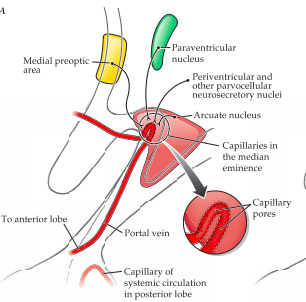
magnocellular neurosecretory system
includes large diameter hypothalamic axons regulating posterior lobe of pituitary gland (vasopressin & oxytocin); only located in middle zone, receives info from solitary nucleus for bp & circumventricular organs, & preoptic area
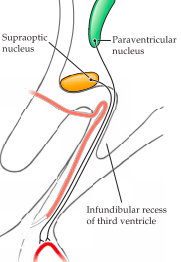
median eminence
set of capillaries in proximal infundibular stalk connnecting portal veins; gets projections from periventricular zone & medial preoptic area (GnRH)
median eminence, anterior pituitary
locations of 2 capillary sets in portal circulatory system
arcuate nucleus
releases GnRH, luteinizing hormone-releasing hormone, somatostatin, and adrenocorticotropic hormone; inside periventricular hypothalamus; optioid induced analgesia due to β-endorphin; sensitive to insulin, leptin, & ghrelin
periventricular paraventicular nucleus
nucleus portion connecting with 3rd ventricle releasing cortiotropin releasing hormone (CRh)
periventricular nucleus
releases GnRH, luteinizing hormone-releasing hormone, & dopamine (-|prolactin)
medial preoptic area
parvocellular neurons secreting luteinizing hormone-releasing hormone; input to magnocellular
vasopressin
posterior pituitary hormone elevating BP via vascular smooth muscle (ADH), pair bonding (M)
oxytocin
posterior pituitary hormone stimulaes uterine contractions & milk production; pair bonding especially F
paraventricular, supraoptic
nuclei synthesizing vasopressin & oxytocin from prohormone molecules, neurophysins; 1 controls sympathetic & parasympathetic functions
preganglionic, postganglionic
2 neurons linking CNS & PNS for visceral autonomic innervation
medial forebrain bundle
lateral hypothalamus & tegmental location of hypothalamic pathway
suprachiasmatic nucleus
brain clock from retina; giving input to preoptic sleep center & tuberomammillary nucleus
Edinger-Westphal, superior salivatory, inferior salivatory, dorsal motor
4 nuclei containing most brainstem preganglionic neurons in parasympathetic system
bp, temperature, metabolism, reproduction, emergency response
5 hypothalamic functions
solitary nucleus, parabrachial nucleus, ventrolateral medulla, pontomedullary reticular formation, dorsal ralphe nucleus
5 brain stem structures working w/ hypothalamus & ANS; 1. viscerosensory info from CNIX & X, 2. 1→forebrain for homeostasis, 3. adrenergic projection → brainstem & spine for bp; 4. complex reflexes, 5. gives forebrain 5-HT
tuberomamillary nucleus
region connected w/ (GABAergic) preoptic sleep center which uses histamine to promote wakefulness
pedunculopontine nucleus
brain stem arousal center using acetylcholine for wakefulness
medial preoptic area
GnRH, dimorphism, sleep, urination, thermoreg are functions of
insulin, leptin, ghrelin
3 hormones arcuate nucleus is sensitive to
lateral pontine tegmentum
“key to atonia in REM”
limbic association cortex, hippocampal formation & fornix, amygala
3 C-shaped components of limbic system
medial orbital gyri, cinguate gyrus, parahippocampal gyris, temporal pole
4 limbic cortical areas going to rest of limbic system via cingulum & uncinate fasciculus
dentate, hippocampus, subiculum
3 subdivisions of hippocampal formation
entorhinal cortex
rostral parahippocampal gyrus going to huppocampal formation; where cortical projections from hippocampus & subiculum terminate
subiculum
hippocampal subdivision whose axons synapse on mamillary body → mammillothalamic tract → anterior thalamic nuclei & cinguate gyrus
lateral septal nucleus
region receiving hippocampal projections
basolateral, central, cortical
3 nuclear amygdala divisions; 1. rec info from cerebral cortex and go to medial dorsal thalamus; 2. reward, emotion expression → hypothalamus (neuroendocrine); 3. olfactory, appetite → vmHypothalamus
stria terminalis, ventral amygdalofugal pathway
2 amygdala output pathways; 1. C-shaped efferent path from cortical nuclei; 2. efferents from central nuclei → brain stem & basolateral nuclei → thalamus, ventral striatum, & basal nucleus
limbic
bg loop from (ventral striatum, caudate, & putamen) → (obPFC, mfPFC, dlPFC); recs projections from ventral tegmental dopaminergic neurons