Sep 29: ACTION POTENTIAL CONDUCTION & THE CHEMICAL SYNAPSE
 Call Kai
 Learn
 Practice Test
 Spaced Repetition
 Match
 Flashcards
 Knowt Play
1/23

There's no tags or description
Looks like no tags are added yet.
24 Terms

What are the phases of action potential and what happens?
1-3: Depolarization due to a graded potential which reaches threshold
4: Triggers opening of Na+ voltage gated channels; Na+ enters (depolarization)
5: Na+ VG channels quick to close; Na+ stops entering. K+ VG channels begin to open; K+ starts leaving the neuron
6: K+ leaving causes repolarization back to RMP
7: K+ VG channels slow to close, so K+ continues to leave (hyperpolarization)
8-9: K+ VG channels close and the membrane returns to RMP
What are the 2 gates of the Na+ Voltage-gated channel?
Activation gate and the inactivation gate

What is the activation gate?
Component of voltage gated ion channel
"lever" inside the channel pore.
Opens to allow ions to flow through membrane

What is the inactivation gate?
The "ball and chain" structure on voltage gated channel
blocks the ion pore shortly after the channel opens
What is the state of the activation gate at RMP (−70 mV)?
closed

What is the state of the inactivation gate at RMP (−70 mV)?
Open

What is the state of the activation gate during depolarization?
open
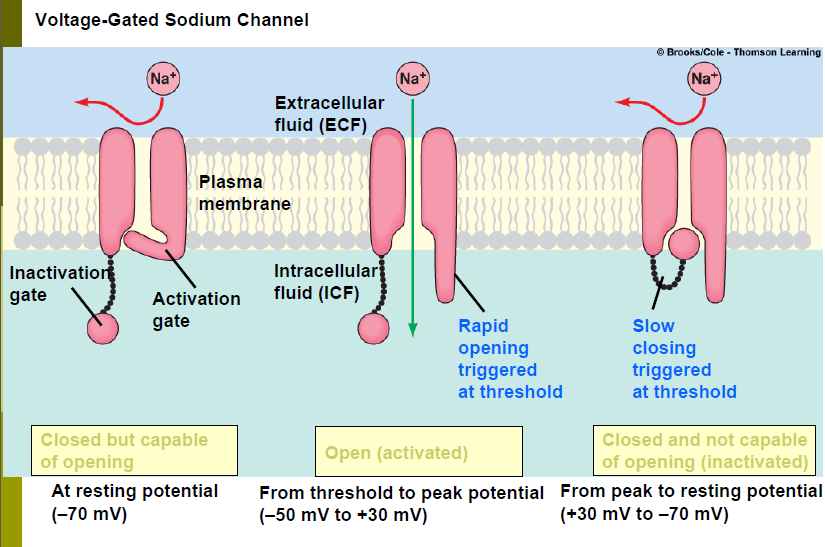
what is the state of the inactivation gate during depolarization?
open

What is the state of the activation gate during repolarization
Open


What is the state of the inactivation gate during repolarization
closed
What is the absolute refractory period
period after an action potential starts during which a second action potential cannot be triggered, no matter how strong the stimulus is.
Which gate of the Na+ VGC is responsible for the absolute refractory period and for the unidirectional propagation of the action potential?
Inactivation gate
Describe propagation of action potential down an axon
Start: A depolarizing graded potential reaches the axon hillock above threshold, so the Na⁺ VG channels open and Na⁺ rushes in (the AP).
Spread: The Na⁺ that enters is attracted to the next region, which is still at −70 mV ("opposites attract"), so that region depolarizes.
Repeat: The depolarization opens the Na⁺ VG channels in that region, so the AP fires there. Meanwhile, the area behind it repolarizes/hyperpolarizes.
Direction: This repeats down the axon, so the AP moves in one direction, away from the hillock.
What are the 2 things that influence speed of action potential?
Myelin (increases resistance to ion leak)
Axon diameter (larger diameter = less resis. to ion flow)
Why is the action potential unidirectional?
because of the locked down inactivation gate
prevents 2 way traffic
What is saltatory conduction in myelinated neurons?
when the action potential jumps from one node of Ranvier to the next node of Ranvier
happens in myelinated only

What is multiple sclerosis? What causes it?
loss of myelin
Positive charges leaks out between nodes so the current is too weak to reach the threshold
What creates the chemical synapse?
when action potential reaches the axon terminal

How can information get transmitted to the next cell neuron through a chemical synapse?
action pot. arrives at axon terminal
depolarization triggers Ca2+ v.g.c to open, Ca2+ enters
Ca2+ entry stimulates synaptic vesicles to release stored neurotransmitters (exocytosis)
Neurotransmitters bind to receptors post syn. neuron causing chemically gated ion channels to open
Graded potential occurs in post syn. neuron, thus called post syn. potential

How is the neurotransmitter removed?
Recycling into axon terminal
Enzymes in the synaptic cleft
Diffusing away from the cleft
If there is a depolarization of the post syn. neuron, this electrical event is called an ————
excitatory postsyn. potential
more Na+ In
If there is a hyperpolarization of the post syn neuron, this signal is called ———-
Inhibitory post syn. potential
More K+ out or Cl- In
What happens to activation gate during hyper polarization?
Closed
What happens to inactivation gate during hyperpolarization
Open (resets)