Perio 16 - Prognosis and Perio Tx Planning (Dr. Shaikh)
 Call Kai
 Learn
 Practice Test
 Spaced Repetition
 Match
 Flashcards
 Knowt Play
1/82

There's no tags or description
Looks like no tags are added yet.
83 Terms
True
T/F: At initial prognosis appt. perio probing is completed, along with an FMX
bacterial plaque
What is an example of an etiology?
contributing factors
These are considered etiology or contributing factors?
- Inadequate OH
- Calculus
- Root proximity
- Open Contacts/ Food impaction
- Uneven marginal ridge
- Tongue thrust
prognosis
Define the following:
A prediction of the probable course, duration, and outcome of a disease based on a general knowledge of the pathogenesis of the disease and the presence of risk factors for the disease
diagnosis
The prognosis is established after what is made?
treatment plan
The prognosis is established before what?
Prognosis
The ___________ is based on specific information about the disease and the manner in which it can be treated, but it also can be influenced by the clinician's previous experience with treatment outcomes (successes and failures) as they relate to the particular case.
Prognosis
_________ is a dynamic process and should be reevaluated after completion of all phases of therapy, including periodontal maintenance
overall clinical factors
What type of factors for prognosis?
- Age
- Disease severity
- Plaque control
- Patient compliance
systemic and environmental
What type of factors for prognosis?
- Smoking
- Systemic disease
- Genetic factors
- Stress
local
What type of factors for prognosis?
- Plaque
- Calculus
- Subgingival restorations
anatomic
What type of factors for prognosis?
- Short, tapered roots
- Cervical enamel projections
- Enamel pearls
- Bifurcation ridge
- Root concavities
- Developmental grooves
- Root proximity
- Furcation involvement
- Tooth mobility
prosthetic/restorative
What type of factors for prognosis?
- Abutment selection
- Caries/non-vital teeth
- Root resorption
short, tapered roots
Which anatomical factor?

cervical enamel projection
Which anatomical factor?

root proximity
Which anatomical factor?
- Less than 1mm of bone between two roots, disease travels fast because there is no protection by the roots
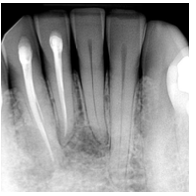
enamel pearls
Which anatomical factor?
- Can cause attachment loss in this area

bifurcation ridge
Which anatomical factor?
- Common in maxillary and mandibular molars

root concavity
Which anatomical factor?

Mesial surface of 1st premolar
Where are root concavities commonly found?
developmental groove
Which anatomical factor?
- Usually found on lateral incisors

McGuire
Which prognosis system is based on tooth loss?
McGuire
Which prognosis system shows a 5-7 year prediction accuracy of 89% and the accuracy decreases to 50% or less when the good prognosis was removed?
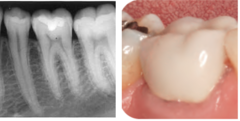
good
Which stage of McGuire prognosis?
One or more of the following:
- Etiologic Factors can be controlled
- Adequate periodontal support
- Tooth or teeth can be adequately maintained by professional and patient
- Controlled systemic factors
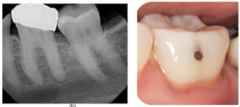
fair
Which stage of McGuire prognosis?
One or more of the following:
- Up to 25% attachment loss measured clinically and radiographically
Grade 1 furcation allows access for maintenance
- Tooth or teeth can be maintained with proper professional and home care
- Limited systemic factors
poor
Which stage of McGuire prognosis?
One or more of the following:
- Up to 50% loss has occurred
- Grade II function with difficult access to the depth and portion of the furcation
- Greater than Miller Class I mobility Poor crown to root ratio
- Lack of patient compliance
- Presence of systemic factors
questionable
Which stage of McGuire prognosis?
One or more of the following:
- Greater than 50% attachment loss
- Grade II or III furcation involvement not accessible for maintenance
- Endodontically involved tooth that must be resolved before periodontal treatment
- Tooth or teeth not easily maintained by professional and/or patient
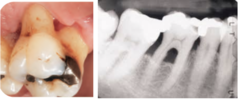
hopeless
Which stage of McGuire prognosis?
One or more of the following:
- Inadequate attachment to support the tooth
- Grade III or IV furcation involvement Miller Class III mobility
- Tooth or teeth cannot be maintained by the professional and / or the patient
good
Which stage of McGuire prognosis?
fair
Which stage of McGuire prognosis?
poor
Which stage of McGuire prognosis?

questionable
Which stage of McGuire prognosis?
hopeless
Which stage of McGuire prognosis?

Kwok and Caton
Which prognosis system?
- Believed that periodontal prognostic system has to be dynamic, suggesting that it should be re-evaluated throughout treatment and maintenance
Kwok and Caton
Which prognosis system is based on probability of disease progression?
McGuire
Which prognosis system is more "quantifiable"?
favorable
Which stage of Kwok and Caton?
The periodontal status of the tooth can be stabilized with comprehensive periodontal treatment and periodontal maintenance
questionable
Which stage of Kwok and Caton?
The periodontal status of the tooth is influenced by local and/or systemic factors that may or may not be controlled
unfavorable
Which stage of Kwok and Caton?
The periodontal status of the tooth is influenced by local and/or systemic factors that cannot be controlled
hopeless
Which stage of Kwok and Caton?
The tooth must be extracted
Kwok and Caton
These are general factors to consider for which prognosis system?
- Amount of patient compliance
- Cigarette smoking: smokers have a greater prevalence for periodontal disease and tooth loss
- Diabetes Mellitus: Patient with diabetes have a greater prevalence of periodontal disease and attachment loss
- Other systemic conditions (neutrophil disfunction, Papillon - Lefevre syndrome, Down syndrome, immunologic dysfunction)
Kwok and Caton
These are local factors to consider for which prognosis system?
- Deep probing depths and attachment
- Loss Anatomical plaque-related factors (Furcation involvement, enamel pearls, CEP, open contacts, crowding, root proximity and overhanging restorations)
- Trauma from occlusion and parafunctional habits
- Root fractures
- Mobility
I
What stage of periodontitis?
Early diagnosis can allow for early intervention and be cost effective
II
What stage of periodontitis?
Standard treatment principles and regular professional maintenance is expected to arrest disease progression
III
What stage of periodontitis?
Management is complicated and tooth loss may occur
IV
What stage of periodontitis?
Considerable damage and significant tooth loss, which means loss of masticatory function
short
Short or long term goal?
Elimination of all infectious and inflammatory processes
short
Short or long term goal?
Correction of conditions that cause and perpetuate inflammation
short
Short or long term goal?
Periodontal and other dental therapies
long
Short or long term goal?
Reconstruction of healthy dentition w/ function and esthetics
long
Short or long term goal?
Restore tissue destroyed by disease and re-establish the physiological contours necessary for preservation of periodontal health
long
Short or long term goal?
Prevent recurrence of disease and tooth loss
short
Short or long term goal?
Pain control
short
Short or long term goal?
Reduction/resolution of gingival inflammation
short
Short or long term goal?
Reduction of probing depths
short
Short or long term goal?
Elimination of open furcations
short
Short or long term goal?
Satisfactory function and esthetics
short
Short or long term goal?
Control of risk factors
10%
Ideally, ___% of sites should have BOP
25%
Ideally, we want less than ___% of BOP in the full mouth
less than 4 mm (no more than 5 mm)
What is the ideal probing depth wanted?
3mm
Ideally, furcation involvement should be less than ___ mm
evaluation of initial therapy (then surgery, SPT/recall, or retreatment)
What comes after initial perio therapy?
non-surgical phase (initial therapy)
What is the first phase of periodontal tx?
surgical phase
What is the second phase of periodontal therapy?
restorative phase
What is the third phase of periodontal therapy?
maintenance phase
What is the 4th phase of periodontal therapy?
dental emergencies (dental, periapical, periodontal, extraction of hopeless teeth)
Before phase I of perio tx, the preliminary phase is done to treat what?
Phase I (initial therapy)
Which phase of periodontal therapy?
- Patient education
- Identification and controlling risk factors
- Oral hygiene instructions
- Diet control
- Supragingival plaque and calculus removal
Phase I (initial therapy)
Which phase of periodontal therapy?
- Correction of restorative and prosthetic irritational factors
- Excavation of caries and restoration
- Antimicrobial therapy
- Occlusal therapy
- Removal of hopeless teeth
- Prophylaxis
- SRP
What are the non-surgical procedures that can be done during phase I of perio tx?
prophylaxis
Define the following:
The removal of plaque, calculus, and stains from the exposed and unexposed surfaces of the teeth by scaling and polishing as a preventive measure for the control of local irrotational factors
scaling
Define the following:
The instrumentation of the crown and root surfaces of the teeth to remove plaque, calculus and stains from these surfaces
root planing
Define the following:
The treatment procedure designed to remove cementum or surface dentin that is rough, impregnated with calculus or contaminated with toxins or microorganisms
prophylaxis
Prophylaxis or SRP?
Gingivitis patients with probing depth of 3mm or less or patients with attachment loss but no inflammation
SRP
Prophylaxis or SRP?
Periodontitis patients with at least 4mm of pocket depth, exposure of central surfaces of the roots (or loss of alveolar crest height beyond normal 2mm distance to CEJ) and subgingival calculus and/or root roughness
phase I (non-surgical)
This is a clinical response after which phase of periodontal therapy?
- Decreased gingival inflammation
- Less BOP
- Decreased PD, gain in clinical attachment
phase I (non-surgical)
This is a microbial response after which phase of periodontal therapy?
- Shift in the composition of the sub gingival microflora
- Decrease in gram negative organisms and increase gram positive
- Bactericides species are reduced but not eliminated
phase I (non-surgical)
These are procedures that are done during which phase of periodontal tx?
- Caries control
- Calculus removal
- Excessive cement
- Defective restoration
- Prosthetic irrotational factors
- Interim restoration
phase II (surgical)
These are procedures that are done during which phase of periodontal tx?
- Surgical debridement
- Resective therapy
- Regeneration
- Pre-prosthetic surgeries
- Root coverage
- Site debridement
- Implant placement
phase III (restorative)
These are procedures that are done during which phase of periodontal tx?
- Re-eval results of surgical tx
- Restorations
- Crown and bridge
- RPD
- Implant supported crowns
phase IV
These are procedures that are done during which phase of periodontal tx?
- Perio maintenance/recall 3-4 times for a year
- Perio exam (check for plaque, calculus, attachment levels, pocket depth, BOP, recession)
phase IV
These are procedures that are done during which phase of periodontal tx?
- OHI, scaling, polishing, chemical
- Schedule next procedure or recall visit (further periodontal tx, schedule or refer for restorative or prosthetic tx)