Biology Chapter 4
 Call Kai
 Learn
 Practice Test
 Spaced Repetition
 Match
 Flashcards
 Knowt Play
1/67

There's no tags or description
Looks like no tags are added yet.
68 Terms
First Law of Thermodynamics
energy is neither created nor destroyed, but can be transferred from one form to another. The total amount of energy in the universe is constant.
Second Law of Thermodynamics
states that when energy is converted from one form to another, the amount of useful energy decreases as some energy is always lost to the surroundings as heat, so entropy increases.
Energy
the ability to do work; to move matter. Energy can neither be created nor be destroyed but can be converted from one form to another. The total amount of energy in an object is the sum of potential and kinetic.
Entropy
the loss of complexity or orderliness and useful energy results in an increase in randomness, disorder, and less useful energy. This measure of randomness is referred to as entropy. Useful energy from an outside source can be infused into the system to counteract entropy.
Kinetic Energy
energy being used to do work; the energy of motion. (ex. Sound, light, thermal energy, electricity, electromagnetic radiation, and muscle contraction).
Potential Energy
Energy that is stored and available to do work. Includes energy that is stored in a molecule in its chemical bonds, the concentration gradient across a membrane (chemical gradients), gravitational energy, and electrical energy.
Endergonic Reactions
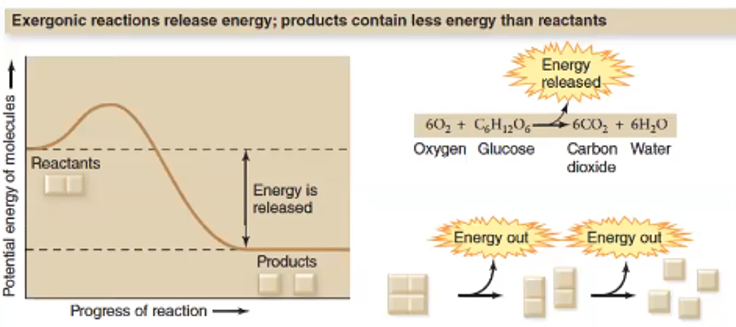
“energy in.” Require an input of energy. Potential energy is less in reactants than in products. Typically, build complex molecules from simple components. Reactions that form bonds to build molecules require energy input.

Exergonic Reactions
“energy out.” Potential energy is greater in reactants than in products. Reactions that end with a net release of energy. Break large, complex molecules into their smaller, simpler components. Even these reactions require an initial energy input, but the energy they release is more than what they require to get started. Reactions that break bonds to release energy stored in the bond.
Photosynthesis
Example of an endergonic reaction. Take carbon dioxide and water. Combine it, utilizing energy from the sun, and you make glucose, and oxygen is released. The product contains much more potential energy (glucose) compared to that of the reactants. Energy is supplied by sun (solar energy).
Cellular Respiration
Example of exergonic reaction. Glucose and oxygen are reactants. The energy in the chemical bonds of glucose is converted to a form of energy called ATP, so the energy is being released. ATP, Carbon dioxide, and water are the products. The reactants have higher potential energy compared to the products because the energy is released
Activation Energy
The minimum amount of energy needed to get a reaction started. Independent of the energy difference between reactants and products. Endergonic and exergonic reactions need activation energy, but the amount varies.
Enzymes
a protein that speeds up a chemical reaction without being consumed. Most are proteins (some RNA). Speeds chemical reactions by lowering the activation energy. Brings substrates (reactants) into contact with each other so less energy is required for reaction. Each enzyme is specific to its substrate(s). The substrates fit like puzzle pieces into the active site, and once the reaction occurs, the enzyme releases the products, ready for more substrate.
Factors that Contribute to the Enzyme Substrate Specificity
Complementary Shape/the shape of the enzyme’s active site: the substrates fit like puzzle pieces into the active site. (Ex. An enzyme that dismantles a fatty acid cannot dismantle starch).
Charge
Hydrophobic/Hydrophilic characteristics of enzymes and substrates
List the Factors that Influence Enzyme Activity
Temperature, Salinity, pH, and inhibitors
How Does Temperature Influence Enzyme Activity?
raising the temperature boosts reaction rates by increasing a substrate’s energy. But very high temperatures denature enzymes. Most enzymes have an optimal temperature, at which their activity is greatest.
How does pH Influence enzyme activity?
Each enzyme has an optimum pH range. (In humans, most enzymes work at ph 6 to 8). Wrong pH can cause the enzyme to become denatured and stop working.
How does Salinity affect enzyme activity?
salt levels affect the hydrogen bonds that hold enzymes in their three-dimensional shape. Wrong salt concentration can cause the enzyme to become denatured and stop working.
List the Mechanisms by which Enzyme Activity is Regulated To control the cells metabolism
Negative Feedback (Competitive and Noncompetitive Inhibition) and Positive Feedback
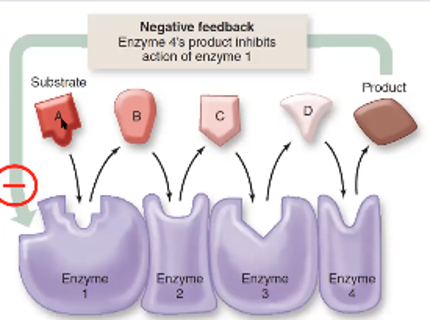
Negative Feedback (Feedback Inhibition)
the product of a reaction inhibits the first enzyme in the pathway, slowing the production of more product. It does so through competitive or noncompetitive inhibition.
Competitive Inhibition
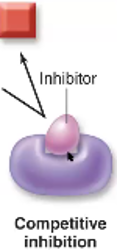
the final product binds to the first enzyme in the pathway, blocking more substrates from binding to the site. Competes with the substrate, preventing it from binding to the site.
Noncompetitive Inhibition
The final product binds to the first enzyme in the pathway at a location other than the active site (allosteric site), altering the enzyme’s shape so that it can no longer bind the substrate.

Metabolic Pathway
a connected series of chemical reactions inside a cell that takes a starting molecule (a substrate) and transforms it step-by-step through a sequence of intermediate compounds into a final product
Positive Feedback
opposite process to negative feedback. A process where the product of a reaction stimulates its own production by the final product binding to an allosteric site of the first enzyme in the pathway, stimulating the active site.

Redox Reactions
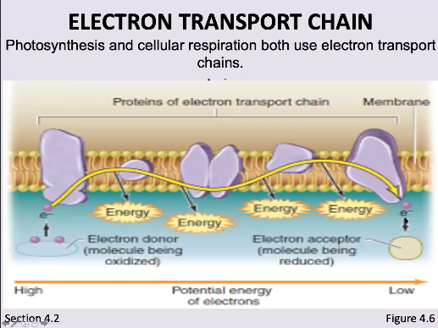
Oxidation-reduction reactions. They link an exergonic process with an endergonic one. Oxidation: Exergonic. Reduction: Endergonic. Most energy transformations in organisms occur in oxidation-reduction reactions. They occur simultaneously because electrons removed from one molecule during oxidation must join another molecule and reduce it. Chemical reaction in which one reactant is oxidized and another is reduced.
Electron Transfer Chain (ETC)
represents groups of proteins embedded in membranes involved in shuttling electrons to slowly extract their energy. In this, each protein accepts an electron from the molecule before it and passes it to the next, like a bucket brigade. During each transfer, a small amount of energy is released. Cells use this energy in other reactions. Protein losing electron becomes oxidized and a protein gaining electron becomes reduced. Formed by redox reactions.
Cofactors
Metal ions that are necessary for enzyme function. Inorganic enzyme helpers (Ex. Minerals). Reversibly react with enzymes (not consumed).
Coenzymes
Organic molecules necessary for enzyme function. Carry chemical groups, atoms, or electrons from one reaction to another in metabolic pathways (ex. vitamins, NADH, NAD+). Reversibly react with enzymes (not consumed).
Passive Transport
occurs when concentration gradients dissipate across a biological membrane. A substance moves from an area with high concentration (lots of molecules) to an area of lower concentration (less molecules). Does not require extra input of energy.
Simple Diffusion
Type of passive transport. Particles move from high concentration to low concentration (they move down their concentration gradient). Substances move across the membrane without assistance of transport proteins.
Facilitated Diffusion
passive transport that requires membrane proteins. A passive transport protein allows a specific solute (such as glucose, or any other polar/larger molecule) to follow its concentration gradient across a membrane. A gated passive transporter changes shape when a specific molecule binds to it. Releases energy because the solute moves from where it is more concentrated to where it is less concentrated.
Osmosis
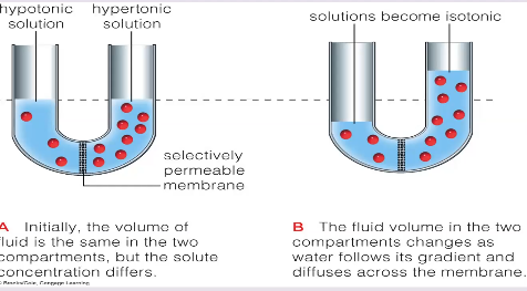
Simple diffusion of water through a selectively permeable membrane. The movement of water down its concentration gradient through a selectively permeable membrane from a region of lower solute (high water) concentration to a region of higher solute (low water) concentration. Driven by tonicity and is countered by turgor. If isotonic, no net movement. Type of passive transport.
Active Transport
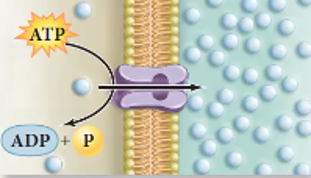
the cell uses energy and a transport protein to move a substance against its concentration gradient. Input energy comes from hydrolysis of ATP. Moves from low concentration to high concentration through the membrane.
The importance of Osmosis to all Cells
If a cell’s interior is isotonic to its surroundings, water moves into and out of the cell at equal rates.
If a cell is in a hypotonic environment, it absorbs water, so the cell may burst.
If a cell is in a hypertonic environment, then a cell loses water, shrivels, and may die.
Hypotonic Solutions
for two fluids separated by a semipermeable membrane, the one with the lower solute concentration is hypotonic.
Hypertonic Solutions
for two fluids separated by a semipermeable membrane, the one with the higher solute concentration is hypertonic. Water diffuses from hypotonic to hypertonic.
Isotonic Solutions
fluids have the same solute concentration.
Tonicity
the relative concentrations of solutes in two fluids separated by a selectively permeable membrane.
Endocytosis

the plasma membrane invaginates (folds inward) to form a vesicle that brings substances into the cell. Allows cell to engulf fluids and large molecules and bring them into the cell. Eukaryotic cells use this to transport larger molecules (ex., proteins and polysaccharides). Requires energy. There are three types: pinocytosis, receptor-mediated endocytosis, and phagocytosis
Pinocytosis
fluid is captured in a vesicle and brought into the cell; reverse of exocytosis.
Receptor-Mediated Endocytosis
specific molecules bind to the surface receptors on a cell, which are then enclosed in an endocytic vesicle.
Phagocytosis
Pseudopods engulf the large/solid target particle and merge as a vesicle, which fuses with a lysosome in the cell.
Exocytosis
the
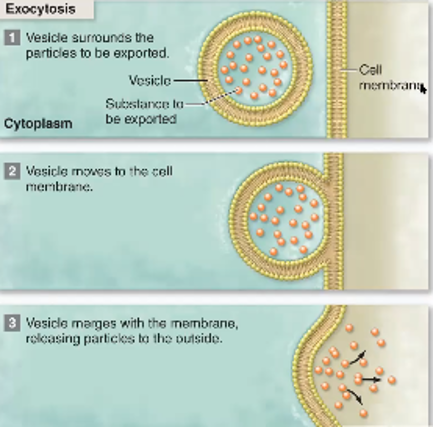
process in which material inside the cell, which is packaged into vesicles, is excreted into the extracellular environment. These vesicles are usually derived from the Golgi apparatus and fuse with cell membrane to be excreted. Eukaryotic cells use this to transport larger molecules (ex. Proteins and polysaccharides). Requires energy to move the transport vesicle.
Concentration Gradient
a difference in solute concentration between two adjacent regions, like across a membrane. A form of potential energy/important way for cells to store potential energy. Following this is when a substance moves from a more concentrated area to a less concentrated area. Cells spend ATP to create/maintain these because concentration gradients dissipate because random molecular movement (diffusion).
Chemical Energy
energy stored in chemical bonds.
Thermodynamics
Study of energy transformations.
Phosphorylation
The transfer of a phosphate group from one molecule (such as ATP) to another, causing the recipient to become energized (more likely to bond with other molecules) or to change shape. ATP fuels endergonic reactions in this way.
ATP (Adenosine Triphosphate)
a molecule whose high-energy phosphate bonds power many biological processes. Cannot be stockpiled because of its high-energy phosphate bonds, which make the molecule too unstable for long-term storage. When ATP runs low, cells divert some of their lipid and carbohydrate reserves to the metabolic pathways of cellular respiration (produces more ATP). Cellular respiration generates ATP.
Structure of ATP
Made of sugar ribose, nitrogen containing base (adenine), and a triphosphate (3 phosphate groups). The bonds between the phosphate groups are called high energy bonds (where ATP stores energy).

How Does ATP Get Hydrolyzed?
when it gets hydrolyzed, the terminal phosphate group is released, so energy is released. Once the terminal phosphate is released, ATP is converted to ADP (Diphosphate).

Calories
the energy required to raise the temperature of 1 gram of water by 1°C under standard conditions
Kilocalorie
a measure of the energy content in food; equal to 1000 calories or 1 food Calorie
Metabolism
the biochemical reactions of a cell
Oxidation
the loss of one or more electrons by a participant in a chemical reaction. Electron donor becomes this. Have a lower potential energy.
Reduction
the gain of one or more electrons by a participant in a chemical reaction. Electron acceptor becomes this. Have a higher potential energy.
Coupled Reactions
Two simultaneous chemical reactions, one of which provides the energy that drives the other. (Ex. Cells use the energy released in ATP hydrolysis to drive another reaction).
Active Site
the part of an enzyme to which substrates bind
Selective Permeability
the property that enables a membrane to admit some substances and exclude others
Diffusion
movement of a substance from a region where it is highly concentrated to an area where it is less concentrated. The dissipation of a concentration gradient by random molecular motion.
Turgor Pressure
the force of water pressing against the cell wall
Sodium-Potassium Pump
protein that uses energy from ATP to transport Na+ out of cells and K+ into cells. Example of active transport.
Induced Fit Model
when an enzyme precisely orients the substrates as they interact with the R groups in the active site either through hydrogen bonding or ionic bonding, depending on what the R group is.
Transition State
the activation energy acts on the bonds of the reactants, forcing a change. This change brings on what is called the transition state where the bonds on the reactant molecule reaches its breaking point and the reaction will run spontaneously to product.
Membrane Trafficking
the constant pinching and fusion of vesicles from the plasma membrane. Demonstrated by exocytosis and endocytosis.
Substrate
What an enzyme acts on
Metabolic Pathways
a linked, step-by-step series of chemical reactions inside a cell that converts a starting molecule into a final product.
Anabolic Pathways
a series of chemical reactions that build complex molecules from smaller, simpler building blocks
Catabolic pathways
a series of chemical reactions that break down complex molecules into simpler units to release stored chemical energy.
How do inhibitors affect enzyme activity?
Competitive inhibitors slow down the rate of reaction by competing for the active site with the substrate. Noncompetitive inhibitors slow down the rate of reaction by binding to the enzyme at a location away from the active site and changing the shape of the enzyme’s active site so the substrate no longer fits.