Eukaryotic Module 11
 Call Kai
 Learn
 Practice Test
 Spaced Repetition
 Match
 Flashcards
 Knowt Play
1/33

There's no tags or description
Looks like no tags are added yet.
34 Terms
evidence that DNA is the genetic material
in 1908, Archibald Garrod found that people with alcaptonuria lacked an enzyme in their blood that oxidized homogentisic acid, a compound formed during the breakdown of Phe and Tyr
in the 1940s, George Beadle and Edward Tatum isolated dozens of mutants in Neurospora and proposed the “one gene-one enzyme” hypothesis
in 1956, Vernon Ingram reported that a substitution of a valine for a Glu causes sickle cell anemia
the beadle-tatum experiment
isolation of genetic mutants in neurospora
helped form the idea that genes direct the production of proteins
neurospora grows in a simple medium containing a single organic carbon source (like a sugar), inorganic salts, and biotin
so it was thought that it synthesized all its required metabolites
the idea was that an organism with such broad synthetic capacity should be very sensitive to enzymatic deficiencies, which would then be detected using the proper experimental protocol
they used to radiation to damage the DNA in the spores
they screened for mutations affecting enzymes by testing their capability to grow in a minimal medium that lacked the essential compounds known to be synthesized by this organism
if a spore was unable to grow in the minimal medium, but a genetically identical sore can grow in a medium supplemented with a particular metabolic compound, then the researchers could conclude the cells have an enzymatic deficiency that prevents them from synthesizing this essential compound
out of over a thousand cells, two of the spores were unable to grow on the minimal medium; one needed pyridoxine (vitamin B6) and the other needed thiamine (B1)
out of dozens of mutants isolated, each had a gene defect resulting in an enzyme deficiency that prevented the cells from catalyzing a particular metabolic reaction
this led to the conclusion that a gene carries the information for the construction of a particular enzyme (one gene-one enzyme hypothesis)
later become the one gene-one polypeptide hypothesis once it was learned that enzymes are often composed of more than one polypeptide, each encoded by its own gene
this was also modified when it was found that a single gene often generates a variety of polypeptides as a result of alternative splicing
picture of beadle-tatum experiment

flow of information in eukaryotes
transcription: synthesis of an RNA from a DNA template
translation: synthesis of a protein from a mRNA molecule

RNAs
mRNAs: RNAs that include nucleotide code information for polypeptide synthesis
rRNAs: RNA components of ribosomes
tRNAs: RNAs that translate the information in the mRNA nucleotide code into the amino acid order of a polypeptide
other RNAs: small nuclear RNAs (snRNAs), small nucleolar RNAs (snoRNAs), small interfering RNAs (siRNAs), microRNAs (miRNAs)
structure of RNAs
many fold into a complex 3D shape, which is different from one type of RNA to another
RNA folding is driven by the formation of regions of having complementary pairs
RNAs often contain nonstandard base pairs and modified nitrogenous bases
the unorthodox regions serve as recognition sites for proteins and other RNAs, promote RNA folding, and help stabilize the structure of the molecule
transcription
DNA-dependent RNA polymerases (RNA polymerases): the enzymes responsible for transcription in both prokaryotic and eukaryotic cells
incorporate nucleotides into a strand of RNA with a sequence complementary to the template DNA strand
template: the DNA strand whose sequence is complementary to the RNA molecule synthesized from it
promoter: the site on DNA to which an RNA polymerase molecule binds prior to initiating transcription
transcription factors: the proteins that are required to help RNA polymerases to recognize promoters
also contains info that determines which DNA strand is transcribed and the site it begins at

transcription direction and energetics
catalytic rate is about 20-50 nt/s
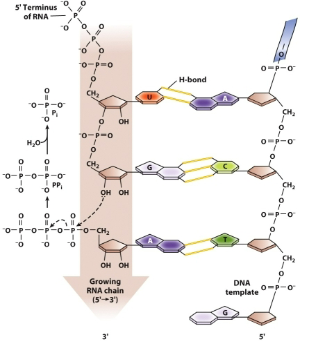
chain elongation: attack by the 3’ OH of the nucleotide at the growing strand, end on the 5’ P of the incoming nucleoside triphosphate
RNA pols move along the template strand 3’→5’ direction
as the pol progresses along, the template strand is unwound and the pol assembles a complementary strand of RNA that grows 5’→3’
overwound DNA ahead of the pol and underwound behind
favorable reactions
transcription in prokaryotes
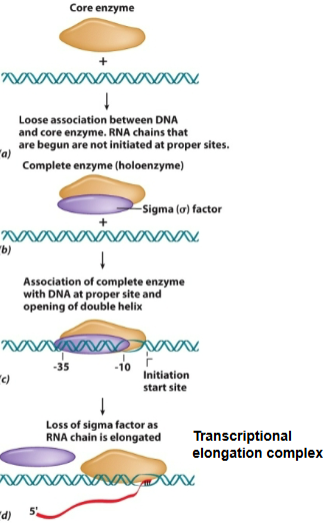
a single type of RNA pol composed of 5 subunits that are tightly associated to form a core enzyme
an accessory polypeptide, sigma factors (s), increases the enzyme’s affinity for promoter sites in DNA
the polymerase, s factor, and DNA with the strands separated is called the open complex
once about 10 nucleotides have been incorporated, the enzyme undergoes a conformational change into a transcriptional elongation complex that can move processively
the basic elements of a promoter region in the DNA of E. coli
+1 nucleotide: where transcription is initiated
-1 nucleotide: preceding the +1 nucleotide
upstream: the portions of DNA preceding the initiation site
downstream: the portions of DNA succeeding the initiation site
consensus sequence: present in the promoters of many genes
-35 element: the TTGACA consensus sequence around -35 site
pribnow box (-10 element): the TATAAT consensus sequence around -10 site

initiation and termination of transcription in prokaryotes
bacterial cells possess a variety of sigma factors that recognize different versions of the promoter sequence
sigma 70 is a “housekeeping” sigma factor that initiates transcription of most genes
alternative sigma factors initiate transcription of a small number of specific genes that participate in a common response
bacterial transcription terminates when a specific nucleotide sequence is reached
in about half of the cases, a ring-shaped rho protein is required for terminatioon
in other cases, the polymerase stops transcription when it reaches a terminator sequence and releases the completed RNA chain
RNA polymerases in eukaryotes
RNA pol I: synthesizes larger ribosomal RNAs (28S, 18S, and 5.8S)
RNA pol II: synthesizes mRNA and most small nuclear RNAs (snRNAs and snoRNAs)
RNA pol III: synthesizes various low MW RNAs, like tRNAs, 5S rRNA, and U6 snRNA
transcription and RNA processing in eukaryotes
transcription requires a large variety of accessory proteins called transcription factors
RNAs are transcribed as a longer precursor RNA transcript or pre-RNA; the corresponding segment of DNA is a transcription unit
the primary RNA transcript is processed into smaller, functional RNAs
plants have two additional RNA pols (IV and V) that are not essential for life and synthesize siRNAs
importance of rRNA
more than 80% of the RNA in most cells consist of rRNA
these rRNAs and many ribosomal proteins form ribosomes
rDNA
the DNA sequences that encode rRNA
normally repeated hundreds of times and are clustered in one or a few region of the genome
clusters of rDNA are gathered together as part of one or more irregular shaped nuclear structures called nucleoli (nucleolus is plural)
the nucleoli
produces ribosomes
most of a nucleolus is composed of ribosomal subunits that give the nucleolus a granular appearance
fibrillar center (fc): contains rDNA
dense fibrillar component (dfc): contains the nascent pre-rRNA transcripts and associated proteins
granular component (gc): contains ribosomal subunits in various stages of assembly

four rRNAs of eukaryotes
eukaryotes have 4 distinct rRNAs
three in the large subunit and one in the small subunit
28S, 5.8S, and 5S in large, and 18S in small
synthesis and processing of the rRNA precursor
the 28S, 18S, and 5.8S are carved by various nucleases from a single primary transcript, the pre-rRNA
pre-rRNA is synthesized by RNA pol I
5S rRNA is synthesized from a separate RNA precursor outside of the nucleolus by RNA pol III
the pre-rRNA has a large number of methylated nucleotides and pseudouridine residues
when the precursor is first cleaved (in humans), over 100 methyl groups have been added to ribose groups in the molecule and approx. 95 of its uridine residues have been enzymatically converted to pseudouridine
all of these modifications occur post-transcriptionally
purpose of modifications could be to protect from cleavage, promote folding, or promote interactions with other molecules
all of the nucleotides that are altered remain as part of the final products, while unaltered sections are discarded during processing
role of snoRNAs in the pre-rRNA processing
a large number of snoRNAs are packaged with particular proteins to form particles (snoRNPs, small nucleolar ribonucleoproteins), which begin to associate with the rRNA precursors before it is fully transcribed
snoRNPs function in processing of pre-rRNAs, such as removal of the 5’ end of the transcript and cleavage of the pre-RNAs
some snoRNAs are present in low abundance, and are divided into two groups
one group determines which nucleotides on the pre-rRNA will have methylated ribose
the other group determines which uridines are converted to pseudouridines
synthesis and processing of the 5S rRNA
about 120 nucleotides
in eukaryotes, the 5S RNA molecules are encoded by a large number of identical genes that are separate from other rRNA genes and located outside the nucleolus
genes are also organized in a tandem array, and alternating with nontranscribed spacers
the promoter sequence lies within the coding section of the gene
5S RNA genes are transcribed by RNA pol III, which can bind to a promoter site located within the transcribed portion of the target gene
the 5’ end of the primary transcript (pre-rRNA) is identical with that of the mature 5S RNA, but the 3’ end usually contains extra nucleotides that are removed during processing
after synthesis, the 5S RNA is transported to the nucleolus to join the other components involved in the assembly of ribosomal subunits
synthesis and processing of the tRNAs
there are about 50 different species of tRNA, each encoded by a repeated DNA sequence
tRNA genes are found in small clusters scattered around the genome
a single cluster contains multiple multiple copies of different tRNA genes
the DNA sequence encoding a tRNA is found in more than one cluster
in a cluster, tRNA genes are separated by non-transcribed spacers
the promoter sequence lies within the coding section of the gene
transcribed by RNA pol III
the primary transcript of a tRNA is larger than the final product, and pieces of both the 5’ and 3’ sides of the pre-tRNA are trimmed
sometimes a small interior piece is trimmed
all mature tRNAs have the triplet sequence CCA at their 3’ end; encoded in the tRNA gene in prokaryotes and added enzymatically after the tRNA is processed in eukaryotes
synthesis of mRNA
all eukaryotic mRNA precursors are synthesized by RNA pol II, which is composed of 12 different conserved subunits
many general transcription factors (GTFs) are required to initiate transcription along with RNA pol II
promoters for RNA pol II lie to the 5’ end of each transcription unit
a TATA box lies between 24 and 32 bases from the transcription start site
site of assembly of a pre-initiation complex (PIC) that contains the GTFs and RNA pol II
formation of the PIC
the PIC assembly starts with the binding of the TATA-binding protein (TBP) to the promoter
TBP is a subunit of the TFIID (a GTF)
TBP binding to the promoter causes a conformational change in DNA
TFIID binding enables the assembly of a complete PIC
the 3 GTFs bound to the promoter allows the binding of RNA pol II with its TFIIF
all of the GTFs together at the promoter region is referred to as the PIC
steps of PIC assembly
TFIID binds
TFIIA and TFIIB come in; A helps TBP and B bridges the gap
TFIIF comes in and then recruits RNA pol II
TFIIE and TFIIH come in; E melts DNA and H acts as a helicase

mRNA transcription
binding of the TBP to an RNA pol II promoter causes a dramatic distortion of the DNA
TBP inserts itself into the minor groove of the double helix, bending the DNA molecule more than 80 degrees
while TBP binds TATA, other subunits of the TFIID complex bind to other regions of the DNA
as long as TFIID remains bound to the promoter, additional RNA pols may be able to attach for additional rounds of transcription
specific transcription factors
a variety of specific TFs are required to bind at numerous sites in the regulatory regions of the promoter DNA to determine whether or not a PIC assembles at a promoter, and the rate the pol initiates new rounds of transcription from that promoter
termination of transcription by RNA pol II
not well understood
a transcribing RNA pol II can travel a variable/extensive distance past the point that will ultimately give rise to the 3’ terminus of the transcribed mRNA
heterogeneous nuclear RNAs (hnRNAs)
RNAs of diverse (heterogeneous) nucleotide sequence
only in the nucleus
have large MWs (up to 80S, and 50,000 nt)
pulse chase results for various RNAs
pulse for 30 min and chase 3 hours
most of the RNA in the cell is present as 18S and 28S rRNA (and small RNAs)
neither hnRNA or mRNA constitute a significant fraction of the RNA in the cell
mRNA and its precursor hnRNA constitute a large percentage of the RNA that is being synthesized by the cell at any given time
hnRNAs and mRNA are degraded after brief periods of time
half-lives of mRNA range from about 15 min to days
tRNAs and rRNAs have half-lives ranging from days to weeks
properties of mRNAs
contain a continuous sequence of nucleotides encoding a specific polypeptide
found in the cytoplasm
attached to ribosomes when they are translated
most mRNAs contain 5’ and 3’ untranslated regions (UTRs), which have important regulatory functions
eukaryotic mRNAs have special modifications at their 5’ and 3’ terminals
3’ end has a string of 50-250 adenosine residues that form a poly(A) tail
5’ end has a methylated guanosine cap
