Past Exam 3
 Call Kai
 Learn
 Practice Test
 Spaced Repetition
 Match
 Flashcards
 Knowt Play
1/57

There's no tags or description
Looks like no tags are added yet.
58 Terms
This type of movement would occur in your right foot if you touch the sole of your right foot to the medial surface of your left leg.
A. inversion
B. pronation
C. plantar flexion
D. eversion
E. dorsiflexion
F. supination
A. inversion
If you turn your hands dorsally so that you can admire the manicure done to your fingernails, you are doing this type of joint movement.
A. inversion
B. supination
C. circumduction
D. pronation
E. eversion
D. pronation
The joints between skull bones have no joint cavity and are referred to as:
A. synovial joints
B. fibrous joints
C. amphiarthrotic joints
D. ligamentous joints
E. cartilaginous joints
B. fibrous joints
How do bursae and tendon sheaths improve joint function?
A. by reinforcing and strengthening the joint
B. by reducing compression from the bones in the joint
C. by reducing fluid in the joint
D. by reducing friction on the joint
D. by reducing friction on the joint
You raise your arms laterally so that when viewed from the front (anteriorly), your body has a T shape. What joint movement have you performed with your arms?
A. extension
B. retraction
C. adduction
D. abduction
E. flexion
D. abduction
Which type of fibrous joint connects the distal end of the tibia and fibula near the ankle?
A. syndesmosis
B. symphysis
C. synchondrosis
D. gomphosis
A. syndesmosis
Gouty arthritis occurs due to:
A. Deposition of uric acid crystals in the joints
B. An infection with group A streptococcal bacteria
C. Degeneration of the articular cartilage in the joint
D. Autoimmune destruction of the synovial membrane
A. Deposition of uric acid crystals in the joints
Which type of cartilaginous joint connects the first rib and the manubrium of the sternum?
A. syndesmosis
B. synchondrosis
C. synarthrosis
D. symphysis
B. synchondrosis
The knee joint includes all of the following structures except:
A. tibia
B. patella
C. bursae
D. fibula
E. menisci
F. ligaments
G. femur
D. fibula
Which joint type (located between the atlas and axis vertebrae) allows for moving the head back and forth to the left and right when answering “no”?
A. hinge joint
B. saddle joint
C. ball and socket joint
D. pivot joint
D. pivot joint
Which of the following ligaments are found in the knee joint?
A. glenohumeral ligament
B. anterior cruciate ligament
C. stylomandibular ligament
D. radial annular ligament
B. anterior cruciate ligament
Which of the following is characteristic of osteoarthritis?
A. an autoimmune reaction causing the immune system to attack joints
B. inflammation of the synovial membrane
C. degeneration of articular cartilage
D. metabolic disorder causing the deposition of crystals into the joint space
C. degeneration of articular cartilage
Structurally, the largest, most complex joint in the body is the:
A. elbow
B. shoulder
C. hip
D. knee
D. knee
Rheumatoid arthritis can be described as all of the following except:
A. a disorder causing frequent deformities and fixation
B. an autoimmune reaction causing the immune system to attack joints
C. a degenerative disorder of large joints like the knees and back
D. inflammation of the synovial membrane
C. a degenerative disorder of large joints like the knees and back
You lift your shoulder to hold your cell phone to your ear. What type of joint movement are you doing at your shoulder?
A. elevation
B. hyperextension
C. extension
D. abduction
E. protration
A. elevation
Muscle fatigue frequently occurs due to an accumulation of:
A. ATP
B. calcium
C. lactic acid
D. oxygen
E. pyruvic acid
C. lactic acid
Creatine phosphate functions to:
A. break down ATP and release energy
B. provide energy for extended periods of exercise
C. store energy for the synthesis of ATP
D. stimulate the release of calcium from sarcoplasmic reticulum
E. detach myosin and actin after contraction has occurred
C. store energy for the synthesis of ATP
What ion enters the motor axon terminal to cause the release of neurotransmitter?
A. calcium
B. bicarbonate
C. sodium
D. potassium
A. calcium
If you are an endurance athlete, you especially rely on which type of skeletal muscle fiber to perform your sport?
A. slow glycolytic fibers
B. fast oxidative-glycolytic fibers
C. slow oxidative fibers
D. fast glycolytic fibers
C. slow oxidative fibers

Put the following levels of organization in the correct sequence from smallest to largest structures.
A. 2, 4, 5, 1, 3
B. 3, 1, 4, 5, 2
C. 1, 5, 3, 4, 2
D. 2, 4, 1, 5, 3
E. 1, 3, 5, 4, 2
F. 3, 5, 1, 4, 2
E. 1, 3, 5, 4, 2

Match the following descriptions with their correct muscle tissue type.
Automaticity; cannot undergo summation or tetany
Cardiac muscle

Match the following descriptions with their correct muscle tissue type.
Uses calmodulin; cells joined by gap junctions
Smooth muscle

Match the following descriptions with their correct muscle tissue type.
Contains dense bodies instead of Z discs
Smooth muscle
What substance must bind to myosin for the heads to detach from the thin filaments?
A. Sodium
B. Calcium
C. Troponin
D. ATP
D. ATP
Which of the following is an example of an isometric contraction?
A. pushing against an immovable wall
B. shaking the head as to say “no”
C. bending the elbow
D. rotating the arm
A. pushing against an immovable wall
Sarin is a nerve gas (chemical weapon) that inhibits acetylcholinesterase. Which of the following would you expect to occur in a person exposed to this chemical?
A. as a result of Sarin binding to ACh receptors, ions would not be able to enter the muscle cell so muscle contraction could not occur
B. Sarin would prevent the release of acetylcholine from the motor neuron, inhibiting muscle contraction
C. acetylcholine would remain in the synaptic cleft, causing prolonged muscle stimulation and contractions that could lead to paralysis
D. Sarin would enter the muscle cell and bind to the myofilaments, causing prolonged, painful muscle contractions
E. acetylcholine would be rapidly degraded in the synaptic clef, preventing muscle contraction from occurring
C. acetylcholine would remain in the synaptic cleft, causing prolonged muscle stimulation and contractions that could lead to paralysis
Once an action potential reaches the sarcoplasmic reticulum, which ions are released into the sarcoplasm?
A. calcium
B. sodium
C. bicarbonate
D. potassium
A. calcium
In order for myosin to bind to actin:
A. tropomyosin must move troponin out of the way to expose binding sites
B. troponin must move tropomyosin out of the way to expose binding sites
C. calcium ions must bind to myosin heads
D. troponin and tropomyosin must detach from actin
B. troponin must move tropomyosin out of the way to expose binding sites
In a recording of a muscle twitch, the delay between the time a stimulus is applied and the time the muscle responds is called the:
A. latent period
B. relaxation period
C. contraction period
D. refractory period
A. latent period
A sustained muscle contraction in which individual twitches cannot be detected is called:
A. wave summation
B. unfused (incomplete) tetanus
C. muscle tone
D. fused (complete) tetanus
D. fused (complete) tetanus
What neurotransmitter is used to stimulate skeletal muscle contraction?
A. tropomyosin
B. calmodulin
C. acetylcholine
D. epinephrine
C. acetylcholine
The layer of connective tissue surrounding a fascicle in the muscular system is called the:
A. endomysium
B. perimysium
C. epimysium
D. fascia
E. sarcolemma
B. perimysium

Match the following areas with their correct description. NOTE: Zones/bands are indicated by brackets, structures/lines are indicated by arrows.
A band
Label 2

Match the following areas with their correct description. NOTE: Zones/bands are indicated by brackets, structures/lines are indicated by arrows.
Z disc
Label 6

Match the following areas with their correct description. NOTE: Zones/bands are indicated by brackets, structures/lines are indicated by arrows.
Myosin
Label 5

Match the following areas with their correct description. NOTE: Zones/bands are indicated by brackets, structures/lines are indicated by arrows.
I band
Label 8
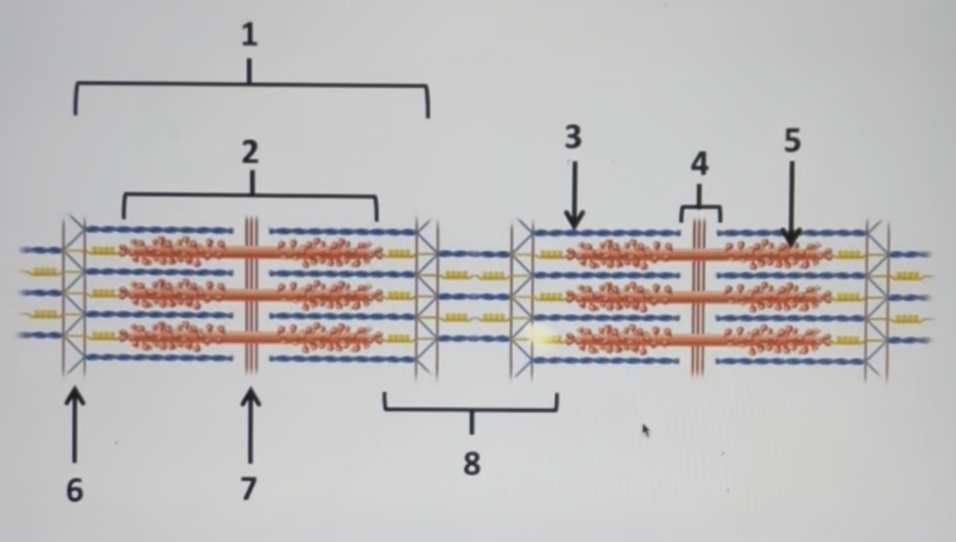
Match the following areas with their correct description. NOTE: Zones/bands are indicated by brackets, structures/lines are indicated by arrows.
M line
Label 7

Match the following areas with their correct description. NOTE: Zones/bands are indicated by brackets, structures/lines are indicated by arrows.
Actin
Label 3
Dendrotoxins released from mambas (one of the deadliest venoms in the world) can block K+ channels in neurons. What would happen as a result?
A. The neuron would be unable to release neurotransmitter from synaptic vesicles
B. The neuron could not depolarize, but it could repolarize, shortening the action potential timeframe
C. The neuron would hyperpolarize, preventing action potentials from being produced
D. The neuron could depolarize, but would not be able to repolarize so the action potential would be prolonged
D. The neuron could depolarize, but would not be able to repolarize so the action potential would be prolonged
Multiple sclerosis is a disease that results in the destruction of which glial cell type?
A. microglial cells
B. ependymal cells
C. satellite cells
D. Schwann cells
E. oligodendrocytes
E. oligodendrocytes
Which cells serve as the immune system of the nervous system and would be most responsible for removing or preventing any type of CNS infection?
A. Schwann cells
B. Microglial cells
C. Oligodendrocytes
D. Ependymal cells
E. Astrocytes
B. Microglial cells
The most rapid nerve impulses are conducted on fibers that are:
A. thin (small diameter) and unmyelinated
B. thick (large diameter) and myelinated
C. thin (small diameter) and myelinated
D. thick (large diameter) and unmyelinated
B. thick (large diameter) and myelinated
Skeletal muscle contraction is under the control of which specific division of the nervous system?
A. parasympathetic nervous system
B. somatic nervous system
C. sympathetic nervous system
D. autonomic nervous system
B. somatic nervous system
When a nerve fiber is polarized, the concentration of:
A. sodium and potassium ions is higher on the inside of its membrane
B. sodium ions is higher on the inside of its membrane and potassium ions is higher on the outside
C. sodium ions is higher on the outside of its membrane and potassium ions is higher on the inside
D. sodium and potassium ions is higher on the outside of its membrane
C. sodium ions is higher on the outside of its membrane and potassium ions is higher on the inside
Which neurotransmitter is the main inhibitory neurotransmitter in the brain, and has a receptor that can also bind alcohol and benzodiazepine drugs?
A. glutamate
B. GABA
C. adenosine
D. dopamine
E. serotonin
B. GABA
Dendrites:
A. provide increased surface area for receiving signals from other neurons
B. all of the choices are correct
C. transmit signals to the cell body
D. produce graded potentials
E. convey incoming messages toward the cell body
B. all of the choices are correct
During the RELATIVE refractory period:
A. no action potentials can be generated
B. exceptionally strong stimuli could trigger action potentials
C. the membrane is fully polarized
D. only graded potentials can occur
B. exceptionally strong stimuli could trigger action potentials
Which neuroglial cell is the most abundant and versatile cell of the nervous system, having multiple functions such as regulating the chemical environment surrounding neurons?
A. astrocytes
B. microglial cells
C. ependymal cells
D. oligodendrocytes
A. astrocytes
Which type of neuroglial cells produce and assist in the circulation of cerebrospinal fluid?
A. Oligodendrocytes
B. Satellite cells
C. Astrocytes
D. Ependymal cells
E. Microglial cells
D. Ependymal cells
Which neurotransmitter has many different types of receptors (especially in the digestive tract), is associated with mood and reproductive behavior, and is commonly impaired in people with depression?
A. GABA
B. glutamate
C. substance P
D. nitric oxide
E. serotonin
E. serotonin
Which neurotransmitter works as an endogenous opioid to inhibit pain perception in the CNS and is also associated with feelings of euphoria?
A. serotonin
B. endorphins
C. acetylcholine
D. glutamate
E. substance P
B. endorphins
Which specific division of the nervous system would be stimulated to increase heart rate and blood pressure when stressed? (think fight or flight)
A. motor
B. sympathetic
C. somatic
D. parasympathetic
E. autonomic
B. sympathetic
The processes of digesting food and producing urine are stimulated by which specific division of the nervous system?
A. autonomic
B. somatic
C. sympathetic
D. motor
E. parasympathetic
E. parasympathetic
Which neurotransmitter is amino-acid based, excitatory in many CNS synapses, and associated with learning and memory?
A. glutamate
B. substance P
C. acetylcholine
D. dopamine
E. GABA
A. glutamate
BONUS: what happens to muscles after a period of immobilization or disuse?
A. dystrophy
B. hypertrophy
C. hyperplasia
D. atrophy
E. anaplasia
D. atrophy
BONUS: How would a local anesthetic like lidocaine prevent pain?
A. It prevents the release of acetylcholine
B. It prevents the release of susbtance P
C. It blocks ion channels to prevent repolarization
D. It triggers hyperpolarization to occur
E. It blocks ion channels to prevent depolarization
E. It blocks ion channels to prevent depolarization
BONUS: Flaccid paralysis results from the lack of muscle stimulation resulting in floppy muscles that do not contract. Which of the following actions could lead to flaccid paralysis?
A. Decreasing ATP levels inside the muscle, preventing myosin head from detaching from actin
B. Increasing calcium concentrations inside the sarcolemma
C. Stimulating the ACh receptor on the motor endplate
D. Blocking the release of ACh from the presynaptic neuron
D. Blocking the release of ACh from the presynaptic neuron
BONUS: In an arthroplasty procedure considered to be a total hip replacement, which statement best describes the procedure?
A. the shaft of the femur is replaced
B. only the head of the femur is completely replaced
C. both the head of femur and acetabulum are replaced
D. only the acetabulum is replaced
C. both the head of femur and acetabulum are replaced