upper Gi imaging SDL
 Call Kai
 Learn
 Practice Test
 Spaced Repetition
 Match
 Flashcards
 Knowt Play
1/17

There's no tags or description
Looks like no tags are added yet.
18 Terms
bolus
a small rounded mass of a substance, especially of chewed food at the moment of swallowing:
"mucin holds the particles of food together in a ball or bolus"
sphincter
a ring of muscle surrounding and serving to guard or close an opening or tube, such as the anus or the openings of the stomach:
"the anal sphincter"
Peristalsis
the involuntary constriction and relaxation of the muscles of the intestine or another canal, creating wave-like movements that push the contents of the canal forward.
What is primary peristalsis
Primary peristalsis is the swallow-induced wave of coordinated esophageal muscle contractions that propels a food bolus from the pharynx into the stomach.
seconday peristalsis
If the food gets stuck, the oesophagus will distend. Local reflexes at these distention sites trigger forceful secondary waves.forceful secondary waves.
Where is the swallowing centre
The swallowing centre in the medullar oblongata is activated by pressure-sensitive sensors in the pharynx
define dysphagica, regurgitation and vommting
Dysphagia | Difficulty swallowing food or liquids. | Difficulty swallowing |
Regurgitation | Food or liquid comes back up into the mouth. | Usually effortless |
Vomiting | Forceful expulsion of stomach contents. | Involuntary, forceful action |

oesophagus gi
Normal appearance of the oesophagoscopy?

What may be seen on gastroscopy
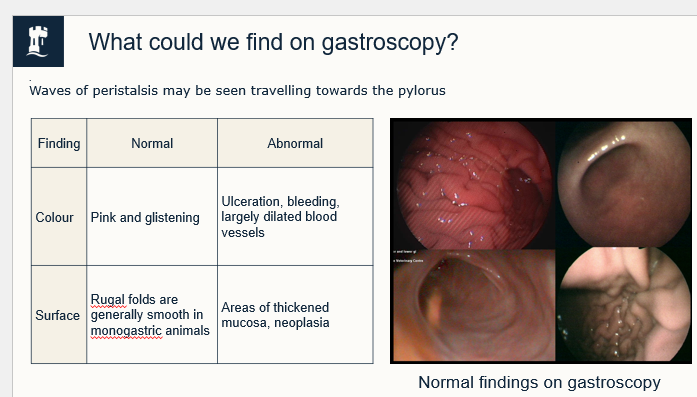
The horse stomach has a clear division between the glandular portion, and non glandular portion of the stomach called the [?]
Margo Pilcatus (pilates mum)


Oesophageal issue
OEsophagus = dorsal too trachea
Bloackes in the oesophagus + appears larger
therefore may have difficulty swallonwing

Normal radiographs showing oesophagus ands stomach

Xazier the cat

Different radiograph images

When would you use radiogrpahy, ultrasonofrepahu, endoscopy or fluoscopu..
Radiography (X-ray): Used to investigate GI disorders such as bowel obstruction, perforation and swallowed foreign bodies.
Ultrasonography (ultrasound): Used to investigate gallstones, liver disease and pancreatic disorders.
Endoscopy: Used to investigate peptic ulcers, gastritis, GORD and cancers of the oesophagus or stomach.
Fluoroscopy: Used to investigate swallowing disorders (dysphagia), oesophageal narrowing, achalasia and hiatus hernias.