5) Darcy in Clinical, Energy, & Power
 Call Kai
 Learn
 Practice Test
 Spaced Repetition
 Match
 Flashcards
 Knowt Play
1/93

There's no tags or description
Looks like no tags are added yet.
94 Terms
describe darcy’s law when applied to the cardiovascular system
CO = (MAP - CVP) / SVR
each organ’s blood supply is arranged in ________ thru capillary bed
parallel
overall resistance to blood flow of entire cardiovascular system is ________
additive
arteriolar/bronchiole resistances are in ________
parallel
what’s the organ with its portion of blood flow in series?
liver via portal vein
what’s an example of laminar flow in the body?
RBCs bc they align themselves in center of blood vessel
what’s an example of turbulent flow in the body?
aorta, ventricles due to large diameter, narrowing portions, sharp turns, angles, and high velocity

laminar flow

turbulent flow

critical RE exceeded
when does blood flow turn from laminar to bolus flow?
capillaries → single file
as heart does ________ work to pump blood thru vasculature, network ________ is overcome
mechanical, resistance
________ energy is converted into ________ energy of flowing blood
metabolic, kinetic
the right and left side CO is ________
equal
compare the work of the right and left ventricles
RV does 1/5 of work of LV

event at 1
mitral valve closes and full heart begins to contract
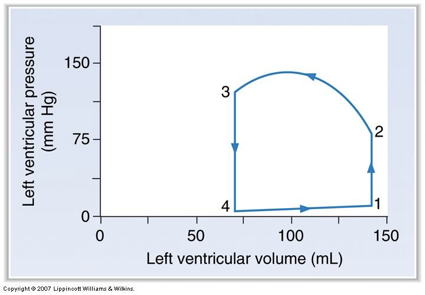
event at 2
aortic valve opens

event at 3
aortic valve closes

event at 4
mitral valve opens

ΔV from 2 to 3
stroke volume = ejection

point 4 to 1
filling

point 1 to 2
isovolumetric contraction

point 3 to 4
isovolumetric relaxation

in the cardiac pressure-volume loop, what is represented by the area within the loop
stroke work
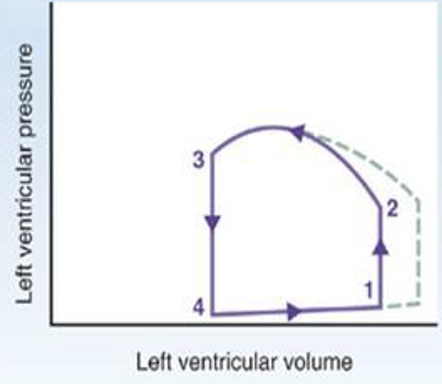
what does this pressure-volume loop show?
increased preload (increased volume or pressure before blood gets to heart)

what does this pressure-volume loop show?
increased afterload (increased resistance due to high BP or aortic stenosis)

what does this pressure-volume loop show?
increased contractility (ex: exercise, CHF)
2 types of resistance in lungs
airway resistance and tissue resistance of lungs and chest wall
airway resistance is caused by…
friction between gas molecules and airway wall
pulmonary tissue resistance is caused by…
friction encountered in lungs as tissues move against each other during expansion
what % of total lung resistance is due to tissue resistance?
20%
what % of total lung resistance is due to airway resistance?
80%
what structures cause upper airway resistance?
how much of the total resistance does it take up?
nose, turbinates, nasopharynx, oropharynx, larynx
25-40%
what structure causes lower airway resistance?
tracheobronchial tree
what are the major factors determining airway resistance?
small and medium size airways
upon inhalation, airway resistance ________ because the tethering effect causes radius to ________
decreases, increase
define tethering effect
mechanical outward pulling force exerted by the alveolar walls and elastic fibers on the outer walls of small airways
upon exhalation, airway resistance ________ because the tethering effect causes radius to ________
increases, decrease
what keeps airways from collapsing?
elastic recoil (traction from connective tissue)
what keeps alveoli open?
pressure gradient (peep)
what does PEEP stand for?
positive end expiratory pressure
in medium size airways., what influences cross sectional area?
smooth muscle tone
what alters smooth muscle tone?
autonomic nervous system
when PEEP is too low, ____ pressure will be needed to re-expand alveoli
more
how is resistance in the airway overcome?
pressure
how does rapid breathing cause hypoxia?
rapid breathing = more turbulence = more power to maintain flow rate = increased energy consumption by respiration muscles = higher O2 demands that can surpass O2 supply
what conditions can cause alterations to airway resistance?
bronchiole dilation/constriction, lung disease (COPD), pleural effusions, pulmonary edema
conditions that change airway resistance have a significant effect on…
work of breathing and ability to distribute gas throughout the lungs
a majority of airway resistance is due to…
changes in airway radii
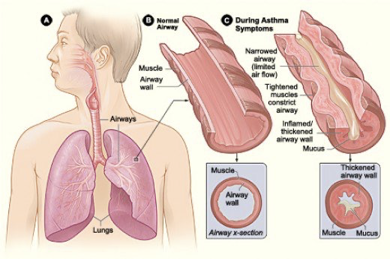
major site of resistance in tracheobronchial tree is in…
1st six generations
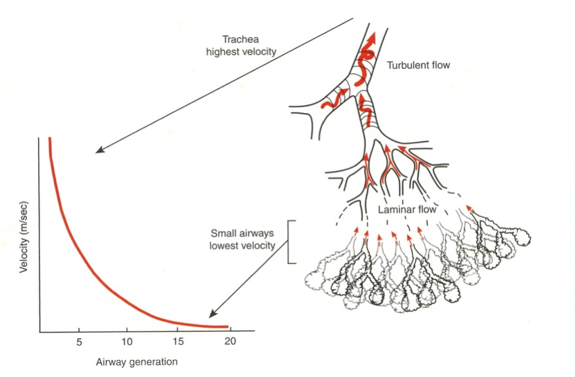
disease involving central airways has ________ impact on total resistance of lung
greatest
in terms of reynold’s number equation, turbulent flow occurs when…
high velocity, high density, large radius, low viscoity
during exhalation, velocity of airway through the trachea is ________ when compared to bronchioles and alveoli
greater

because airways are in parallel, total resistance is ____ than the sum of individual' airways’ resistances
less

why is He-O2 used clinically?
decreased density = decreased resistance = decreased likelihood of turbulent flow
opposite of compliance is…
elastance
compliance equation
C = change in volume / change in pressure
define compliance
tendency of blood vessels, airways, or the breathing circuit to become distended by an inflating force (pressure)
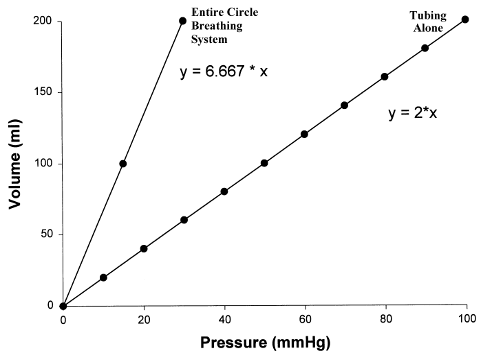
what does the slope of the line represent?
compliance

the _________ the slope, the more compliant
steeper
how much is system compliance in mL?
6.667mL/cmH2O
how do you calculate compliance lost to the system?
multiple system compliance and peak pressure (at end of inspiration)
how to calculate how much Vt a patient receives?
Vt delivered - compliance lost by system
why do you not have to worry about calculating compliance lost to the system?
new machines compensate for it
what happens in phase 1 of filling the 3L breathing bag?
3L capacity achieved
what happens in phase 2 of filling the 3L breathing bag?
pressure peaks
what happens in phase 3 of filling the 3L breathing bag?
pressure plateaus or decreases despite increasing volume
why is phase 3 of filling the 3L breathing bag beneficial?
ceiling effect provides minimal protection against high airway pressures in the patient’s lungs if APL left closed with FGF on
why is too high of pulmonary compliance a bad thing?
elastic coil is diminished so exhalation muscles do more work
why is too low of pulmonary compliance a bad thing?
work done to inhale is increased
patients with emphysema have too ____ of compliance and too ____ elastance
high, low
low compliance requires ________ pressure to achieve same volume
higher
examples of low compliance states
atelectasis, fibrosis, edema, pneumonia, surfactant deficiency
define the time constant of lung filling and what it is normally
time necessary to inflate a particular lung region to 63% of its capacity. 0.2 sec
how to calculate time constant for how well gas is moved in and out of alveoli
multiply resistance and compliance
because alveoli are all different, it takes different time for each one to fill and they have ________ time constants
unequal
work equation
W = force x distance
units of work
newton meters or joules (electrically)
define thermal energy
energy of vibrating molecules
define sound energy
energy transferred by mechanical vibration of air molecules in a wave manner
what is extracorporeal shockwave lithotripsy (ESWL)?
using ultrasound shock waves to crush urinary stones for easier elimination
define elastic energy
potential energy stored in deformed or stretched material
efficiency equation
Efficiency = (energy output / energy input) x 100%
define power
the rate at which work is done or energy is transferred
power equation
P = work / change in time where work = change in pressure x change in volume
where is CVP transduced?
junction of superior vena cava and right atrium
MAP equation
MAP = (2 x DBP + SBP) / 3
highest resistance in the airway is at level of ________
arterioles
what percent of metabolic energy is converted to mechanical energy by the heart and where does the rest go?
10%, the rest is lost as heat
what’s mechanical output of the heart at rest?
1.3W
how much energy does the heart need to power it at rest?
13W
during quiet breathing, flow is ________ in trachea and ________ in small peripheral airways
turbulent, laminar
why is turbulent flow better at purging contents of a tube?
its pressure front is a square not a cone