Weather & Climate Unit Vocabulary (6.3)
 Call Kai
 Learn
 Practice Test
 Spaced Repetition
 Match
 Flashcards
1/21

There's no tags or description
Looks like no tags are added yet.
22 Terms
How does the air higher up compare to the air near the ground?
The temperature of the air always decreases as you move away from Earth's surface and higher into the atmosphere.

Why is the air near the ground warmer than the air higher up?
Energy from the Sun is absorbed by the ground, which then increases the kinetic energy (and therefore temperature) of the particles in the ground.
Hot air density
less dense/low density

Cold air density
more dense/more density

Evaporation
The change of a substance from a liquid to a gas

What happens to water vapor in the air if we cool the air down, and why?
Water molecules are attracted to each other. When they are moving fast enough, they can break away from each other and bounce off each other. When they are moving slow enough, they clump and stick together and form snow/hail/sleet

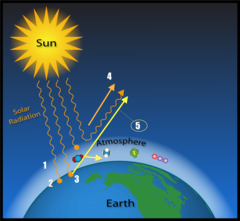
Radiation
Energy that is radiated or transmitted in the form of rays or waves or particles.
Convection
The transfer of heat by the movement of a fluid

Conduction
The direct transfer of heat from one substance to another substance that it is touching.

Weather
The state of the atmosphere at a specific place and time, including factors such as temperature, humidity, precipitation, and wind.
Temperature
A measure of how hot or cold something is, typically measured in degrees Celsius or Fahrenheit.
Humidity
The amount of water vapor present in the air, often expressed as a percentage.
Precipitation
Any form of water, liquid or solid, that falls from the atmosphere to the Earth's surface, including rain, snow, sleet, and hail.
Atmosphere
The layer of gases surrounding the Earth, which is essential for weather and climate.
Meteorologist
A scientist who studies weather patterns and forecasts atmospheric conditions.
Cloud
A visible mass of condensed water vapor floating in the atmosphere, often indicating weather changes.
Wind
The movement of air from an area of high pressure to an area of low pressure, influencing weather patterns.
Climate
The long-term average of weather conditions in a particular area, typically measured over 30 years.
Why don't water droplets or ice crystals fall from the clouds all the time?
The more mass something has, the greater the force of gravity pulling down on it.
Air moving upward (updrafts) can keep an object suspended or floating in the air.
Barometer
An instrument that measures atmospheric pressure

Density
Mass per unit volume

Cumulonimbus Cloud
Are thunderclouds and are likely to generate lightning, hail and fierce convection currents. When the cloud reaches very high levels it is composed of ice crystals which tail off in the upper wind, This is then known as the anvil.
