Western Art History Midterm Exam Terms
 Call Kai
 Learn
Learn Practice Test
 Spaced Repetition
 Match
Match Flashcards
 Knowt Play
1/93

There's no tags or description
Looks like no tags are added yet.
Name | Mastery | Learn | Test | Matching | Spaced | Call with Kai | Chat |
|---|
No analytics yet
Send a link to your students to track their progress
94 Terms
Petroglyphs
Rock Carvings
Pictographs
Rock Painting
Parietal Art
Prehistoric imagery created on walls ceilings or floors of caves (including graffiti)
Paleolithic
Old of Stone - old period of the stone age
Mesolithic
Middle period of the stone age
Neolithic
New period of the stone age
Çatalhöyük
A neolithic town that flourished
7500 BCE
Modern day Turkey
Mudbrick

Henge
Prehistoric monument consisting of a circle of stone or wooden uprights
Post and lintel construction
Tongue and groove joints

Megalith; Trilithon
Mesopotamia
Historical Region of West Asia stretching between Tigris and Euphrates Rivers
Hippopotamus
Animal
Sumer/ Sumerian
First Major civilization of Mesopotamia
Akkadia/ Assyria/ Babylon
Ancient City within southern Mesopotamia
Fell in 539 BCE
Cuneiform
Earliest known writing system developed by Sumerians around 3200 BCE
Votive/ Votive Sculptures
an object offered in fulfillment of a vow such as a candle or statue
Registers
Horizontal Bands or levels that divides a composition
Hieratic Scale
Art technique where the size of a figure indicates its importance
Relief Carving
sculptural technique where a design is carved into a flat surface
Iconoclasm; Looting
Iconoclasm - destruction of religious images or monuments
Looting - unlawful taking of property often during unrest conflict or protest
Stele
Stone ot wooden slab erected as a monument in the ancient world
Lamassu
Human headed winged bull
Tombs
tombs in ancient Egypt were designed as spaces to house the soul, protect the body and ensure immortality in the afterlife
Necropolis
a large planned cemetery with monumental tombs - city of the dead
Sarcophagus
Large stone coffin often made of granite, limestone or quartzite used to protect a mummified body
Old Kingdom
early period of Ancient Egypt
2649-2150 BCE
Middle Kingdom
2040 - 1640 BCE
Middle period of ancient Egypt
New Kingdom
1550 -1070 BCE
New Kingdom of ancient Egypt
hieroglyphs
Complex writing system combining pictorial symbols with phonetic ideographic elements
Pyramid
monumental tombs built for Pharaohs
Papyrus
a versatile plant central to ancient egyptian life
Mummification
sacred practice to preserve the body in the afterlife
Pharaoh
political and religious leaders of ancient Egypt
Orientalism
The imitation or depiction of aspects of the Eastern world by writers, designers and artists from the western world
King Djoser
Ancient Egyptian Pharaoh buried in a famous step pyramid
Khufu, Khafra, Menkaure
Pharaohs who were all buried in the Pyramids of Giza
imhotep
Ancient Egyptian Architect, physician, and high priest
Thutmose
Ancient Egyptian Sculptor
Ra
God of the Sun
Osiris
God of fertility, death and resurrection
Isis
Goddess of motherhood, magic and kingship
Horus
Son of Osiris
God of Sky, kingship and protection
Anubis
Egyptian god of funerary rites, mummification, cemeteries and the guide of souls to the afterlife
Hatshepsut
Powerful female pharaoh of the 18th dynasty known for her prosperous reign
Akhenaten and Nefertiti
Royal couple that led Amarna religious revolution promoting exclusive worship
promoted the reshaping of Egyptian art politics and culture
Tutankhamun
Son of Akhenaten and Nefertiti and Pharaoh of Egypt
Napoleon Boneparte
French general and emperor who reshaped Europe through military conquest
Archaic
refers to the period of Greek history from around 800-480 BCE marked by the rise of city states and widespread colonization
Amphora, Krater
Amphora - Two handled Jar with a neck narrower than the body
Krater - Large two handled bowl
kourus/kouroi | kore/korae
Kourus: free standing ancient Greek sculptures that depict idealized male youths
Kore/ Korae: Free standing ancient Greek sculptures depicting idealized women
Classical Period
500-323 BCE - pinnacle of Greek culture, politics, philosophy and art
Persian Sack of Athens
Second Persian Invasion of Greece - Persian Empire captured and destroyed Athens
Canon of Proportions
Mathematical and artistic system that defined the ideal human form through precise ratios
Ideal proportions
ideal distribution of weights within the human body defined by the canon of proportions
Contrapposto
Sculptural pose developed in early 5th century Ancient Greece - figure stands with more weight on one leg creating tilted hips and shoulders
Relief sculpture
figures from varying depths from a flat background
Sculpture in the round
Free-standing three-dimensional works most often marble or bronze
Perikles
A Greek Statesman, general and orator who led Athens during its Golden Age
Pheidias
5th Centruy BC greek sculptor painter and architect
Kallikrates
Prominent Athenian architect of Mid - 5th Century BCE known for Co Designing the Parthenon
Iktinos
Architect known for Co Designing the Parthenon
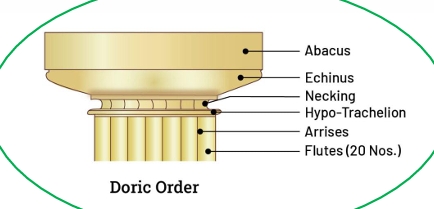
Doric
order of architecture
Doric Columns
No base
typically 20 flutes (indents in columns)
Simple design
Ionic
More complex columns
has Volutes/ rosettes that are like spirals
24 flutes
Frieze

Corinthian
Most complex form of column
Has a caulicolum which has detailed carvings

Panathenaic Procession
Religious parade of Athens
Acropolis
ancient location renowned for its monumental architecture especially the Parthenon
temple
homes for the deities and gathering spaces for worshippers
Sculptural Program
Planned and coordinated set of statues or architecture designed to convey a theme
Pediment
Triangular gable at the top of a Greek temple often filled with sculptures and decoration
Optical Refinements: entasis
Subtle convex and swelling of a columns shaft introduced to counter the optical illusion that columns are concave or thinner when viewed from a distance
Stylobate
Continuous base supporting a row of columns in Greek architecture
Triglyphs and Metopes; Frieze
Triglyph: A rectangular block in the doric frieze featuring 2 vertical channels and two half channels at the edges
Metopes: Square or rectangular panel between two triglyphs in the doric frieze
Frieze: the alteration between Triglyphs and Metopes creates a distinct rhythm within a doric frieze
Caryatids
Sculpted female figure used as an architectural support rather than a column or pilaster
Attribute
object that is usually sculpted with a god or goddess that allows them to be identified
Alexander the Great
Ancient king and military commander
Gigantomachy
mythological battle between the Olympian gods and the giants
Theatricality; Naturalism
Theatricality - Subjective, symbolic, stylized
Naturalism - realistic, representing something as it is
Spoils
rob of goods by force or violence
round arch
Semicircular curve
Barrel vault
continuous series of round arches extending in one direction
Groin Vault
intersection of two barrel vaults at right angles
Concrete
the romans perfected the creation of concrete and used it in their construction
Verism, Veristic Portraiture
Art that prioritized hyper-realism and often exaggerations of age like more wrinkles and sagging skin
Syncretism
the fusion of different cultural, religious or stylistic elements to produce a new hybrid artistic expression
Mosaic, Tesserae
Mosaics - decorative art form that arranges small colored pieces of material (tesserae) to form images and designs
Egyptomania; Cleopatra
Sustained fascination with ancient Egypt. Cleopatra’s death marked the turning point in this and allowed several romans to gain access to Egyptian culture
Propaganda
art created to persuade an audience towards a certain political viewpoint
Deification; apotheosis
artistic representation of a subject’s deification or glorification to a divine level
Forum; Fora
forum refers to the central public plaza or open space in ancient Roman cities, surrounded by temples, basilicas, markets, and other public buildings
Dome; oculus
Oculus is a circular opening at the apex of a dome
Liturgy
art created specifically for use in public worship and religious ceremony
Roman Republic
Ends when Julius Caesar dies and is assassinated on the ides of march
battle of Actium 31 BCE
Battle between the fleets of Octavian of Ancient Rome against the fleets of mark Antony and cleopatra
Roman Victory over Judea 71 BCE
Roman forces won in the Jewish-Roman war and caused the destruction and seize of Jerusalem