A&P II Exam 2 Study Guide
 Call Kai
 Learn
 Practice Test
 Spaced Repetition
 Match
 Flashcards
 Knowt Play
1/246

247 Terms
The blood distributes this
Oxygen, nutrients, waste products, hormones
The blood regulates this
body temp, pH, fluid volume
The blood provides protection for this
prevention of blood loss and infection
The average volume of blood in the body of women
4-5 L
The average volume of blood in the body of males
5-6 L
Hematocrit
means “Blood Fraction” and is a percentage of the blood component relative to total blood volume
Hemoglobin
protein in red blood cells that carries oxygen from the lungs to tissues and returns carbon dioxide to the lungs

Hematopoiesis
blood cell formation
Connective Tissue Specialized Blood
It is the fibrin threads that form during clotting that classify blood as connective tissue
Blood makes up this much of body weight
8% (1.5 gallons)
Blood has a pH between
7.25 and 7.45
You can suffer from a heat stroke if what happens?
If the body temperature rises to 106°F or higher within 10 to 15 minutes
Heat Stroke Symptoms
Throbbing headache, confusion, nausea, dizziness, body temperature above 103°F, hot, red, dry or damp skin, rapid and strong pulse, fainting, loss of consciousness
What can an untreated heatstroke damage?
your brain, heart, kidneys and muscles thus leading to death or permanent damage
Hematocrit Equation
(volume of composed element / volume of the orignal total of whole blood) x 100
Plasma makes up this much of the blood
55%
Formed elements
The non-plasmic portion that makes up the remainder of the blood
Protein makes up this much of blood plasma
9%
Albumin makes up this much of plasma proteins
60%
Globulins makes up this much of plasma proteins
36%
Gamma-globulins
antibodies released primarily by plasma cells during immune response
Alpha and Beta-globulins
transport proteins that bind to lipids, metal ions, and fat-soluble vitamins
Clotting proteins makes up this much of plasma proteins
4%
Albumin
exerts osmotic pressure to maintain water balance between blood and tissue
Clotting Proteins
fibrinogen and prothrombin which help in the formation of clots
Non-Protein Components of Plasma makes up this amount of the plasma volume
2%
Erythrocytes (RBCs)
Erythro means “red” and cytes means “cell” (not a true cell)
This is the average hematocrit value for erythrocytes under normal conditions
45%
Nutrients of plasma contains
Glucose, simple carbohydrates, amino acids, fatty acids, glycerol, and triglycerides, cholesterol, and vitamin
Electrolytes of plasma contains
Cations: Sodium, Potassium, Calcium, Magnesium; Anions: Chloride, Phosphate, Sulfate, and Bicarbonate.
Electrolytes of plasma
Helps to maintain plasma osmotic pressure and normal blood pH
Respiratory gases of plasma contains
Oxygen and Carbon dioxide
An indicator of the rate of red blood cell formation
Reticulocytes
Reticulocytes represent this much of all erythrocytes
1-2%
Erythropoietin (EPO)
regulates formation of red blood cells

Buffy Coat
a layer between the plasma layer and the layer of erythrocytes
Buffy coat makes up this of the blood
less than 1%
Leukocytes (WBCs)
Leuko means “white” and cytes means “cell” which work to help the body’s defense and immune system (4,000 – 11,000 cells)
Granulocytes
Phagocytic cells which tend to be large and short lived cells
Basophils
the rarest of WBCs and contains histamine-filled granules which act as a vasodilator and an attractant for other WBCs (Binding to immunoglobin E causes the release of histamine)
Basophils represent this much of leukocytes
0.5 - 1%
Eosinophils
important for the body’s response to parasitic worms (they contain a two lobule nuclei and granules that stain deep red with an acid dye - eosin)
Eosinophils represent this much of leukocytes
2 - 4%
Neutrophils
the most numerous for WBCs and re responsible for attacking bacteria and some fungi (stain a pale lilac with a 3 to 6 lobule nuclei and very fine granules that contain defensins and hydrolytic enzymes - lysosomes)
Neutrophils represent this much of leukocytes
50 - 70%
Agranulocytes
WBCs which lack visible cytoplasmic granules (They contain spherical or kidney shaped nuclei)
Lymphocytes
WBC that plays a crucial role in immunity (they contain a large nuclei which takes up the majority of space within the cell and are classified by their size)
Lymphocytes make up this much of WBCs
25%
T-lymphocytes
acts directly against virus infected and tumor forming cells
B-Lymphocytes
gives rise to plasma cells which produce antibodies that are released in the blood
Monocytes
helps in the defense against viruses, bacterial parasites, and chronic infections (the body’s active phagocytic cells)
Monocytes makes up this of the WBCs
3 - 8%
Platelets
helps with blood clotting
Platelets are averaged around this much in the blood
250,000 – 500,000
Platelets stay in the blood for this many days
10 days
Thrombopoietin
Regulates platelet formation

neutrophil (image)

eosinophil (image)

basophil (image)

lymphocyte (image)

monocyte (image)

Hemostasis
the stoppage of bleeding
Coagulation
the process by which blood is transformed from a liquid to a gel
Fibrinolysis
the process that breaks down clots when they are no longer needed
Plasmin
the enzyme that helps in the breakdown of clots

What is being pointed to by the pink term?
Platelets

What is being pointed to by the blue term?
Erythrocytes

What is being pointed to by the red term?
Monocyte

What is being pointed to by the orange term?
Neutrophils
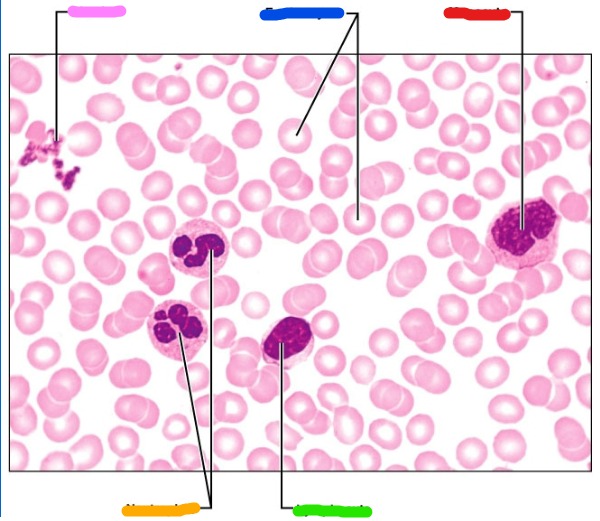
What is being pointed to by the green term?
Lymphocyte
Hemorrhagic Anemias
low levels caused by blood loss
Acute Hemorrhagic Anemias
brief incident causing blood loss (ex: stabbing)
Chronic Hemorrhagic Anemias
slow continuous loss of blood over a long time (ex: bleeding ulcer)
Hemolytic Anemias
erythrocytes rupture or lyse prematurely
Aplastic Anemias
destruction or inhibition of red marrow by certain bacterial toxins, drugs, or ionizing radiation
Iron-deficiency Anemia
anemias caused by inadequate intake of iron-containing foods (microcytes are small pale erythrocytes that are produced as a result)
Athlete’s Anemia
occurs after vigorous athletic workouts where the blood volume may increase by as much as 15%
Pernicious Anemia
resultant from a deficiency in vitamin B12 (macrocytes are large pale erythrocytes that are produced as a result)
Thalassemias
One of the hemoglobin chains is absent or faulty resulting in thin delicate erythrocytes
Sickle cell anemia
a hereditary disorder that causes the abnormal formation of the beta hemoglobin to link together under low oxygen conditions causing the blood to take on a sickle like shape
Blood doping
the practice of removal of blood for later infusion to provide a temporary state of polycythemia to increase performance in aerobic sports
Leukemia
a malignant disorder of the lymphoid tissue that is characterized by high numbers of abnormal WBCs
High WBC (leukocytosis)
may indicate viral or bacterial infection, metabolic disease, hemorrhage, or poisoning
High RBC (polycythemia)
may indicate bone marrow cancer (polycythemia vera) or the need to have more oxygen carrying blood cells due to high altitudes or less available oxygen (Secondary polycythemia)
Low WBC (leukopenia)
may indicate typhoid fever, measles, infectious hepatitis or cirrhosis, tuberculosis, or excessive antibody or x-ray therapy
Infectious Mononucleosis
“ kissing disease” a highly contagious viral disease most often seen in children and young adults caused by the Epstein-Barr virus…associated with being tired, achy, chronic sore throat and a low-grade fever. (a.k.a Mono or Cooties)
Thrombus
A clot that forms in an unbroken blood vessel
Embolus
A thrombus that floats freely in the blood vessels
Embolism
When an embolus gets to a blood vessel too small to travel through
Hemolytic disease of the newborn
when an Rh-negative mother has an Rh-positive child and becomes exposed to the blood, the mother will make antibodies targeting the next Rh-positive child
Pathway of blood from the extremities to the Lungs
Superior and Inferior Vena Cava -> Rt. Atrium -> Tricuspid Valve -> Rt. Ventricle -> Pulmonary Semilunar Valve -> Pulmonary Trunk -> Rt. and Lft. Pulmonary Arteries -> Lungs
Endocardium
membrane layered inside the heart
Myocardium (heart muscle)
the layer in between the visceral pericardium and endocardium
Visceral Pericardium (Epicardium)
the innermost layer of the pericardium that directly covers the heart’s surface
Parietal Pericardium
the outer layer of the serous pericardium (lining the inner surface of the fibrous pericardium and forming part of the pericardial sac that protects and stabilizes the heart)
Serous Fluid
a thin, pale yellow or clear, watery liquid produced by serous membranes to lubricate internal organs and reduce friction (commonly found in pleural, pericardial, and peritoneal cavities)

What is the light blue line pointing to?
Superior vena cava

What is the dark blue line pointing to?
Left lung

What is the light purple line pointing to?
Aorta

What is the dark purple line pointing to?
Parietal Pleura (cut)