11- Pediatric health assessment
 Call Kai
 Learn
 Practice Test
 Spaced Repetition
 Match
 Flashcards
 Knowt Play
1/39

There's no tags or description
Looks like no tags are added yet.
40 Terms
Health assessment
Collecting Data
By Observation (first and always)
family, child
Interviewing the Parent
any guardian
Interviewing the Child
Physical Assessment
Bio-graphic Demographics
Name, age, health care provider
Parent’s names and ages
Siblings names and ages
Ethnicity and cultural practices
Religion and religious practices
Parent Occupation
Child Occupation – Adolescent
Past medical history
Important to Gather information on:
Allergies/Immunizations/Medications**
Weight
Childhood Illness
Trauma or hospitalizations
Birth History (the younger the child is, the more prevalent it is)
Premature delivery
Babe in NICU
How long til Babe Discharged
Genetics- any investigations or concerns
Developmental Delays
Neonate age
birth to one month
Infant age
1-12 months
Toddler age
1-3 years
Preschooler age
3-6 years
School age
6-12 years
Adolescent age
12-18 years
At what age does the child’s physiology mimic an adults
12 years old and above
Principles of Communication with Children
Include the child-(use their name; consider other pertinent information)
Make communication developmentally appropriate
Get on child’s eye level (to limit power imbalance)
Approach child gently/quietly
Always be truthful (yes the shot will hurt, but well go get a sticker after)
Give child choices as appropriate- use doll or toy
Involve child and pay attention to them
Normal growth and developement
as long as they follow the growth curve and dont dip off
take into consideration culture and background
Approaching the Pediatric Patient
As always, OBSERVE first
Remain calm & confident
Don’t separate child from parent unless absolutely necessary
Infants can sit on parent’s lap
Parent close by for toddlers and older children
Establish rapport with parents AND child
Be honest (with both child and parent)
Assessment Tips: Infant
Have parent nearby, or holding baby
Warm environment; leave diaper on
Warm your hands and your stethoscope
Talk softly
Comfort measures such as pacifier
Timing around feeds may be helpful
feed then assess
Assessment Tips: Toddler
Examine on parent lap if uncooperative; do exam quickly
Greet the child by name, but pay attention to the caregiver more initially.
Use play therapy
Start with talking about something different “What a nice Diego truck you have!”
Let toddler play with equipment/BP
Observe non-verbal behaviours
Give choices and praise them frequently
Demonstrate what you will do on a caregiver, yourself, or a doll first
Assessment Tips: Preschooler
Increasing verbal communication
Keep it simple
May be able to “help”
Holding the measuring tape or stethoscope
Use games – blow out the penlight used to assess eyes, use stethoscope on teddy bear first.
Assessment Tips: School Age
Allow older child the choice if parent present
Use small talk for older children as appropriate
Ask questions about school, friends
Ask what they like to do in their free time
Explain procedures and equipment
Be patient; give choices; be honest
Again, parents can help too
Assessment Tips: Adolescent
Privacy
Provide reassurance as the body is changing rapidly
HEADSS assessment tool
Need feedback that they are healthy and normal
Communicate with care: Don’t treat them like a child, but not as an adult either
Great time for health teaching and promoting positive attitudes!
Systematic Assessment
Vital signs
Measurements
Head to Toe
Systems
Reflexes
Growth & Development
Head & Neck
Eyes/Ears
Mouth/Nose
Chest
Abdomen
Musculoskeletal
Genitalia
Elimination
Neurological
Normal Pediatric Vital Sign Ranges

Temperature
auxiliary most commons, rectal most reliable
Measuring the apical pulse

The 5th Vital Sign
PAIN
Assess subjectively and objectively
Non-verbal behaviours
Vital signs (changes from baseline)
Faces Scale (grimacing, knees up: belly pain)
Other paediatric pain scales as appropriate
over sucking relfex: indicator of pain
high pitch cry: neuro
lusty cry: normal
weak cry: no muscle tone (hypotonic)
Hypertonic
wants to stay curled up
Hypotonic
floppy baby
Measurements
head circumference, weight, legnth
Systematic approach
LOOK
Observation
position, movement, behavior, colour
LISTEN
auscultation
cry, respiratory effort
FEEL
palpation
muscle tone, skin temperature
Neurological Assessment
General level of consciousness
Behaviour/Development appropriate for age
Interest in environment
Alertness ( awake, lethargic, active, easily aroused)
Orientation (person, place, time)
Speech (slurred, clear, hoarse)
Cry (lusty, high pitched, weak)
Pupils (reactivity, size) - one of the earliest signs of ICP is increase in pupil size and decrease in pupil response to light
Movement of limbs (coordinated, purposeful, symmetric, flexed)
Ambulation (independent)
Modified Glascow Coma Scale
Strength of suck
Tone
Fontanelles

Normal: soft and flat
firm
sunken: dehydrated
bulging: increased CSF and ICP
tense
Reflexes
a. rooting
b. sucking
c. grasp
d. moro
e. tonic neck
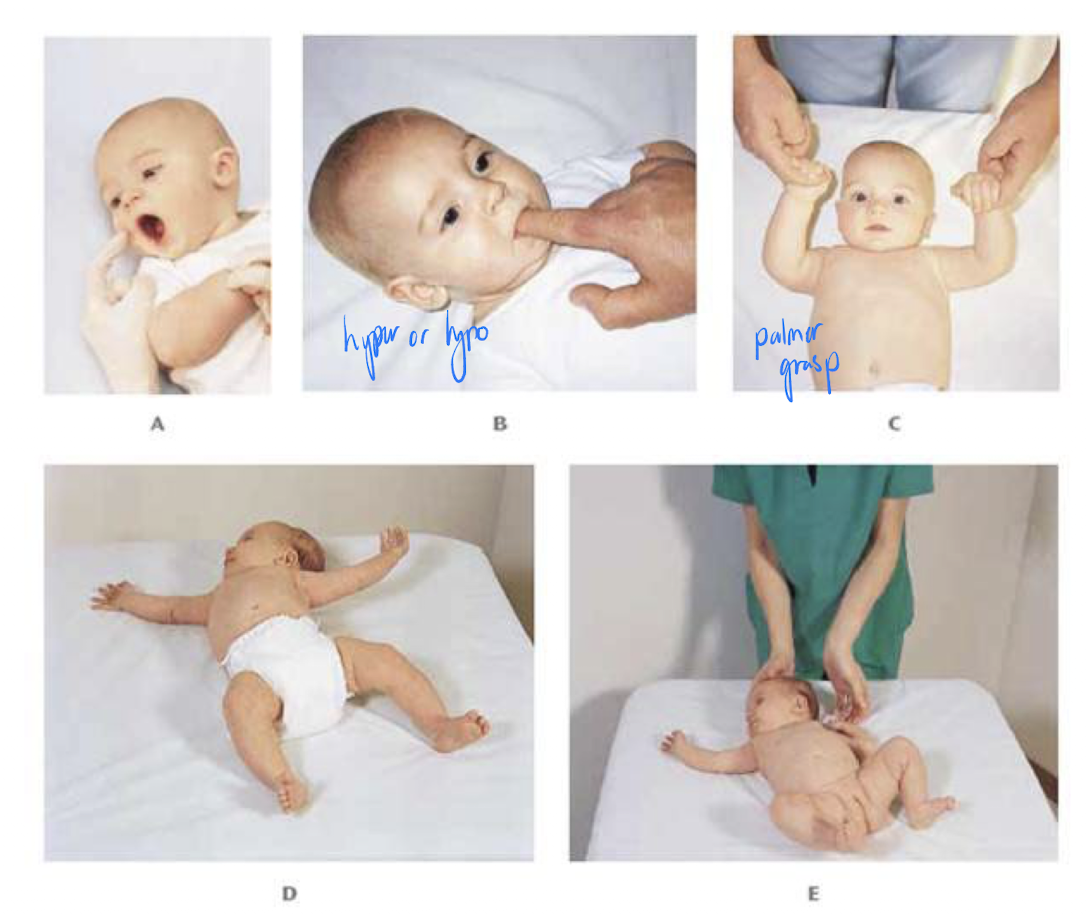
Cardiovascular Assessment
Blood Pressure (within normal limits)
Use BP machines (correct sized cuff, sensitive to movement, correct placement) chronic disase alter BP, don't charge do to acute things
Heart Rate (assess for one full minute, apical in those under 2)
Rhythm (normal sinus, sinus arrhythmia is common)
PMI - Left ventricular beat the strongest
Heart sounds (normal S1 and S2, murmurs, pericardial rub)
Cap Refill (<3 seconds) alter throughout day, easy indicator of deterioration
Skin Colour (pale, red, pink, cyanotic, jaundice, dusky)
Chest Shape (round (child), oval(infant), barrel, asymmetrical
Skin texture (rashes with description)
Joints (swelling), Edema
Skin integrity (wounds, abrasions, dressings, tubes, bruises)
Hydration State (mucous membranes - moist, dry, cracked, red, thrush)
Temperature (axilla or oral)
Peripheral pulses palpable (strength symmetry)
Resp Assessment
Rate (assess for one full minute) - most accurate while asleep
Infants & young children are primarily diaphragmatic so observe abdominal movements
Rhythm (regular, periodic, apnea)
Depth (normal, too deeply, shallow)
Auscultation
Cough with description (productive, loose, congested, etc.)
Secretions (colour, consistency, nasal discharge)
Oxygen saturations
Oxygen requirements (FiO2, delivery)
Suctioning (method, frequency)

Gastrointestinal Assessment
Abdomen (soft, round, flat, hard, distended, firm, tender with palpation)
Bowel sounds (location, frequency, quality)
Flatus
Stools (colour, consistency, amount, frequency, blood, mucous)
Diet (NG, G tube, oral, NPO, type BF, formula, amount, tolerating?)
Appetite (normal, decreased)
Emesis (colour, consistency, amount, frequency, blood, bile) chunks?
Colostomy/ileostomy (amount, stoma, colour, consistency)
Buttock & Spine
Genitourinary Assessment
Urine output (accurate, weighing diapers, 12 and 24 hour balances)
Urine (colour, odour, clarity, sediment, blood)
Pain with urination
Catheter (size, straight drainage)
Ask about urine output
External Genitalia
Signs of precocious puberty (hair growth, breast development, etc.)
Rashes
Descended testicles
Vaginal discharge
Patent anus
Patent anus
no opening, medical emergency
MSK
Coordinated movements
Casts (type, dry, site, intact, drainage)
Tone (floppy, hypotonic, hypertonic)
Ears
Ear infections common
Examine pulling pinna down and back to straighten ear canal in children <3 years of age.
Mouth
Palate, condition of teeth, brushing
Eyes
Red-reflex; strabismus; 5 years and older, vision screening