Muscle relaxant MED CHEM
 Call Kai
 Learn
Learn Practice Test
 Spaced Repetition
 Match
Match Flashcards
 Knowt Play
1/9

There's no tags or description
Looks like no tags are added yet.
Name | Mastery | Learn | Test | Matching | Spaced | Call with Kai | Chat |
|---|
No analytics yet
Send a link to your students to track their progress
10 Terms
Describe the SAR of acetylcholine at nicotinic receptors.
- Follows Ing's rule of 5 where there are 5 atoms between the nitrogen and the end of the molecule.
- Contains a charged nitrogen and H-bond acceptor.

Describe the antagonist binding site at nicotinic receptors.
Contains 2 hydrophobic pockets for aromatic rings to fit into.

How do depolarising muscle relaxants cause muscle relaxation?
Depolarising muscle relaxants cause muscle relaxation by persistently activating nicotinic receptors at the neuromuscular junction, leading to sustained depolarisation and subsequent desensitisation that prevents further muscle contraction.
Describe depolarising muscle relaxants.
- Agonists at the nicotinic receptor
- Caused prolonged depolarisation causing muscle relaxation.
Describe the SAR of depolarising muscle relaxants (agonists).
Charged nitrogens are 10-12 atoms apart, provides 2 ionic interactions

How do non-depolarising muscle relaxants cause muscle relaxation?
Non-depolarising muscle relaxants cause muscle relaxation by competitively blocking acetylcholine at nicotinic receptors at the neuromuscular junction, preventing depolarisation and subsequent muscle contraction.
Describe non-depolarising muscle relaxants.
- Competitive antagonists at the nicotinic receptors.
- Block binding of acetylcholine.
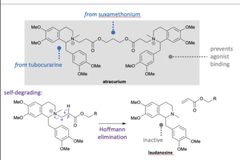
Describe the SAR of non-depolarising muscle relaxants (antagonists).
- Large size show it is an antagonist as they block binding site for acetylcholine.
- Contains an 11 atom chain between 2 charged nitrogens, similar to depolarising muscle relaxants.
- Induces opening of sodium potassium channels.
- Engineered to be self-degrading via a Hoffman elimination.
Describe the SAR of aminosteroids as non-depolarising muscle relaxants.
- Steroid skeleton acts as a spacer between 2 charged nitrogen atoms.
- Also have integrated acetylcholine into their structure.

What is an issue of aminosteroids?
- Hydrolysis of esters does not change the nitrogen functionality.
- Therefore have a long DOA.