e7 - extracting and amplifying mtDNA with PCR
 Call Kai
 Learn
 Practice Test
 Spaced Repetition
 Match
 Flashcards
 Knowt Play
1/59

There's no tags or description
Looks like no tags are added yet.
60 Terms
purpose of PCR
amplifies unique regions of DNA within a few hours
Amplified samples made from PCR allows for _____, _____, and _____.
size determination
restriction mapping
nucleotide sequencing
SiR…Mmmm…No.
back extra:
can be used in basic and applied research
applied:
DNA “fingerprinting” - forensic science
paternity determination
genetic disease dx
dna polymerase fxn
builds dna by linking deoxynucleoside triphosphates (dNTPs) along a template strand
what do you need in a PCR reaction mixture?
target DNA (purified or a crude extract)
a pair of primers specific for the target DNA
free deoxynucleotides (dATP, dGTP, dCTP, dTTP) - building blocks + energy source
heat stable DNA pol
buffer containing cofactor Mg++
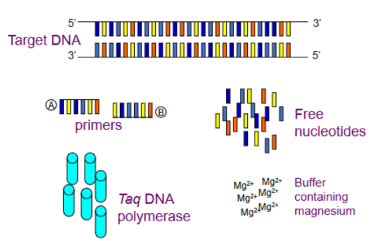
what is the heat stable DNA pol we used in this experiment
thermus acquaticuswhat
what is the cofactor we used in this experiment
Mg++


why can we use crude DNA extract for a pcr
because pcr reaction is very specific - contaminants will not amplify
why do we require a pair of primers, rather than just one
will flank/frame the sequence that you are trying to amplify
primers are around __[#]__ nucleotides in length
20
primers are designed to
flank the region to be amplified
the primer must be complementary to the ___ end of the target gene
3’
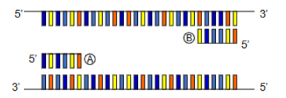
which is the primer?
smaller pieces

false - complementary to 5’, not 3’ end
what is the basic protocol for pcr reactions
DNA denaturation (separate DNA strands)
annealing of primers to DNA
extension by polymerase
repeat 30-35 times
how to denature DNA
add heat - 90 deg C
how to anneal primers
lower temp - 55 deg C
what happens during extension
temp - 72 deg C
taq pol binds to primer
taq pol synthesizes other DNA strand
why taq pol specifically?
can function in extreme heat
how many cycles does the pcr run for?
30-35
at the end of each PCR cycle, the amount of DNA
doubles
does amplification happen linearly or exponentially
exponentially (DNA doubles each round)
how to find the number of copies of DNA has been made after all the rounds have finished
2(# of cycles) = # of copies
(ex: 235 = 34 billion copies after 35 cycles)
the PCR reaction occurs in a [machine]
thermal cycler
thermal cycler fxn
cycles the temperature automatically throughout each PCR cycle
taq pol was isolated from _____ which is ______
thermus aquaticus
bacteria that grows in hot springs
What is the optimal temperature of taq DNA polymerase
75 degrees C
where are we getting our DNA sample from
mitochondria - mtDNA
nuclear DNA vs mtDNA - size
nuclear: large
mtDNA: small
nuclear DNA vs mtDNA - complexity
nuclear: complex
mtDNA: simple
nuclear DNA vs mtDNA - structure
nuclear: linear
mtDNA: small circular loop
nuclear DNA vs mtDNA - how many copies per cell?
nuclear: two copies per cell (one from each parent)
mtDNA: many copies per cell (many copies per mitochondria, many mitochondria per cell)
a small genetic change, or variation, that can occur within a person’s DNA sequence
single nucleotide polymorphism (SNPs)
SNP’s are _____ inherited in a ______ fashion
stably; mendelian
back extra:
used to study human diversity and evolution
what does it mean if a gene is stably inherited
inherited from person to person
what are the steps for e7?
total DNA isolation
mtDNA amplification by PCR
PCR product analysis by gel electrophoresis
what is our cofactor solution + how much
4 mM MgCl2
how much human DNA did we use
5 microliters
what is the pcr program for our experiment

DNA migrates to the [electrode and charge]
anode (+)
what factors influence rate of migration in agarose gel
size
conformation
agarose concentration
buffer
applied voltage
the mobility of linear DNA fragments is [proportional/inversely proportional] to ______
inversely proportional
log10 of their molecular weight
how do we view the DNA after electrophoresis
before loading - mix samples with GelRed
GelRed intercalates into DNA molecules
GelRed exitation at ~300 nm (UV rad); emission at 593 nm (red) - use fluorescence to visualize/measure
GelRed excitation at ___ nm (+ what type of radiation)
~300 (UV rad)
GelRed emission at ___ nm (+ what type of radiation)
593 nm (red)
in our experiment:
agarose concentration =
buffers =
molecular weight marker =
in our experiment:
agarose concentration = 1.5%
buffers = 1x TAE
molecular weight marker = 100 bp ladder
what is chelex
substance which removes metal ions that catalyze DNA digestion (DNAase)
when is chelex present
only in the beginning
true or false: chelex must be transfered to the PCR reaction tube
FALSE
What is the direction of synthesis of the new DNA strand in each cycle? From 5’ to 3’ or from 3’ to 5’?
direction of synthesis = 5’ → 3’
what determines the size fo the final PCR product
the # of base pairs between the left and right primers
what temperature is used to denature the DNA template
94 degrees C
what temperature is used to synthesize the new DNA strand?
72 degrees C
what temperature is used to anneal the primers?
58 degrees C
what is unique about the taq DNA polymerase
can survive high temperatures
do you need to have a pure template DNA sample (free of other DNA sequences) to allow specific amiplification of a segment of the template DNA? why or why not?
no - PCR is specific to the target DNA, so anything else present in the sample won’t get amplified
what would be the consequence if the reaction contained proteases (enzimes that can degrade proteins into amino acids)?
taq polymerase, the protein enzyme used in the reaction, would be degraded, thus significantly slowing down the reaction time— likely to such a speed that it seems to us that the reaction has stopped
what would be the consequence if the reaction contained DNases (enzymes that can degrade DNA into nucleotides)?
all the DNA components outside of the free nucleotides (samples, primers) would degrade, and the PCR reaction would not move forward.
what components need to be added to the DreamTaq PCR Master Mix (2x)
DreamTaq DNA pol
DreamTaq buffer
4 mM MgCl2
dNTPs
true or false: the amiplification of the original target DNA is exponential
true