Fluid, Electrolytes, and Acid-Base Homeostasis Part 2
 Call Kai
 Learn
 Practice Test
 Spaced Repetition
 Match
 Flashcards
 Knowt Play
1/33

There's no tags or description
Looks like no tags are added yet.
34 Terms
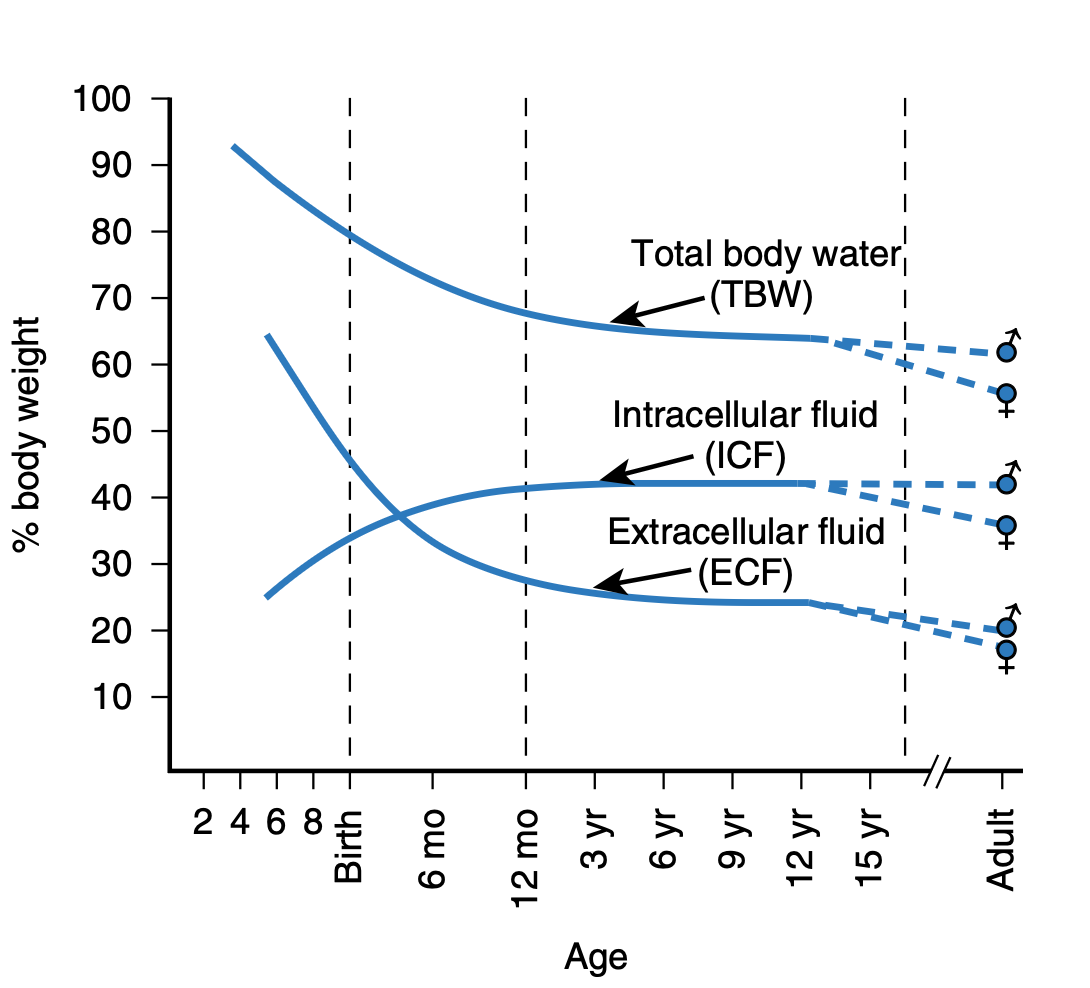
What is the Total Body water of baby according to their gestation? Why does it decrease as the infant gets older?
Early in fetal development, TBW is 95% of the total body weight.
At birth, TBW is approximately 75% of body weight in a full-term infant.
PART 2TBW decreases due to decrease in the extracellular water compartment so premature infants have higher TBW percentage than that of term infants and is proportional to gestational age.
Why do all neonates experience a reduction in body weight in the first week?
Why do they have infants decreased urine output, followed by a robust diuresis?
Due to an isotonic contraction of extracellular water.
PART 2It is part of normal postnatal adaptation mediated in part through the release of atrial natriuretic peptide.
Leading to imbalances in sodium and water homeostasis, and
in preterm infants, it may increase the risk of downstream pathology, including patent ductus arteriosus, necrotizing enterocolitis, and bronchopulmonary dysplasia.
What is the normal percentage of weight loss in term & preterm?
In term infants, this weight loss can be up to 10%.
In very premature infants, weight loss can be up to 15%
What limits preterm’s ability to concentrate urine?
The inability to adjust to fluid perturbations especially the perturbations that result in increased free water losses.
Structural immaturity of the renal medulla limits sodium, chloride, and urea movement to the interstitium.
Preferential blood flow through the vasa recta limits generation of a medullary gradient.
Diminished urea-generated osmotic gradient in the renal medulla limits production and maintenance of the countercurrent mechanisms that are essential in producing maximally concentrated urine.
Tubular responsiveness to vasopressin is diminished because of decreased transcription and protein synthesis of aquaporin 2 water channels
What is insensible water loss and where does it occur most of the time?
What are some factors affecting it?
Insensible water losses are primarily evaporative losses via the skin and respiratory tract. In newborns, one-third of insensible water loss occurs through the respiratory tract, and the remaining two-thirds occurs through the skin.

What is the difference between total sodium content and serum sodium concentration?
The total sodium content determines the volume of the ECF while the serum sodium concentration, which reflects only the relative relationship between salt and water
Where in the kidney is sodium re-absorbed?
First in the proximal tubule and then additionally in the loop of Henle using the Na+-K+-2Cl− cotransporter (which is the therapeutic target of loop diuretics)
Thirdly in the distal convoluted tubule, sodium is further reabsorbed via the sodium chloride cotransporter, the therapeutic target of thiazide diuretics.
Where is the major site of Na regulation in the kidneys? What hormone works then and how?
The major site of fine regulation of sodium reabsorption is the collecting tubule, wherein aldosterone acts on the principal cells to promote reabsorption through sodium channels located on the luminal membrane.
Why do preterm infants have negative balance and hyponatremia in the first 2-3 weeks of life? What are the mechanisms responsible for increased urinary sodium loss?
Due to high renal sodium losses
Inefficient intestinal sodium absorption.
MECHANISMSThe immature kidney has glomerulotubular imbalance (GFR) exceeds the reabsorptive capacity of the renal tubules.
(Due to renal tubular immaturity, large extracellular volume, and reduced oxygen availability. Decreased responsiveness to aldosterone is also characteristic of fetal and postnatal kidneys compared with adult kidneys and results in a decrease in sodium reabsorption)
Other than the regular mechanism or prematurity, what else causes urinary sodium losses?
Certain conditions
Hypoxia
Respiratory distress
Hyperbilirubinemia
Acute tubular necrosis
Polycythemia.
Pharmacologic agents such asDopamine,
Beta blockers
Angiotensin-converting enzyme inhibitors
Diuretics may also increase urinary sodium losses in
neonates.
What is ADH? Where is it made and how does it relate to the newborn?
ADH also called antidiuretic hormone controls water absorption in the collecting duct
ADH secretion is regulated by hypothalamic osmoreceptors that monitor serum osmolarity and baroreceptors of the carotid sinus and left atrium that monitor intravascular blood volume.
ADH is also stimulated when serum osmolarity increases to greater than 285 mOsm/kg or when effective blood volume is significantly diminished.
At baseline, when the serum osmolarity and effective blood volume status are normal, the collecting duct is impermeable to water but when (ADH) produced in the hypothalamus binds to arginine-vasopressin V2 receptor, located on the basolateral membrane, it renders them permeable to water.
What are the factors that determine formation of urine in preterms?
The degree of renal function
The renal solute load (the calories, TFI and where energy is derived from TPN vz catabolism)
Why don’t we usually give sodium in the first 1-2 days of life? What is then the purpose of the sodium given after the first few days?
Most newborns are already in a relatively volume-expanded state
Very premature infants already have increased water losses and early administration of sodium supplementation is associated with an increased risk of hypernatremia.
Sodium supplementation initiated after the first few days of life helps improves somatic growth in the neonatal period and improved neurodevelopmental outcomes.
What needs to be in place before potassium can be administered?
Urinary flow has been established
A normal renal function is ensured
A normal serum potassium is confirmed.
What are some indicators to assess for fluid status?
Heart rate
Blood pressure
Skin turgor
Capillary refill
Oral mucosa integrity,
Fullness of the anterior fontanelle
What is normal urine output and urine specific gravity for the first few days of life?
What amount of weight loss is expected for term infant & premature infant (especially VLBW)
Urine output of approximately 1 to 3 mL/kg/h
Urine specific gravity of approximately 1.008 to 1.012
Approximate weight loss of 5% in term infants and 15% in premature infants with very low birth weight.
When babies fluctuates too often between hypo & hypernatremia, what are somethings we’re worried about?
Long-term neurologic outcomes.
Hypernatremia, rather than rapid changes in sodium (up to 15 mmol/L/day), has been identified as an independent risk factor for intraventricular hemorrhage
What are the top main causes of hyponatremia?
(1) An inability to excrete a water load
- due to decreased effective arterial blood volume preventing the suppression of ADH secretion
(2) Excessive sodium losses
(3) inadequate sodium intake.
(4) Decreased fluid delivery to the distal nephron diluting segments.
- Due to decreased GFR caused by acute kidney injury (AKI)
- Due to increased proximal tubular fluid and sodium reabsorption associated with volume depletion.
(5) Defects in sodium chloride transport in the cortical and medullary ascending limb of the loop of Henle
- When this occurs, it is difficult to produce an osmotic gradient for distal water absorption via the countercurrent multiplier which indirectly limit the diluting capacity of the nephron.
When a baby is hyponatremic, what are some things you might start thinking ?
After physical assessment, I would inquire as to why baby is hyponatremic
For example is there hyponatremia and volume depletion should = receive increased fluids. But if its hyponatremia & oliguric
AKI = fluids restricted.
Does lab ALWAYS get accurate sodium measurement in the neonate? Why?
With Labs, serum sodium is measured indirectly using an ion-selective electrode - this method assumes that water comprised 93% of plasma volume but this is not true as there are atypical protein or lipid content (especially when it comes to premature neonates)
This leads to an overestimation of the plasma sodium concentration. The end result is pseudonormonatremia or pseudohypernatremia for these infants.
POC on the other hand, measures sodium directly and are thus more likely to be accurate in samples with abnormal protein or lipid content, compared with samples sent to the lab
What are some factors that contributes to increased free water load leading to hyponatremia?
Increased maternal free water intake during labor
Excess free water administration in the postnatal period
Perinatal nonosmotic release of vasopressin. (especially in conditions such as perinatal asphyxia, respiratory distress, bilateral pneumothoraces, and intraventricular hemorrhage, or with various medications, including morphine, barbiturates, or carbamazepine.
Conditions that lead to pathologic urinary sodium losses such as
- Bartter syndrome (inherited tubulopathies) or
disorders of aldosterone production (congenital adrenal hyperplasia) or responsiveness (pseudohypoaldosteronism)
Tell me all about aldosterone
Aldosterone is a steroid hormone produced in the adrenal cortex.
It helps maintain sodium and potassium homeostasis in the kidney.
It is usually produced when there is either volume depletion, via the renin-angiotensin-aldosterone axis, or an increase in serum potassium.
It works by activating apical epithelial sodium channels on the luminal (urinary) surface and allows sodium to be reabsorbed
Potassium on the other end is an intracellular cation that is excreted through the process called aldosterone-mediated increase in the activity of basolateral Na+, K+-ATPase.
Aldosterone also helps in acid-base homeostasis and promotes hydrogen secretion via actions on H+-ATPase.
Abnormalities in either the production of, or the renal responsiveness to, aldosterone can result in variable degrees of renal sodium wasting, hyperkalemia, and metabolic acidosis
What is Congenital adrenal hyperplasia? What does it have to do with fluid imbalance? What do we notice and what investigations do we do?
Congenital adrenal hyperplasia is an inherited disorder of cortisol synthesis that results in diminished aldosterone production.
When aldosterone is not produced, the body can’t maintain sodium and potassium homeostasis in the kidney.
Congenital adrenal hyperplasia occurs when there is a complete absence of 21-hydroxylase activity, a key enzyme in the production of aldosterone
When it affects females, they tend to have ambiguous genitalia at birth because of excess adrenal androgens - they also tend to presence with shock and severe hyponatremia, hyperkalemia, and metabolic acidosis at 1 to 3 weeks of age due to a salt-losing crisis.
Labs include elevated plasma levels of renin, adrenocorticotropic hormone, 17-hydroxy-progesterone, progesterone, androstenedione, and urinary 17-ketosteroids with undetectable serum cortisol and aldosterone.
Treatment includes correcting volume and electrolyte abnormalities, including fluid resuscitation and management of life threatening hyperkalemia.
Long-term glucocorticoid and mineralocorticoid
replacement therapy should be initiated
Sodium supplements may be necessary for a prolonged period.
Pseudohypoaldosteronism (PHA) refers to a group of
disorders characterized by renal tubular unresponsiveness to
aldosterone as evidenced by hyperkalemia, metabolic acido-
sis, and variable degrees of renal sodium wasting. PHA can
be primary (genetic) or secondary (acquired). The two sub-
types of primary PHA include type I, which usually mani-
fests in infancy with hypotension, severe sodium wasting,
and hyperkalemia, and type II (Gordon syndrome), which
typically presents later in childhood. Autosomal domi-
nant type I PHA, previously designated the “renal” type I,
is the most common type I PHA. Patients with this form
usually present during early infancy with failure to thrive,
weight loss, vomiting, dehydration, or shock. Sweat and
salivary electrolytes are normal in this form of type I PHA.
Although it is inherited as an autosomal dominant trait,
expression may be variable. Treatment involves administra-
tion of large quantities of sodium chloride (10–15 mEq/
kg/day). Autosomal recessive type I PHA, previously des-
ignated “multiple target organ defects” type I PHA, is a
severe, life-threatening systemic disease that affects sodium
and potassium handling in the kidney, sweat glands, salivary
glands, nasal mucosa, and colon.45 Patients with this disor-
der usually present in the newborn period with severe salt
wasting and life-threatening hyperkalemia. They also have
increased sweat chloride, which may mimic the presenta-
tion of cystic fibrosis. Sodium chloride supplementation
alone often is inadequate in controlling hyperkalemia and
metabolic acidosis in these patients. Dietary restriction of
potassium intake and the use of rectal sodium polystyrene
sulfonate resin (kayexalate), a sodium-potassium exchange
resin, are often required. Indomethacin or hydrochloro-
thiazide may be necessary to control hyperkalemia and
acidosis. Mutations in multiple different genes have been
implicated in the pathogenesis of PHA type 1, including
What is Pseudohypoaldosteronism (PHA) and it’s correlation with fluid imbalance?
Its a term used to categorised any disorders caused by renal tubular unresponsiveness to aldosterone and it can be genetic (type 1 = during infancy with hypotension, severe sodium wasting, and hyperkalemia) and type II (Gordon syndrome), which typically presents later in childhood or acquired.
Infants presents with failure to thrive, weight loss, vomiting, dehydration, or shock. Sweat and salivary electrolytes
Treatment includes lots of sodium chloride, and hyperkalemia correction (sometimes can mimic presentation of cystic fibrosis)
Correction of hyperkalcemia includes the use of rectal sodium polystyrene ulfonate resin (kayexalate), a sodium-potassium exchange
Indomethacin or hydrochlorothiazide may be necessary to control hyperkalemia and acidosis.
Acquired or secondary PHA include unilateral renal vein thrombosis, neonatal medullary necrosis, urinary tract malformations, pyelonephritis, or other tubulointerstitial diseases.
Patients with congenital obstructive uropathies such as posterior urethral valves are particularly prone to exhibiting aldosterone resistance, manifesting as a hyperkalemic metabolic acidosis, even in the face of relatively intact renal function.
What are some causes of hypernatremia (especially early vs late hypernatremia)
Hypernatremia in general happens due to
Increased insensible or urinary water losses
Inadequate water intake
Excess sodium administration.
In the first week of life, hypernatremia is due to
1. Increased insensible water losses
2. Excess parenteral sodium intake.
3. Medications such as calcium gluconate, gentamicin, dopamine, dobutamine, heparin, and intravenous fluids used to maintain arterial or venous vascular lines
Hypernatremia in the later first month is due to
1. Excess sodium supplementation
2. Inadequate free water intake.
We hear a lot about diabetes insipidus (DI), what is it and what does it have to do with Fluid and electrolyte imbalance?
DI is when there is lots of water losses that the body has an inability to produce concentrated urine.
It happens due to either low level of circulating ADH (central DI) or impaired renal response to ADH (nephrogenic DI).
So newborns with central or nephrogenic DI presents with hypernatremia, polyuria, polydipsia, chronic dehydration, irritability, fever, poor feeding, and growth failure.
Nephrogenic DI are congenital or they occur due to processes that cause renal tubular damage such as mutations in the gene encoding the vasopressin receptor.
Nephrogenic DI can also be due to congenital structural disorders such as obstructive uropathy or nephronophthisis, chronic kidney disease, hypercalcemia, and hypokalemia.
Treatment of nephrogenic DI includes placement on a low sodium formula to reduce solute intake and resultant obligate water loss associated with solute excretion.
Thiazide diuretics are also used to reduce extracellular sodium content, which enhances sodium reabsorption in the proximal tubule and diminishes sodium and water delivery to the distal nephron.
Prostaglandin inhibitors have used to treat nephrogenic DI (but not for long term).
Central DI are caused by midline central nervous system malformations, anoxic encephalopathy, cerebral edema, or trauma.
Desmopressin acetate (DDAVP) is generally an effective therapy for this condition, and DDAVP responsiveness can help distinguish central versus nephrogenic causes when the underlying etiology is unclear.
What are some neonatal conditions that could lead to fluid & electrolyte imbalance ?
Perinatal Asphyxia
Hyperbilirubinemia
Symptomatic Patent Ductus Arteriosus
Bronchopulmonary Dysplasia
Abdominal Wall Defects
How does perinatal asphyxia contributes to neonatal fluid & electrolyte imbalance ?
When a baby experiences kidney injury due to oxygen deprivation around birth, the kidneys may produce very little urine. Therefore, fluid intake must be carefully managed to prevent excess fluid from building up in the baby's body.
Perinatal asphyxia = Renal parenchymal injury & Acute tubular necrosis / AKI —> Oliguria or anuria.
What are some treatment options for Hyperkalemia? Which one would help in the case of significant arrhythmia?
Insulin given with glucose
Sodium polystyrene sulfonate resin (kayexalate)
Sodium bicarbonate if metabolic acidosis is present
Peritoneal dialysis.
If a significant arrhythmia is present,Calcium chloride
Calcium gluconate infusion is also indicated to antagonize the toxic effects of hyperkalemia on the cardiac membrane.
True or False
Hyponatremia is one of the complications of therapeutic hypothermia and has been associated with positive fluid balance, possibly related to decreased insensible losses from skin vasoconstriction. Which is why we don’t give cooling kids too much TFI cz they won’t be able to get rid of the fluids
TRUE
How does hyperbilirubin contributes to neonatal fluid & electrolyte imbalance ?
Hyperbilirubinemia = The need for phototherapy = Possible dehydration or need for intravenous fluids to decrease bili levels
Phototherapy itself may increase insensible fluid losses
How does Symptomatic Patent Ductus Arteriosus contributes to neonatal fluid & electrolyte imbalance ?
PDA
- A PDA can cause excessive pulmonary blood flow, and fluid overloadcan make the clinical consequences ofthat shunt worse. (Which is why it’s often too hard to wean them off ventilators)
-