10 Hybrid Lenses
 Call Kai
 Learn
 Practice Test
 Spaced Repetition
 Match
 Flashcards
 Knowt Play
1/71

There's no tags or description
Looks like no tags are added yet.
72 Terms
What is the basic design and clinical goal of a hybrid contact lens?
A hybrid lens combines a spherical GP center bonded to a soft lens skirt.
GP center: provides clear, rigid-lens-quality vision
Soft skirt: improves comfort
Overall goal: “Clear GP vision with soft lens comfort.”
What are the key dimensions and design features of the hybrid lens shown?
Posterior optic zone: 7.0 mm
RGP diameter: 8.4 mm
Junction lift area: approximately 0.75 mm
The junction is where the rigid GP center joins the soft skirt.
The posterior optic zone helps distribute and support the weight of the lens.

Which SynergEyes hybrid lens families are used for regular versus irregular corneas?
Regular corneas:
Duette
Duette HD
Duette Progressive
SynergEyes iD
Single vision
Multifocal EDOF
Irregular corneas:
UltraHealth
What does EDOF mean in the SynergEyes iD multifocal design?
EDOF = Extended Depth of Focus.
The SynergEyes iD line for regular corneas is available in:
Single vision
Multifocal EDOF
EDOF extends the range of usable focus rather than relying only on sharply separated focal zones.
What refractive findings make a patient a strong candidate for a hybrid contact lens?
Corneal cylinder matches spectacle cylinder
Up to 6.00 D of corneal cylinder may be corrected
Approximate spherical power range: +10.00 DS to −15.00 DS
Which visual complaints suggest that a patient may benefit from a hybrid lens?
Blur caused by soft toric lens rotation
Halos or glare at night
Contact-lens vision that is worse than spectacle vision
Previous contact-lens dropout because of poor visual acuity
Desire for better or more stable vision
Which occupational or lifestyle demands may make a patient a good hybrid-lens candidate?
Patients whose work or hobbies require consistently precise vision, including:
Frequent overhead viewing, such as mechanics, carpenters, and medical assistants
Extensive computer work, such as engineers, architects, and graphic designers
Precision-dependent activities, such as athletics and hunting
How should the initial base curve be selected when fitting Duette or SynergEyes iD hybrid lenses?
Select a base curve approximately 0.50-0.75 D steeper than flat K.
How is the initial Duette skirt selected using HVID?
HVID ≤11.7 mm: choose 8.4 / flat skirt
HVID ≥11.8 mm: choose 8.1 / medium skirt
Never begin with a steep skirt
How does initial skirt selection differ between Duette and SynergEyes iD?
Duette: Use HVID to select among flat, medium, or steep skirts, but do not select steep initially.
SynergEyes iD: Skirt selection is also based on HVID, but the design provides more skirt options.
What is the optical design of the Duette Progressive hybrid lens?
Duette Progressive is a center-near multifocal hybrid lens with:
A 3.0 mm aspheric center-near add zone
A surrounding distance aspheric zone
An 8.4 mm GP center
A 14.5 mm overall diameter
What base curves and skirt curves are available for Duette Progressive?
Base curves: 7.1-8.3 mm in 0.1 mm increments
Skirt curves:
8.7 = Flat 2
8.4 = Flat
8.1 = Medium
Pattern: A smaller numerical skirt radius means a steeper skirt.
What distance and add powers are available for Duette Progressive?
Distance powers: +5.50 to −10.00 D
Powers greater than −8.00 D are available in 0.50 D steps
Add powers: +1.00, +1.75, and +2.50 D
What are the material, UV-protection, and replacement characteristics of Duette Progressive?
GP center: Dk 130
Silicone hydrogel skirt: Dk 84
Class II UV blocker:
Blocks more than 80% of UVA
Blocks more than 95% of UVB
Daily wear
Replace every 6 months
What is the fitting philosophy for the Duette hybrid lens, and how is the initial base curve selected?
Duette uses an alignment-fitting philosophy.
Base curves are available in 0.1 mm increments
The initial base curve is usually 0.25–0.50 D steeper than flat K
What are the major design and dimensional features of the Duette HD lens?
Front- and back-surface aspheric design
8.4 mm GP diameter
14.5 mm overall diameter
SoftCushion outer landing zone
GP center is bonded to the soft skirt with HyperBond
What base curves and skirt curves are available for Duette HD?
Base curves: 7.10–8.30 mm in 0.1 mm steps
Skirt curves:
8.7 = Flat 2
8.4 = Flat
8.1 = Medium
What lens powers are available for Duette HD, and how do the power increments change?
Overall range: +10.00 to −15.00 D
+8.00 to −8.00 D: 0.25 D steps
+8.50 to +10.00 D: 0.50 D steps
−8.50 to −15.00 D: 0.50 D steps
What are the material, UV-protection, wear, and replacement characteristics of Duette HD?
GP center: Dk 130
Silicone hydrogel skirt: Dk 84
Contains UVA and UVB blockers
Daily wear
Replace every 6 months
What design features make empirical fitting possible with Duette lenses?
Alignment fitting of the GP center
Consistent centration from the soft skirt
Lens power calculated from the relationship between flat K and the lens base curve
Application of familiar GP and soft-lens fitting principles
Use of corneal diameter/HVID to select the skirt
What are the three main steps in empirically selecting a Duette diagnostic lens?
Base curve: Select from the flat corneal curvature measurement, typically 0.50 D steeper than flat K, but no more than 0.75 D steeper
Skirt curve: Select according to corneal diameter/HVID
≤11.7 mm: 8.4 flat skirt
≥11.8 mm: 8.1 medium skirt
Lens power: Begin with the spherical component of the spectacle prescription, then compensate for the tear lens created by the base curve-to-flat-K relationship
How does fitting a Duette base curve steeper than flat K affect tear-lens power and the ordered lens power?
A base curve steeper than flat K creates a plus-powered tear lens.
Therefore, compensate by ordering more minus lens power:
SAM: Steeper Add Minus
Example: A lens fitted 0.50 D steeper than flat K creates approximately +0.50 D of tear-lens power, so add approximately −0.50 D to the lens power.
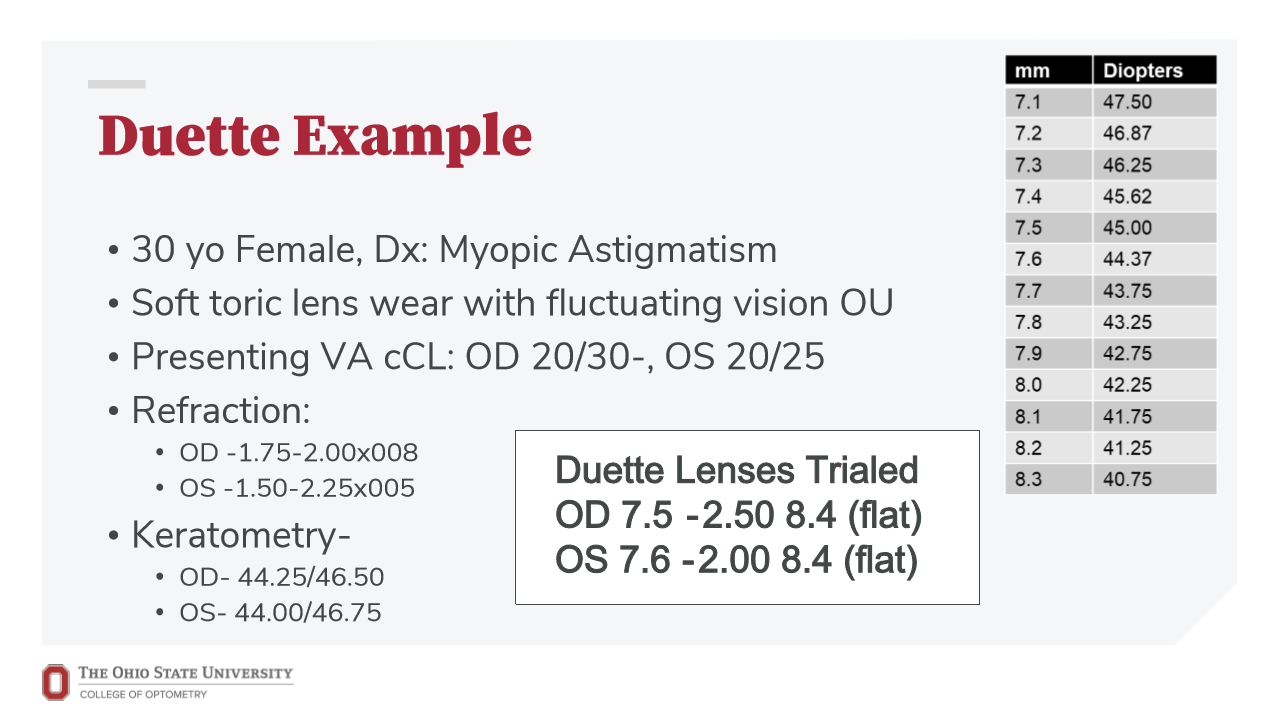
For the example patient, how were the initial Duette base curves and powers selected?
OD
Flat K = 44.25 D
Trial base curve = 7.5 mm = 45.00 D
Base curve is 0.75 D steeper than flat K
Spectacle sphere = −1.75 D
Compensate for the approximately +0.75 D tear lens by adding −0.75 D
Trial lens: 7.5 / −2.50 / 8.4 flat
OS
Flat K = 44.00 D
Trial base curve = 7.6 mm = 44.37 D
Base curve is approximately 0.37 D steeper than flat K
Spectacle sphere = −1.50 D
Add minus to compensate for the plus tear lens
Trial lens: 7.6 / −2.00 / 8.4 flat

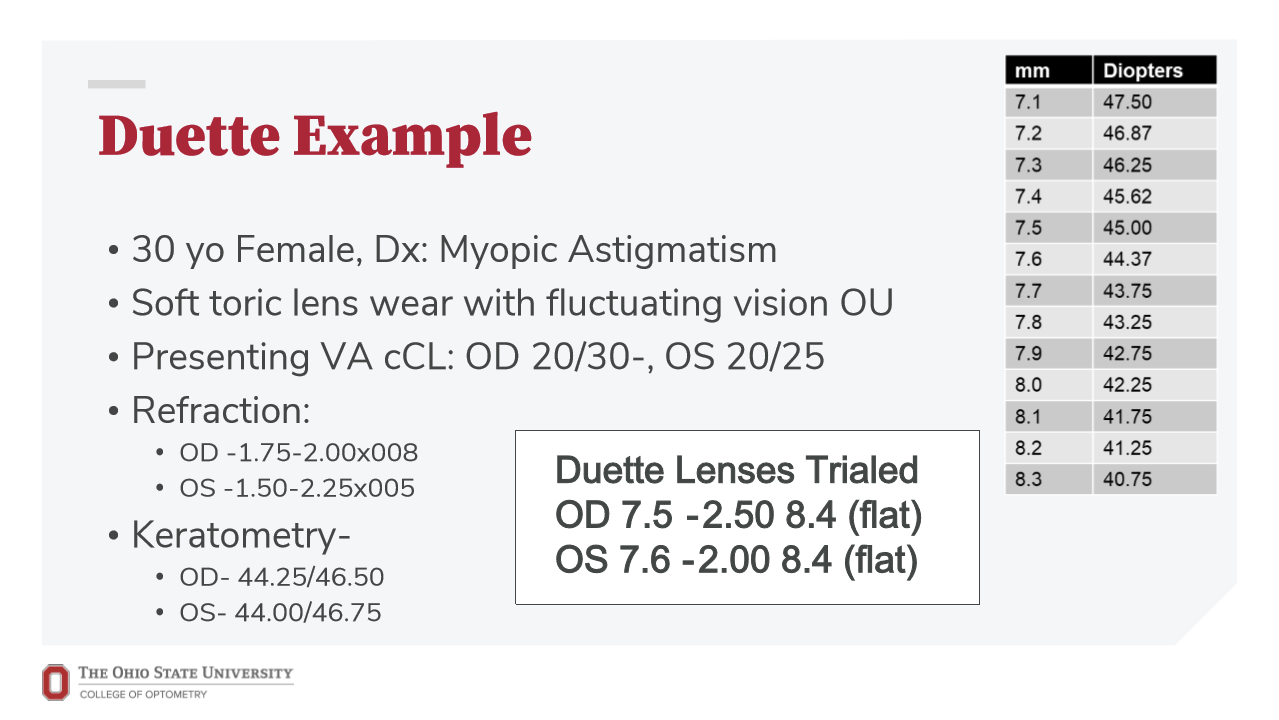
Why were spherical Duette lenses selected for a patient with approximately 2.00–2.25 D of refractive cylinder?
The refractive cylinder closely corresponds to the corneal cylinder:
OD: K readings 44.25/46.50 = 2.25 D corneal cylinder
OS: K readings 44.00/46.75 = 2.75 D corneal cylinder
The rigid GP center and resulting tear lens neutralize the corneal astigmatism, so the initial Duette lens power is based primarily on the spherical component of the spectacle prescription, with adjustment for the base curve-induced tear lens.
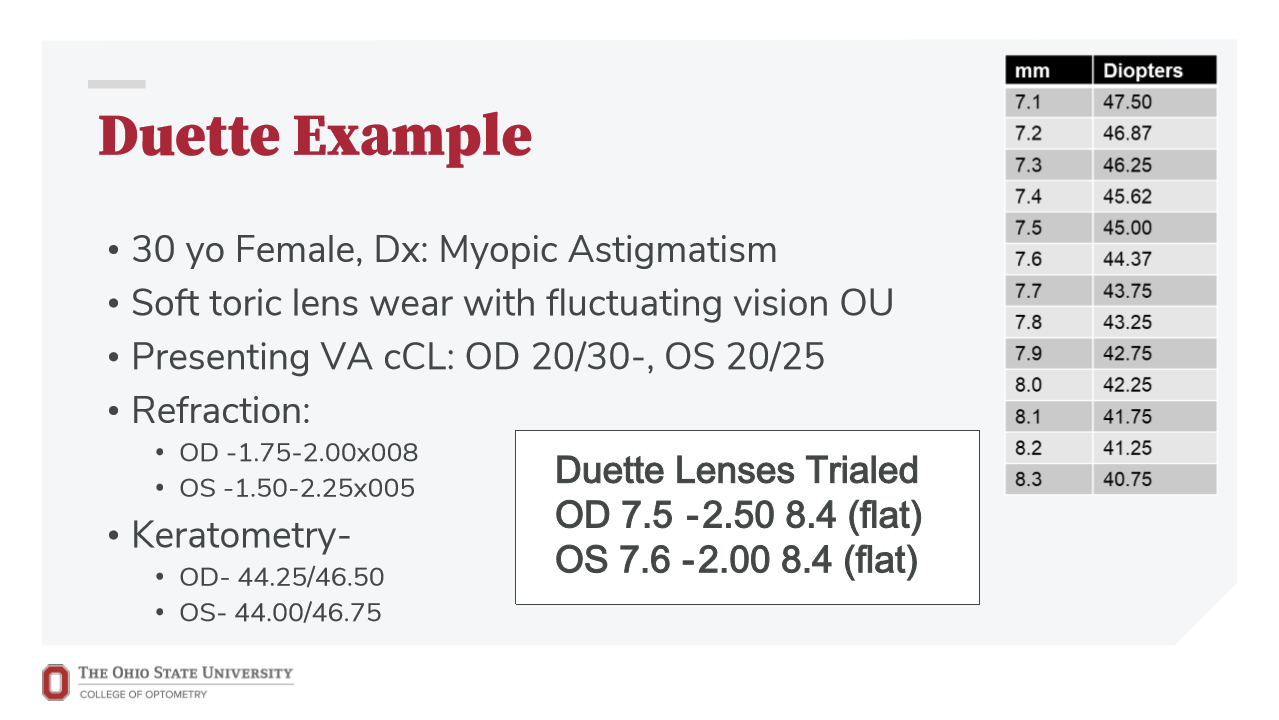
What are the key design features and dimensions of the SynergEyes iD hybrid lens?
8.5 mm GP diameter and back optic zone
14.5 mm overall diameter
GP center joined to the skirt by the HyperBond junction
Silicone hydrogel soft skirt
Linear precision skirt personalized according to the patient’s HVID
How does the SynergEyes iD linear skirt differ from traditional hybrid-lens skirts?
Traditional skirts are available only in a few fixed curve options, whereas the SynergEyes iD uses a precision linear skirt individualized to HVID.
Skirts range from 38 to 49 in one-step increments.
The range accommodates HVIDs from 10.0 to 13.0 mm.
A lower skirt number is flatter.
A higher skirt number is steeper.
There is no need to choose only among flat, medium, and steep categories.
How are the initial base curve and skirt selected for a SynergEyes iD lens?
Base curve: Begin near mid-K, but do not select a base curve more than 1.00 D steeper than flat K.
Skirt: Select the personalized linear skirt according to HVID.
What SynergEyes iD fitting changes are made for poor centration or improper movement?
Decentered lens: Steepen the base curve by 0.50 D, then compensate the power using SAM/FAP.
Desired movement: approximately 0.5 mm with a blink or nudge.
Too little movement: Decrease the skirt number by 2 to flatten the skirt and increase movement.
Too much movement: Increase the skirt number by 2 to steepen the skirt and decrease movement.
What three patient measurements are needed to order a SynergEyes iD lens empirically?
K readings
HVID measured to 0.1 mm
Manifest refraction, including the add for a multifocal order
What parameters are available for empirical SynergEyes iD orders?
Base curve: 7.10–8.30 mm in 0.10 mm increments
Linear skirt: 38–49 in one-step increments
Skirt range accommodates HVIDs from 10.0–13.0 mm
An HVID outside that range defaults to 10.0 or 13.0 mm, whichever boundary is applicable
What single-vision and multifocal powers are available for SynergEyes iD?
Single vision
Overall range: +10.00 to −15.00 D
+8.00 to −8.00 D: 0.25 D steps
+8.50 to +10.00 D: 0.50 D steps
−8.50 to −15.00 D: 0.50 D steps
Multifocal
Overall range: +5.50 to −10.00 D
+5.50 to −8.00 D: 0.25 D steps
−8.50 to −10.00 D: 0.50 D steps
Add powers: Low, Medium, and High
What optional features are available for SynergEyes iD, and when is the Enhanced Profile used?
Tangible Hydra-PEG coating: available upon request
Enhanced Profile: creates a thicker GP lens to reduce flexure and mask greater amounts of corneal cylinder
Enhanced Profile is automatically added with ≥2.50 D of corneal cylinder
Enhanced Profile may be requested with smaller amounts of corneal cylinder
What is the optical design of the SynergEyes iD MF EDOF lens?
The SynergEyes iD MF EDOF is a center-near multifocal with a patented non-monotonic, non-periodic power profile.
Non-monotonic: power does not change continuously in only one direction.
Non-periodic: power variations do not repeat in a regular pattern.
The lens power instead varies continuously and rapidly across the optic.
How does the SynergEyes iD MF EDOF power profile differ from other multifocal designs?
SynergEyes iD MF EDOF: continuously and rapidly varying, non-monotonic and non-periodic power profile
Zonal concentric multifocal: periodic power changes with discrete, broad zones of the same power
Aspheric multifocal: monotonic, progressive change in power
What are the intended visual benefits of the SynergEyes iD MF EDOF design?
Good vision across all viewing distances
Reduced visual disturbances, including ghosting and halos
More consistent performance across different:
Pupil sizes
Degrees of lens decentration
Individual ocular aberrations
How can over-refraction help determine whether the GP portion of a hybrid lens is too steep?
If the spherical over-refraction is −1.00 D or more minus relative to the vertexed spectacle sphere, the GP base curve is likely too steep.
The steep base curve produces excessive plus tear-lens power, requiring additional minus on over-refraction.
Is fluorescein required to assess GP alignment in a hybrid lens?
No. Fluorescein is not necessary to judge GP alignment.
The fit can be evaluated using:
Over-refraction relative to the vertexed spectacle sphere
Lens centration
Lens movement
Soft-skirt appearance and edge behavior
How do you recognize an appropriate, too-flat, or too-tight hybrid-lens skirt?
Appropriate skirt: smooth alignment without edge fluting; appropriate movement
Skirt too flat: edge fluting or edge lift
Skirt too tight/steep: little or no movement with blinking or the push-up test
How should a decentered hybrid lens be managed?
Re-verify the GP base curve
If the base curve is correct, steepen the skirt
If the base curve is incorrect, adjust the GP base curve
How should excessive or minimal movement of a hybrid lens be managed?
Excessive movement: steepen the skirt
Minimal movement with good comfort and adequate wearing time: make no change
Minimal movement with poor comfort or inadequate wearing time: flatten the skirt
How should initial discomfort with a hybrid lens be managed?
Educate the patient that some initial adaptation may be necessary.
If the skirt shows edge fluting, steepen the skirt.
If the skirt appears too tight, consider flattening the skirt.
How should late-day discomfort with a hybrid lens be evaluated and managed?
Evaluate for and treat ocular dryness.
Assess skirt movement and edge appearance:
No movement with reduced comfort: flatten the skirt.
Edge fluting: steepen the skirt.
What should be evaluated when cylinder is found during over-refraction of a hybrid lens?
Determine whether the spectacle cylinder matches the corneal cylinder.
Consider GP-center flexure, especially when corneal cylinder is greater than 2.25 D.
If flexure is present:
Use the Enhanced Profile with increased center thickness.
An aspheric posterior surface also helps resist flexure.
When should the GP base curve be flattened based on the spherical over-refraction?
Flatten the GP base curve when the over-refraction requires more than −0.75 D relative to the vertexed spectacle sphere.
This additional minus suggests that the current GP base curve is too steep, producing excessive plus tear-lens power.
Which patients are candidates for UltraHealth hybrid lenses, and what is the lens’s overall fitting concept?
UltraHealth is designed for irregular corneas, especially conditions such as keratoconus.
Uses an aspheric reverse-geometry vaulted design
Vaults over the corneal apex and clears many ectatic corneas
Centers the optics over the visual axis
Requires a diagnostic fitting set
What are the major structural components of the UltraHealth lens?
Reverse-geometry aspheric GP center
Inner landing zone (ILZ)
SoftCushion outer landing zone
Peripheral silicone hydrogel skirt
HyperBond junction connecting the GP center to the soft skirt
The reverse geometry provides central vault, while the landing zones and skirt support and center the lens.
What clinical and material features characterize UltraHealth?
Facilitates an active tear pump
GP center: Dk 130
Silicone hydrogel skirt: Dk 84
Class II UVA and UVB blocker
Available since 2012
Designed to provide GP-quality optics with soft-skirt comfort for irregular corneas
What diameter and vault parameters are available for UltraHealth?
Overall diameter: 14.5 mm
GP diameter: 8.5 mm
Optic zone: 6.0 mm
Vault range: 50–550 μm
Vaults are available in 50 μm increments

What lens-power range and power increments are available for UltraHealth?
Overall power range: +10.00 to −20.00 D
+10.00 to +2.50 D: 0.50 D steps
+2.00 to −8.00 D: 0.25 D steps
−8.50 to −20.00 D: 0.50 D steps
How is support distributed across an ideally fitting UltraHealth lens?
SoftCushion/soft skirt: provides approximately 70–80% of the lens support
Inner landing zone (ILZ): provides approximately 20–30% of the lens support

What is the correct order for evaluating and adjusting an UltraHealth fit?
Evaluate and correct central vault first
After achieving the proper vault, evaluate the ILZ and soft skirt
Adjust the skirt only after the vault is correct
What findings characterize an ideal UltraHealth fit?

What happens when the UltraHealth skirt is too steep, and how does the support pattern change?
Support shifts too far outward toward the soft skirt.
Approximate support split becomes 90% skirt / 10% ILZ.
The elevated peripheral area provides inadequate balanced support.
The lens may “crash” or settle excessively after wear.

What happens when the UltraHealth skirt is too flat, and what clinical finding results?
Support shifts inward, too close to the GP-soft skirt junction.
Approximate support split becomes 40% skirt / 60% ILZ.
Excess pressure develops in the inner landing zone.
This produces excess ILZ bearing, seen as a prominent annular bearing ring.

Compare the support distributions of an ideal, too-steep, and too-flat UltraHealth skirt.
Ideal: 70–80% soft skirt / 20–30% ILZ
Skirt too steep: approximately 90% skirt / 10% ILZ → lens may crash after wear
Skirt too flat: approximately 40% skirt / 60% ILZ → excess ILZ bearing
Recall:
Too steep = support too far out.
Too flat = support too far in.
How can UltraHealth lenses be ordered or fitted empirically?
100% empirical fitting: A lens can be designed and ordered without using a fitting set.
Empirical consultation: The provided measurements can be used to recommend a starting trial lens from the diagnostic set.
If a trial lens is used, evaluate the fit and perform an over-refraction to determine the final lens power.
Why is UltraHealth fit according to sagittal depth rather than radius of curvature?
UltraHealth uses a reverse-geometry design, so the central fit is determined mainly by sagittal depth/vault, not a conventional base-curve radius.
This allows:
Desired apical clearance
Flatter optic zones
Crisper vision
Recall: UltraHealth = fit by sagittal depth, not base curve.
What information should be submitted for empirical UltraHealth lens design?
Corneal topography, as a PDF or raw data
Keratometry readings
Corneal eccentricity data, such as:
E or E²
CEI
Shape factor
Q value
Manifest refraction, or previous RGP/scleral base curve, power, and over-refraction
HVID
If available, previous RGP or scleral data with base curve and over-refraction to improve power estimation
Why is empirical power determination less predictable for UltraHealth than for a regular-cornea hybrid lens?
Determining lens power empirically over an irregular cornea is inherently less accurate.
If available, provide previous RGP or scleral lens parameters and over-refraction, because those data improve the initial power estimate. The final lens power may still require an over-refraction with the trial lens in place.
Which patients may benefit from the UltraHealth FC design?
UltraHealth FC may benefit patients with flat central corneas, including:
Post-radial keratotomy
Post-refractive surgery
Peripheral ectasia, whether postsurgical or from another cause
Penetrating keratoplasty corneal grafts
DSEK
Other irregular-cornea conditions
When should UltraHealth FC be considered instead of standard UltraHealth?
Consider UltraHealth FC when:
A patient has a flat central cornea that cannot be fit successfully with standard UltraHealth.
The peripheral cornea is relatively steep and is unsuitable for the standard UltraHealth geometry.
What is the proper technique for inserting a hybrid contact lens?
Place the lens on the tip of the index finger, similar to inserting a soft lens.
If desired, place a drop of preservative-free lubricant in the lens bowl.
Pull down the lower eyelid and gently place the lens onto the eye.
Release the eyelid and blink several times.
What is the proper technique for removing a Duette hybrid lens?
Ensure the fingers are completely dry.
Pinch the bottom of the soft skirt at the 5 and 7 o’clock positions.
Keep the finger pads together while pinching.
Hold the pinch for a count of two, then lift the lens away from the eye.
Dry the fingers again before removing the second lens.
What should a patient do if a Duette lens is difficult to remove?
Improve grip by drying the fingers thoroughly. A tissue may be used to help keep the fingers dry if removal remains difficult.
How frequently should hybrid contact lenses be replaced?
Replace hybrid lenses every 6 months.
What is Hydra-PEG, and what is its main purpose on a hybrid contact lens?
Hydra-PEG is a polyethylene glycol polymer coating that is covalently bonded to the lens surface.
The hydrophilic polymer attracts water.
This improves surface wettability.
The coating is estimated to last about 1 year, although durability varies, especially with heavy deposits.
What care instructions help preserve the Hydra-PEG coating?
Do not rub heavily.
Do not rinse or store the lens in water.
Do not store the lens dry.
Use only Hydra-PEG-approved solutions.
Which solutions are compatible with hybrid lenses that do not have Hydra-PEG?
Hydrogen peroxide systems, such as Clear Care
Multipurpose solutions, such as Biotrue or Opti-Free
Artificial tears as needed
Additional cleaning products may be required for significant lipid or protein deposits.
Which care solutions are approved for hybrid lenses with Hydra-PEG?
Tangible Clean
SimpLus
Unique pH
Clear Care
Clear Care Plus
Which cleaning products are contraindicated with Hydra-PEG-coated hybrid lenses?
Alcohol-based cleaners
Abrasive cleaners
Extra-strength cleaners
Enzymatic cleaners
Progent
Unapproved multipurpose solutions, including Opti-Free, because the formulation may damage the coating
How are lipid or protein deposits managed on hybrid lenses, and how does Hydra-PEG change the options?
Evaluate the lens for lipid and protein accumulation.
For lenses without Hydra-PEG, alternative cleaning products such as LensFresh or enzymatic cleaners may be considered when necessary.
Enzymatic cleaners are contraindicated with Hydra-PEG.
Replace hybrid lenses every 6 months.