Biolab Chapter 29
 Call Kai
 Learn
 Practice Test
 Spaced Repetition
 Match
 Flashcards
 Knowt Play
1/60

There's no tags or description
Looks like no tags are added yet.
61 Terms

This is a flatworm from Phylum ___, Class ___, Genus ___ (Planaria). The phylum’s name refers to flatworms.
Platyhelminthes, Turbellaria, Dugesia

The head is considered ___ (anterior/posterior), where the mouth is located on the ___ region (midventral / middorsal). This is different from many bilaterians (organisms that exhibit bilateral symmetry) in which the mouth is usually on the head.
anterior; midventral
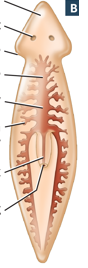
The gastrovascular cavity has three main branches (one ___ and two ___ —- anterior/posterior), and the little branches coming off them are called the ___.
anterior; posterior; diverticula

This organism, called ___, has ____ digestion (complete/incomplete); therefore, the waste comes out the ___.
planaria; incomplete; mouth
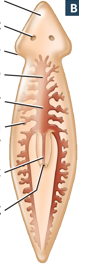
Planarian does not have a respiratory or a circulatory system. Therefore, its flattened body allows ___ and ___ ___ to diffuse and has a highly branched ___ ___ which helps distributes nutrients.
oxygen; carbon dioxide; gastrovascular cavity

Planarian has two eyespots, which are ____, which means perceives light. It also has two auricles, which are ___ and ___, meaning they detect chemicals and touch.
photoreceptors; chemoreceptors; mechanoreceptors
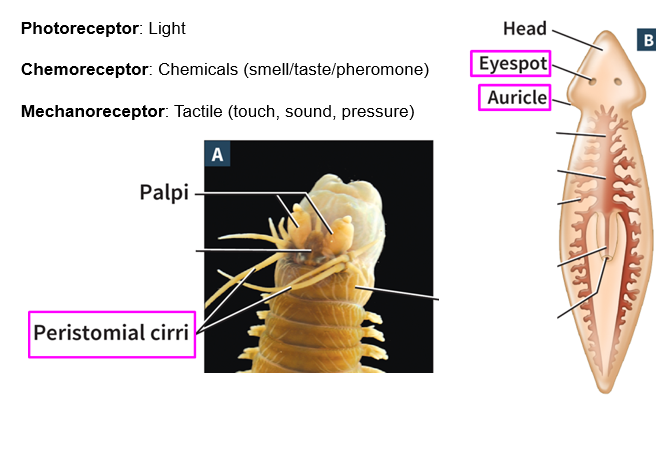
The eyespot is a ___, and the auricles are both ___ and ___. This makes up the head region, which is responsible for responding to its ___
photoreceptor; chemoreceptors and mechanoreceptors; environment
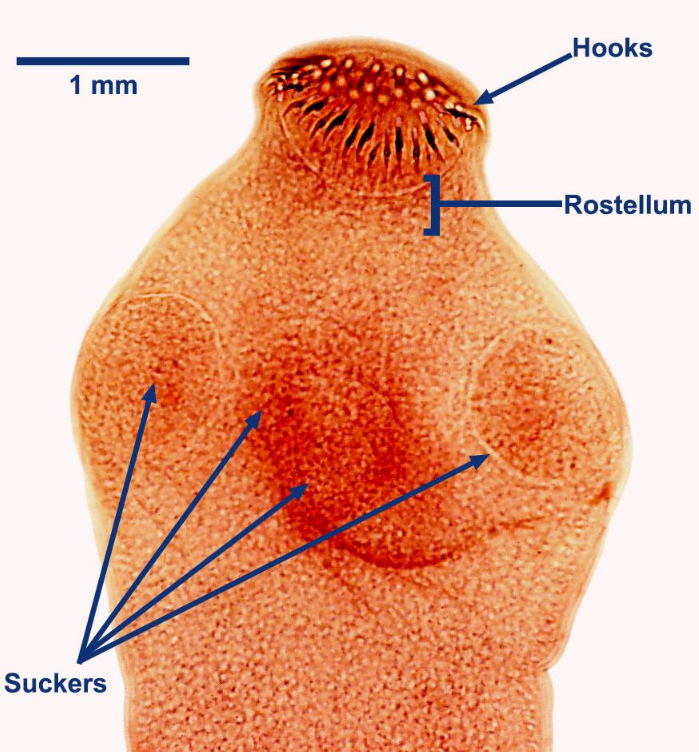
This is a tapeworm in phylum ___, class ___, genus ___.
platyhelminthes; cestoda; taenia

Taenia’s head differ from planarian’s head because a tapeworm’s has a scolex with ___ and ___ for attachment to its host, while a planarian has ___ and ___ for sensory reception.
suckers; hooks; eyespots; auricles
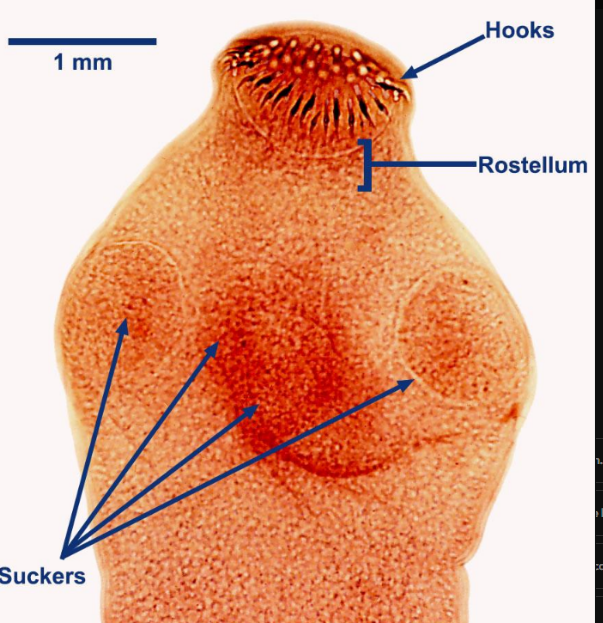
Tapeworms lack a ___ ___ and absorb nutrients directly from its ___. Planarians have an ___ digestive system with a mouth and a ___ cavity.
digestive tract; host; incomplete; gastrovascular
Tapeworms are found in the ___ intestine of their host. It attaches to the host’s intestinal wall using its ___.
small; scolex

The ___ proglottids is more anterior to the scolex. The gravid proglottid is its ___ filled with ___ eggs.
Taenia can reproduce sexually through ___ or ___ fertilization. The genital pore that extends from the side of the proglottid allows ___ transfer.
mature; uterus; fertilized
cross; self; sperm

This is from Phylum ___, Class ___. This specimen is called a ___.
Mollusca; Polyplacophora; Chiton

It has ___ dorsal shell plates. Its foot is ___/___. It uses its ___ to move. It eats using its ___ and ___. It senses using its ___ and ___
8; broad/flat; foot; radula; mouth; tentacles; eyes

Phylum ___, Class ___. Specimen is commonly known as a ___.
Mollusca; Gastropoda; Snail

It has ___ shell, foot is ___/___, uses ___ to move, uses ___ and ___ to eat, and uses ___ and ___ for senses.
one; broad/flat; foot; mouth; radula; tentacles; eyes

This is Phylum ___, Class ___. Common name is clam
Mollusca; Bivalvia

Has ___ shells, has a ___ foot, uses its ___ for movement, uses its ___ and ___ to eat, and uses its ___ and ___ for senses.
2; muscular; foot; mouth; gills; tentacles; eyespots
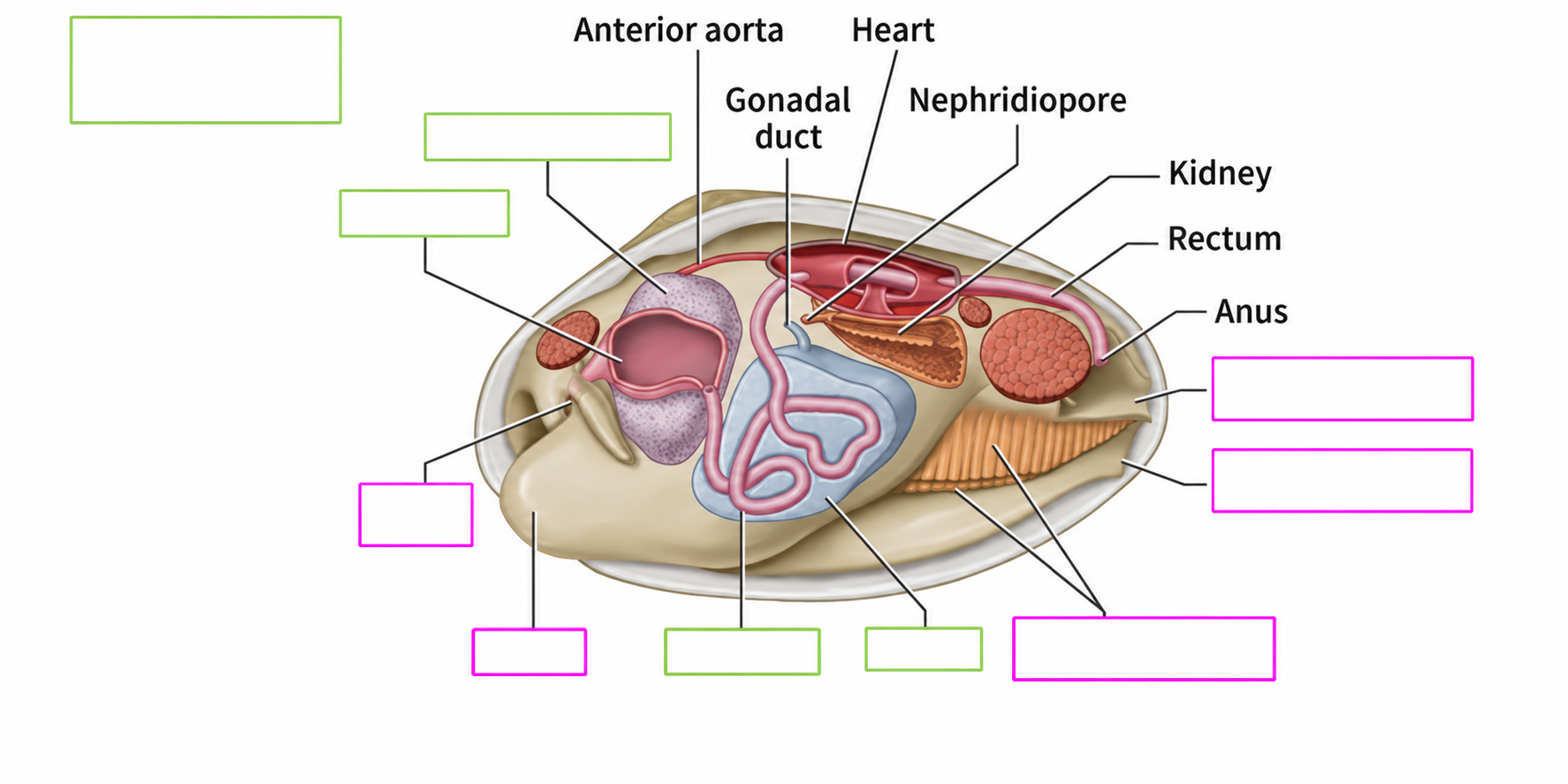
Name each pink box from left to right
mouth; foot; external gills; incurrent siphon; excurrent siphon

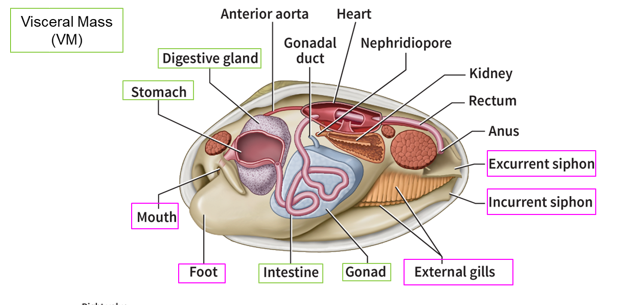
Mouth is responsible for ___ intake.
Foot is responsible for ___
External gills is responsible for ___ ___ and filtering ___ particles from the water
Incurrent siphon brings water containing ___ and ___ particles into the clam
Excurrent siphon expels ___ and ___ from the clam.
food
movement
gas exchange; food
oxygen; food
water; waste
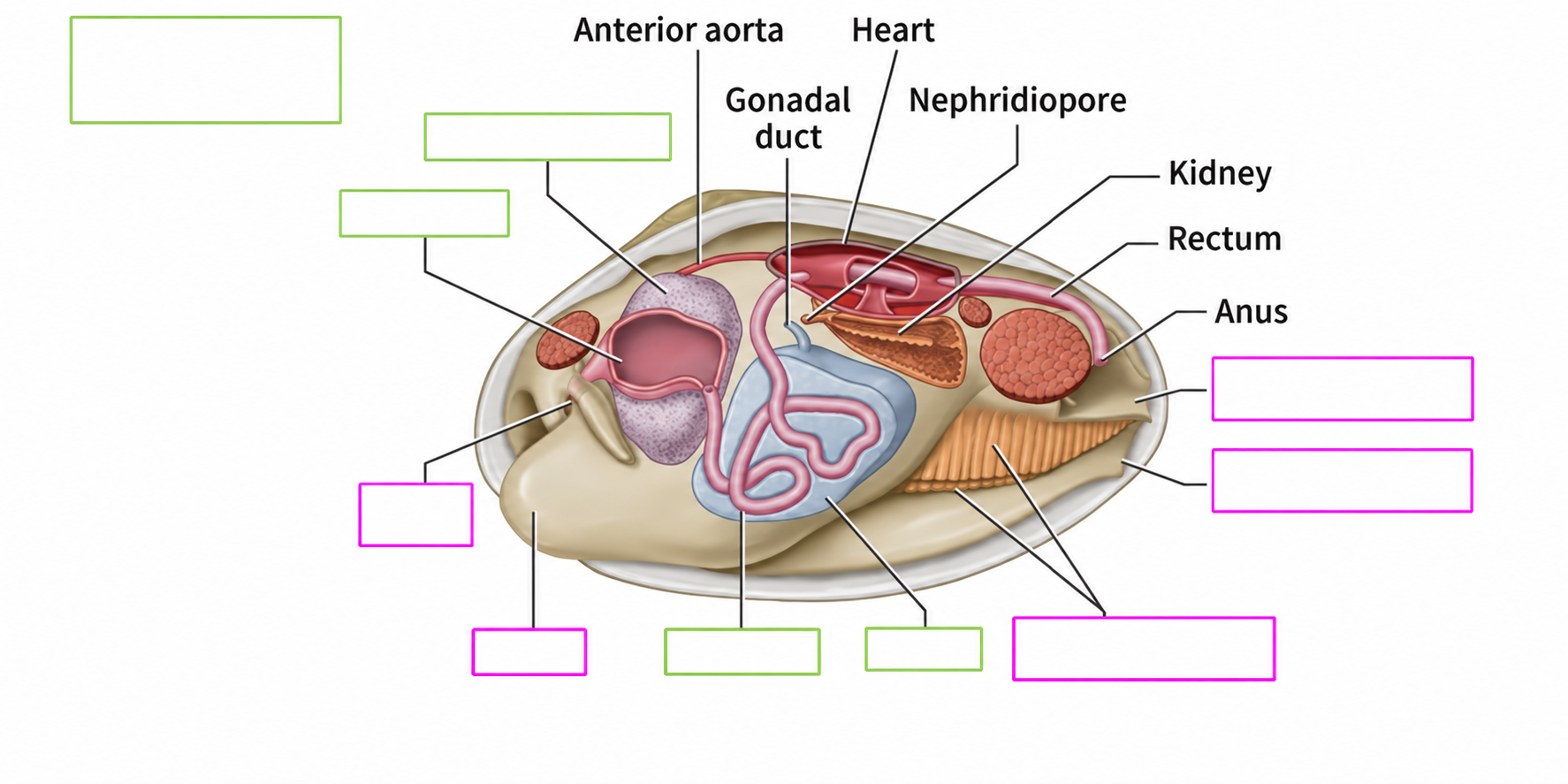
Name the green boxes from left to right
stomach; digestive gland; intestine; gonad


Visceral mass of the clam has 4 organs:
1. Stomach ___ the food
Digestive gland helps process ___
Intestine ___ and further processes ___ contents
Produces ___ or ___
digests
nutrients
moves; nutrient
sperm or egg
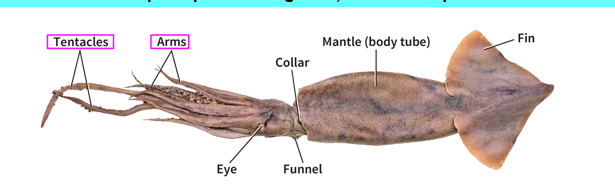
Phylum ___ and Class ___. Common name is squid.
Mollusca; Cephalopoda

Doesn’t have shells but rather an internal ___, its foot is modified into ___/___, uses ___ and ___ to move, uses ___/___ and ___ to eat, and uses ___ to sense.
pen; arms/tentacles; siphon; fins; arms/tentacles; beak; eyes

Name two top structures and then name from left to right on bottom
Tentacles and arms
2. beak; eyes; pen; gills


Arms are to ___ prey.
Tentacles are to ___ to capture prey.
Beak is to ___ and ___ food.
Eye is for ___
Pen is the internal shell that ___ the body
Gill is for ___ ___ (to breathe)
capture
extend
bite; tear
vision
support
gas exchange

Phylum ___, Class ___. Common name is earthworm.
Annelida; Oligochaeta
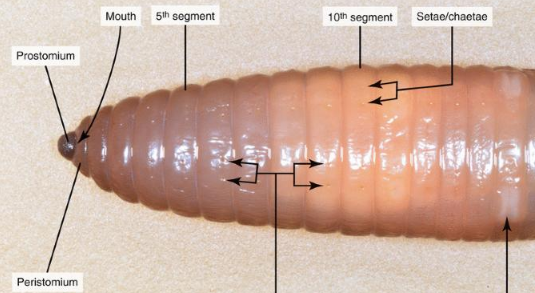
It has visible ___, which are each little ring. It uses ___ for locomotion. Distinguishing feature from other members of Annelida is its ___
metameres; setae; clitellum
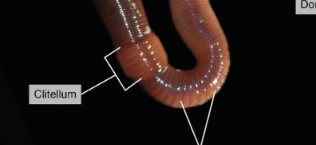

Name each structure of the earth worm going up to down

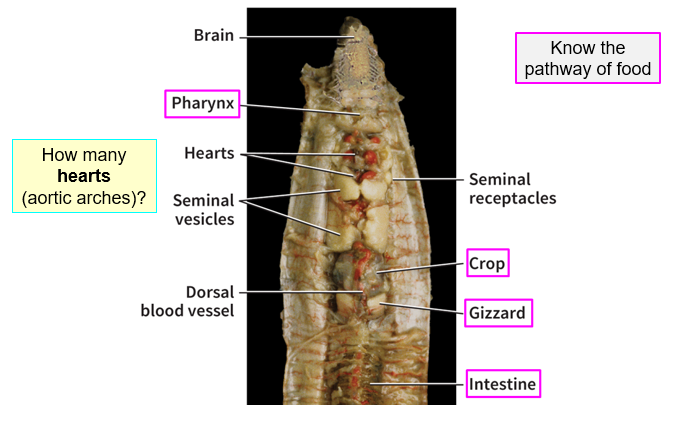
Pharynx draws ___ inward
Crop ___ stores food
Gizzard ___ food
Intestine ___ and ___ food.
food
temporarily
grinds
digests; absorbs
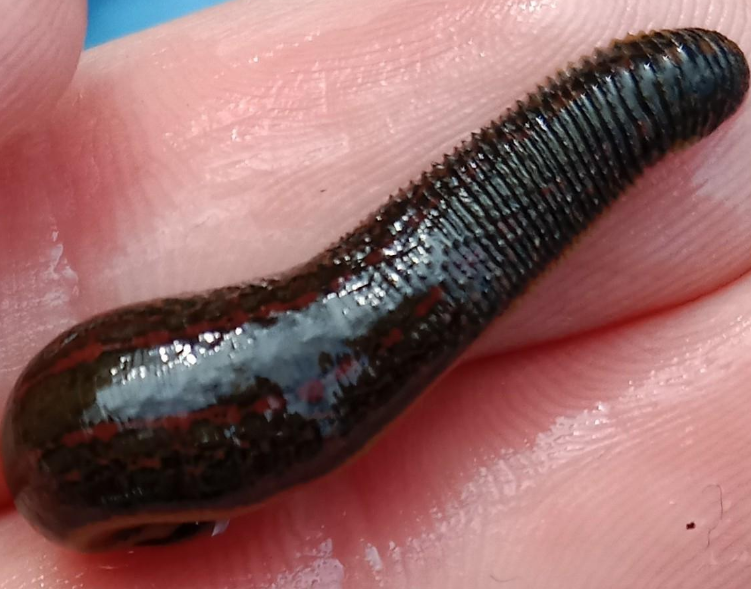
Phylum ___, Class ___. Genus ___. Commonly known as leech.
Annelida; Hirudiena; Haementeria
Leeches ___ have metameres; uses ___ for movement; and distinguishing features are two ___ and a ___ body.
They are considered ___ (type of parasite) and live in ___.
don’t; suckers; suckers; flattened
ectoparasite; freshwater

Phylum ___, Class ___, Genus ___. Common name is sandworm.
Annelida; Polychaeta; Nereis

Contains visible ___, uses ___ bearing setae for movement, which is its distinctive structure because the other members don’t have that.
metameres; parapodia

Nereis (sandworm) has eyes, which is a ____, and a peristomial cirri, which acts as a ___ and a ___. It also has powerful ___.
photoreceptor; chemoreceptor and mechanoreceptor; jaws

Name each structure from left to right. Also, how many hearts does it have?
Prostomium; mouth; setae; segment; clitellum; metameres; and anus
An earthworm has 5 hearts


Prostomium is for ___
Mouth is for ___ intake
Segments are for ___ and ___
Clitellum is for ___
Anus is for ___
Setae is for ___ and ___
sensation
food
flexibility; movement
reproduction
waste
grip; movement

Brain processes ___
Pharynx draws ___ into digestive tract
Heart (aortic arches) ___ blood
Dorsal blood vessel transports blood to the ___ end.
Crop temporarily ___ food
Gizzard ___ food
Intestine ___ food.
Septa ___ body segments
Nephridia removes ___
information
food
pumps
anterior
stores
grinds
digests
separates
waste
Lophotrochozoa have two definining characteristics, one for its ___ (ciliated tentacles) and for its ___ (ciliated larva)
lophophore; trochophore

Lophotrochozoan has two groups that we looked at: Platyzoa and Trochozoa. Which phylum belongs to each one?
Platyzoa - Platyhelminthes
Mollusca and Annelida

Endoparasites live ___ its host. An example is ___
Ectoparasites live ___ its host. An example is ___.
inside; Taenia
outside; Haementeria
Cephalization is when ___ organs are ___ tissue is present on the ___ end (anterior/posterior) of an animal. For instance, ___ exhibits this because its eyespots and auricles.
sensory; nervous; anterior; planaria
Eyespot represents a ___, which detects light. Auricles function as ___ and ___, which detect chemicals and touch. This is seen on Dugesia (Planaria), which also has a pharynx located on its ___ portion of the body.
photoreceptor; chemoreceptor; mechanoreceptor; midventral

Genus ___, Class ___, nutrition mode is ___, and it is ___ (free-living or attached).
Gas exchange involves ___ across flat body, reproduces ___ and ___, and features include ___, ___, and incomplete ___.
Dugesia; Turbellaria; chemoheterotroph; free-living
diffusion; sexually/asexually; eyespot; auricles; digestion

Genus ___, Class ___, nutrition mode is ___ and is ___ (free-living or attached?)
Gas exchange is ___ across body surface, reproduces ___ or ___-___, and features include ___, ___, and no ___ tract.
Taenia; Cestoda; parasitic; attached
diffusion; sexually/self-fertilization; scolex; suckers; digestive
Mollusk shells are primarily composed of ___ ___
calcium carbonate

Class ___, is ___ (free-swimming/benthic), has ___ cephalization, has ___ shell plates, and nutritional mode is ___ by scraping algae using a ___
Polyplacophora; benthic (bottom of the ocean floor); no; 8; radula

Class ___, considered ___ (free-swimming/benthic); does ___ cephalization; has ___ shell; nutrition mode is chemoheterotroph by scaping algae using a ___
Gastropoda; benthic; have; one; radula
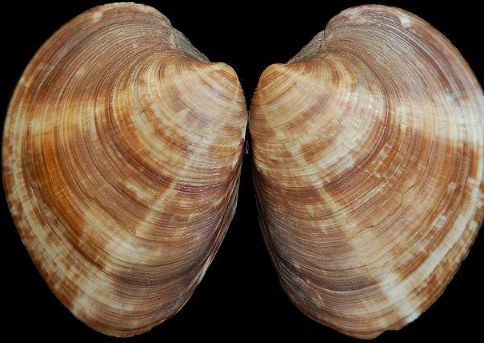
Class ___, considered ___ (free-swimming/benthic) has ___ cephalization; has ___ shells; and is a ___ feeder
Bivalvia; benthic; no; two; filter

Class ___, considered ___ (free-swimming or benthic), does ___ cephalization; shell is reduced called a ___, and nutritional mode is a ___
Cephalopoda; free-swimming; have; pen; predator
Setae help with movement and anchoring. This was seen in ___ and ___ but lacked in ___.
Oligochaeta; Nereis; Hirudiena
The clitellum, a reproductive structure, was seen in ___ and ___ but it lacks in ___.
Oligochaeta; Hirudiena; Nereis
Nereis belongs to subclass ___, which goes with the notecard that says “Errant polychaete”
Errantia are actively moving worms, Sedentaria are mostly stationary worms
Errantia
Oligochaeta digestion starts at the ___, which takes in food.
The ___ draws food inward and goes down the esophagus.
The ___ stores the food, then the ___ grinds the food.
Finally, the ___ absorbs the food and undigested food comes out the ___.
mouth
pharynx
crop; gizzard
intestine; anus
Oligochaeta exchange ___ during mating, which is stored in the ___ receptacles and fertilization later occurs in a cocoon produced by the ___. This is advantageous because it increases ___ ___
sperm; seminal; clitellum; genetic diversity
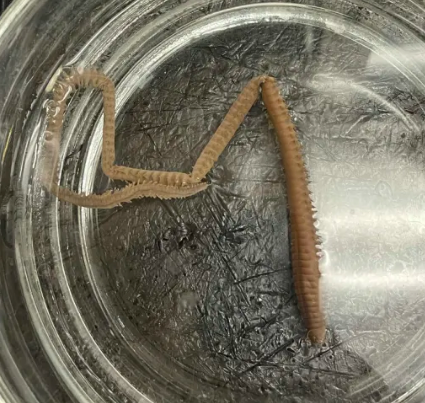
Genus ___, Class ___, Nutrition mode is ___, Features include paired ___ with setae, ___ ___, and powerful ___.
Nereis; Polychaeta; predator; parapodia; peristomial cirri; jaws

Genus ___, Class ___, Nutrition mode is ___, Features include ___, lacking ___, lives in ___
Macrobdella (Haementeria); ectoparasite; suckers; setae; freshwater
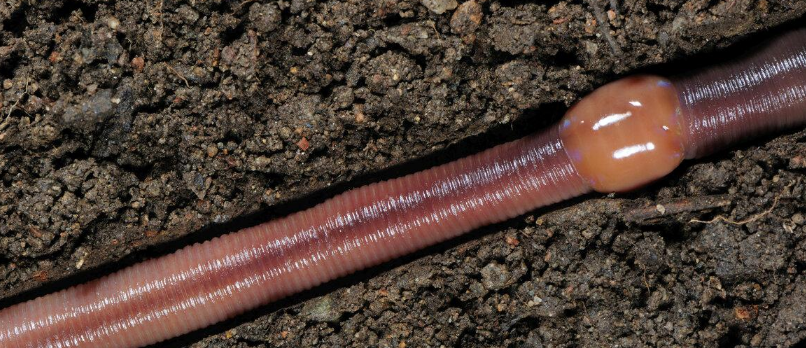
Genus ___, Class ___, Nutrition mode is ___ (feeding on decaying matter). Features include short ___, and complete ___ tract.
Lumbricus; Oligochaeta; Detritivore; setae; digestive
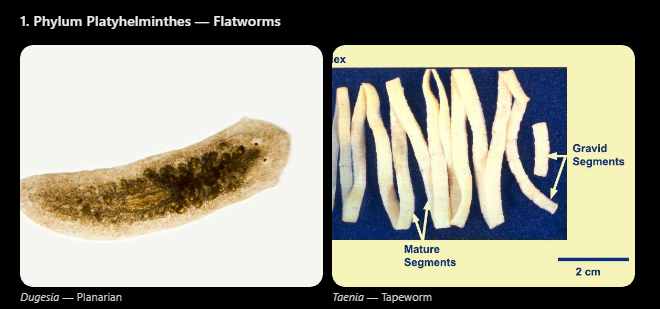
Phylum Platyhelminthes has ___ symmetry, contains ___ germ layers, have ___ (acoelomate/pseudo) coelom type, considered ___ (monoecious/dioecious).
Dugesia has ___ digestive tract, where it is ___ in Taenia.
bilateral; 3; acoelomate; monoecious
incomplete; absent

Phylum Mollusca has ___ symmetry, has ___ germ layers, has a ___ coelom type, they are mostly ___ (monoecious/dioecious) but some gastropods can be ___. They have a ___ digestive tract.
bilateral; 3; eucoelomate; dioecious; monoecious; complete

Phylum Annelida has ___ symmetry, has ___ germ layers, has ____ coelom type, and has a ___ digestive tract.
Nereis is considered ___, whereas Oligochaeta and Hirudiena are considered ___.
bilateral; 3; eucoelomate; complete
dioecious; monoecious