Genetics Exam 2
 Call Kai
 Learn
Learn Practice Test
 Spaced Repetition
 Match
Match Flashcards
 Knowt Play
1/52

Earn XP
Description and Tags
Vocabulary flashcards covering the key experiments, structures, mechanisms of replication, and molecular steps of recombination from Honors Genetics Chapter 6.
Name | Mastery | Learn | Test | Matching | Spaced | Call with Kai | Chat |
|---|
No analytics yet
Send a link to your students to track their progress
53 Terms
Nuclein
The phosphorus-rich, acid-precipitable compound containing carbon, hydrogen, nitrogen, oxygen, and high amounts of phosphorus isolated from cell nuclei by Friedrich Miescher in 1869, today known as DNA.

Smooth (S) strain S. pneumoniae
A virulent form of Streptococcus pneumoniae that forms smooth colonies with a capsule, causing fatal pneumonia in host organisms.
Rough (R) strain S. pneumoniae
A mutant, non-virulent form of Streptococcus pneumoniae that forms rough colonies without a capsule and does not cause pneumonia.
Transformation principle
The heritable molecule from heat-killed virulent S cells that permanently transforms non-virulent R cells into living, virulent S cells, first observed by Frederick Griffith.
Avery, MacLeod, and McCarty experiment
A 1944 experiment demonstrating that DNA is the transforming principle through in vitro assays showing that transformation is prevented by DNase, but not by protease or RNase.

Hershey-Chase experiment
A 1952 study using T2 bacteriophages labeled with radioactive phosphorus (32P) for DNA and radioactive sulfur (35S) for protein, proving that phage DNA is injected into host cells as the heritable genetic material.
Nucleoside
A molecule formed by attaching a nitrogenous purine or pyrimidine base to the 1′ carbon of a deoxyribose sugar.
Nucleotide
The fundamental building block of nucleic acids, formed by attaching a phosphate group to the 5′ carbon of a nucleoside's sugar.
Phosphodiester bond
The covalent link formed between the 3′ carbon of one nucleotide's deoxyribose sugar and the 5′ phosphate group of the next nucleotide, imparting 5′→3′ polarity to the strand.
Chargaff's rules
The empirical observation that in double-stranded DNA, the ratios of adenine to thymine (A:T) and guanine to cytosine (G:C) are approximately 1:1, while total G/C and A/T content varies across species.
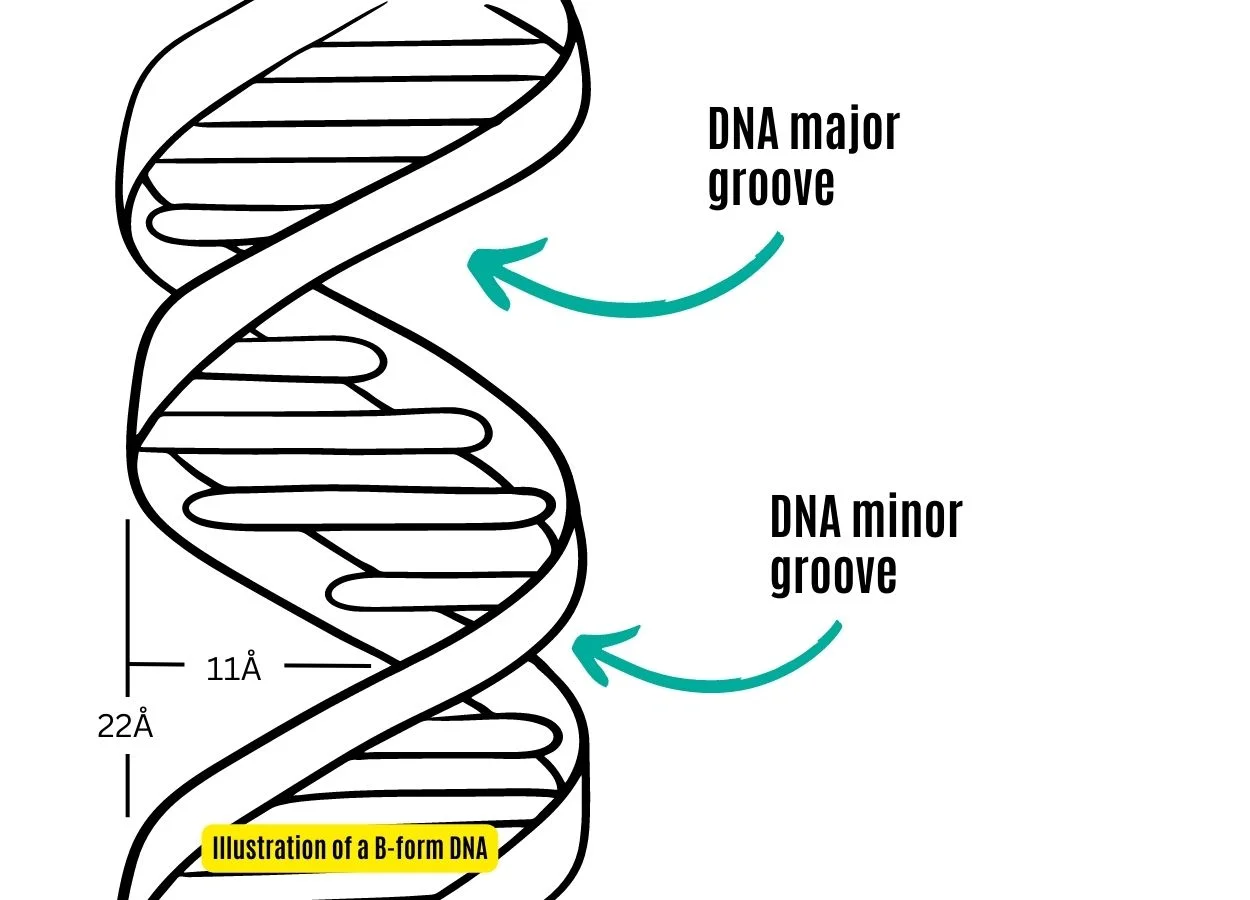
B-form DNA
The predominant double-helical structure of DNA characterized by a right-handed helix, smooth backbone, a major groove measuring 34A˚, and a minor groove measuring 3.4A˚.
Z-form DNA
An alternative left-handed double-helical DNA structure featuring an irregular, zigzagging sugar-phosphate backbone.
Central Dogma
The core framework of molecular biology stating that genetic information flows from DNA to RNA via transcription, and from RNA to protein via translation.
Semiconservative replication
The mechanism of DNA duplication in which each produced daughter double helix contains one intact original parental template strand and one newly synthesized strand.
Conservative replication
A hypothesized DNA replication model in which the original parental double helix remains entirely intact while a completely new double helix is formed.
Dispersive replication
A hypothesized DNA replication model where each strand of both daughter double helices consists of alternating segments of parental and newly synthesized DNA.
Meselson-Stahl experiment
The 1958 experiment using Escherichia coli grown in heavy nitrogen (15N) and transferred to light nitrogen (14N), followed by CsCl density gradient centrifugation, which confirmed semiconservative replication.
Initiator protein
A specialized protein that binds to the origin of replication (Ori) site to begin the DNA replication process.
DNA Helicase
An enzyme that unwinds and separates the parental double-stranded DNA helix at the replication fork.
Single-strand binding proteins
Proteins that bind to unwound single-stranded DNA to keep the strands open and prevent them from re-annealing during replication.
Primase
An enzyme that synthesizes a short RNA primer complementary and antiparallel to the template strand, providing a free 3′-OH group for DNA polymerase.
DNA Polymerase III
The principal enzyme responsible for elongating newly synthesized DNA strands by catalyzing phosphodiester bond formation exclusively in the 5′→3′ direction.
Leading strand
The newly synthesized DNA strand that undergoes continuous synthesis in the 5′→3′ direction toward the advancing replication fork.
Lagging strand
The newly synthesized DNA strand that undergoes discontinuous synthesis away from the replication fork, producing short Okazaki fragments.
Okazaki fragments
Short segments of newly synthesized DNA generated on the lagging strand during discontinuous DNA replication.
DNA Polymerase I
An enzyme involved in DNA replication that removes RNA primers from newly synthesized strands and replaces them with DNA nucleotides.
DNA Ligase
An enzyme that seals nicks in the sugar-phosphate backbone by forming covalent phosphodiester bonds between adjacent DNA fragments.
DNA Topoisomerase
An enzyme that relaxes supercoiling tension ahead of the replication fork by cutting, rotating to unwind, and rejoining the DNA backbone.
Spo11
A protein that initiates meiotic genetic recombination by breaking the phosphodiester bonds on both strands of one chromatid.
Dmc1
A meiotic recombination protein that assists a single-stranded 3′ DNA tail in invading a non-sister chromatid to form a heteroduplex.
Displacement loop (D-loop)
A single-stranded DNA loop created when an invading 3′ single-stranded tail displaces a strand of an intact non-sister chromatid during recombination.
Heteroduplex
A region of double-stranded DNA formed during recombination that contains complementary strands originating from different homologous chromosomes.
Holliday junction
A temporary four-way X-shaped DNA structure that forms during homologous recombination to mediate strand exchange.
Branch migration
The lateral movement of a Holliday junction along the DNA double helices, extending the region of heteroduplex DNA.
Resolvase
An enzyme that cleaves the strands of a Holliday junction to separate the recombined DNA molecules.
Meselson-Weigle experiment
An experiment involving coinfection of Escherichia coli with heavy (13C, 15N) and light (12C, 14N) labeled bacteriophages, proving that genetic recombination occurs via physical breakage and rejoining of DNA molecules.
Experiments that led to the discovery and structure of DNA
Meischer’s discovery of nuclein
Fredrick Griffith Experiments
Avery, MacLeod and McCarty
Hershey – Chase Experiments
Erwin Chargaff’s ratiometric studies
Watson and Crick’s discovery of DNA
Order these in chronological order of the timeline to discover DNA:
1) Morgan 2) Mendel 3) Miescher 4) Sutton-Boveri
A)1865 b)1869 c)1902 d)1920’s
a-2; b-3; c-4; d-1
A scientist repeats Griffith's transformation experiment. They take heat-killed S bacteria and treat the extract with an enzyme that specifically destroys DNA before mixing it with live R bacteria.
The live R bacteria remain R.
What is the best conclusion?
A. DNA is required for transformation of R bacteria into S bacteria.
B. Protein is required for transformation of R bacteria into S bacteria.
C. The heat-killed S bacteria were still alive and therefore could not transform the R bacteria.
D. DNA is not involved in bacterial transformation.
a
A researcher has three purified samples from S bacteria:
Sample 1: DNA
Sample 2: RNA
Sample 3: Protein
Each sample is separately added to live R bacteria.
Only one sample causes the R bacteria to become S bacteria.
Which observation would provide the strongest evidence that DNA is the transforming principle?
A. Only Sample 1 causes transformation.
B. Samples 1 and 2 cause transformation.
C. Sample 3 causes transformation, but Sample 1 does not.
D. All three samples cause transformation.
a
Question 4 — Hershey & Chase
Hershey and Chase infect bacteria with bacteriophages. They conduct two experiments:
In Experiment 1, they label phage DNA with radioactive phosphorus.
In Experiment 2, they label phage protein with radioactive sulfur.
After infection, they find that the radioactive phosphorus is associated with the bacteria and appears in newly produced phages, while the radioactive sulfur does not.
Which conclusion is best supported?
A. Protein enters the bacteria and DNA remains outside.
B. DNA enters the bacteria and is involved in directing production of new phages.
C. Both DNA and protein enter the bacteria and contribute equally to phage production.
D. DNA and protein are both required to enter the bacteria, but only protein is inherited.
b
What are the four main components of DNA?
deoxyribose, phosphate, nitrogenous bases
Which ones are purines out of AGCT? Which ones are the pyrimidines?
AG; CT
Bases bind to the sugar group at the ? position, making a nucleoside
1’
Phosphorus binds to the sugar in a nucleoside at the ? position, making a nucleotide
5’
A scientist analyzes DNA from two different species.
Species X has a very high percentage of G and C bases.
Species Y has a much higher percentage of A and T bases.
Which statement is most consistent with Chargaff's findings?
A. Species X must have more total DNA than Species Y.
B. Species X should have approximately equal amounts of G and C, while Species Y should have approximately equal amounts of A and T.
C. Species X should have more purines than pyrimidines.
D. Species Y should have more G and C than A and T.
b
Nitrogenous base + sugar = ?
Nitrogenous base + sugar + phosphate = ?
nucleoside; nucleotide
A researcher is trying to determine whether DNA replication is conservative, semiconservative, or dispersive.
After one round of replication, the researcher observes one DNA band at an intermediate density. After a second round, they observe two bands: one intermediate-density band and one light-density band.
Which replication model does this pattern most strongly support?
A. Conservative
B. Semiconservative
C. Dispersive
D. None of these
b
Imagine DNA replication is conservative instead of semiconservative.
A bacterium begins with DNA made entirely of ¹⁵N and is then moved into a ¹⁴N environment.
After one round of replication, what would you expect to see in a cesium chloride density gradient?
A. One intermediate-density band
B. One heavy band and one light band
C. One heavy band only
D. One light band only
b
What type of bonds hold two complementary base pairs together?
hydrogen
What is the major grove (34A); how many base pairs are in between?
What is the minor grove is (3.4A)
how long it takes to make one helical revolution; 10 base pairs
distance between two adjacent nucleotides
Some bacterial DNA is ?
circular
DNA can take many forms, which are these two? (one letter)
?-form DNA forms right-handed helix and has a smooth backbone
?-form DNA forms left-handed helix and has an irregular backbone
B;Z