W8 Tear Film and Contact Lens
 Call Kai
 Learn
 Practice Test
 Spaced Repetition
 Match
 Flashcards
 Knowt Play
1/48

There's no tags or description
Looks like no tags are added yet.
49 Terms
What are sources of lipid production within the secretory system?
Meibomian glands
Glands of Moll
Glands of Zeis
What are sources of aqueous production within the secretory system?
Main lacrimal gland
Palpebral glands
Tarsal glands
(AKA accessory lacrimal glands of Krause and Wolfring respectively)
What are sources of mucus production within the secretory system?
Conjunctival goblet cells
Superficial corneal epithelial cells
How is the lipid tear film composed of?
Thin superficial oily surface layer
Secreted by Zeis, Moll and Meibomian glands
Prevents evaporation and spillage- 0.1 to 0.2 micrometres thick
DOES NOT FLOW OR ENTER CONJUNCTIVAL SAC
What is the composition of the lipid phase?
Low polarity and high polarity lipids
Examples of low polarity lipids
High levels of these esters, includes waxy esters and cholesterol esters
Examples of high polarity lipids
Low levels of these lipids includes triglycerides, phospholipids and free fatty acids
What is the main function of the lipid phase?
To reduce evaporation
What is the aqueous tear film composed of?
7 micrometres thick
Secreted by Krause and Wolfring glands
Contains many ions
Contains metabolites (enzymes) for immune
What are the names of the proteins from the serum in aqueous phase?
Albumin
Immunoglobulins
Transferrin
What are names of proteins from the lacrimal glands within the aqueous phase?
Lysozyme
Lipocalin
IgA
Lactoferrin
Whats the role of Vitamin A in aqueous phase?
Normal for necessary differentiation of non-squamous epithelium
Deficiency leads to corneal and conjunctival keratinisation
What are common cells found in the aqueous phase?
Leukocytes
Bacteria
Desquamated corneal and conjunctival epithelial cells
Features of mucin within the tear film
From Manz glands and Crypts of Henle
Forms deepest tear layer
Rod shaped- non-polar ends aligns with hydrophobic epithelial cells
0.05 micrometres thick
What is the function of the mucus phase?
Renders corneal surface wettable
Prevents bacterial adherence to epithelium

What are features of the distributory system?
Tear film, eyelids and tear meniscus
What factors increase blink rate?
Conversation
Anxiety
Tiredness
Poor environmental conditions- air con, smoke
Poor tear film stability
What factors decrease blink rate?
Reading
Increased task difficulty
Computer use
Corneal anaesthesia
What is average blink rate?
12 times per minute
How do we close the eyelids?
Orbicularis muscle
How do we open the eyelids?
Levator palpebrae superioris opens the upper lid
How do we look down gaze?
Levator relaxes, upper lid displaces downwards
How do we look up gaze?
Levator and frontalis muscles pull upper lid upwards
What are features of the excretory system?
Drainage and evaporation
How much evaporation occurs?
10% of evaporation occurs but the lipid layer prevents evaporation
How are tears driven into lacrimal sac?
Tears move through punctum in cannaliculus and then nasolacrimal duct
Contraction of orbicularis closes and shortens canaliculi which drives tears into lacrimal sac
What are the functions of the tear film?
NOW MAT
Nutritional- supplies essential nutrients
Optical properties- smooth optical surface
Waste removal- removes waste product
Mechanical- flushes away debris and lubricates
Antibacterial- prevents infection (lysozymes, etc.)
Transparency- prevents desiccation
What is tear film output?
15-30g a day, higher in females, output decreases with age
Where does neural control of the tear film come from?
Sensory input from CN V
Irritation causes reflex lacrimation
Parasympathetic and some possible sympathetic innervation controls lacrimal gland
What is the pH of tear film in an open eye?
7.45±0.16
What is the pH of tear film in a closed eye?
7.25±0.16
How does pH of tear film shift?
Cyclic alkaline daytime shift and acidic overnight shift
How does reflex tearing affect osmolarity?
Reflex tearing decreases osmolarity which can cause adaptive oedema in rigid CL wear
What is a key characteristic of dry eye?
Tear film has higher osmolarity (tonicity)- more salts/proteins >308
What is osmolarity in an open eye?
315
How do we measure secretion/volume of tears?
Schirmer’s strip or phenol red (cotton thread) test
How do we carry out Schrimer’s test?
Filter strip hooked over lower lid
Measure tear creep over 5 minutes
Less than or equal to 5mm indicates tear production issue
How do you do the phenol red test?
Thread changes colour when wet
More reliable
<9mm indicates dry eye
How do we observe eyes stained with lissamine green?
White light on slit lamp- best to observe 1-4 mins after instillation
Observe green stains on conjunctiva- this indicates dryness
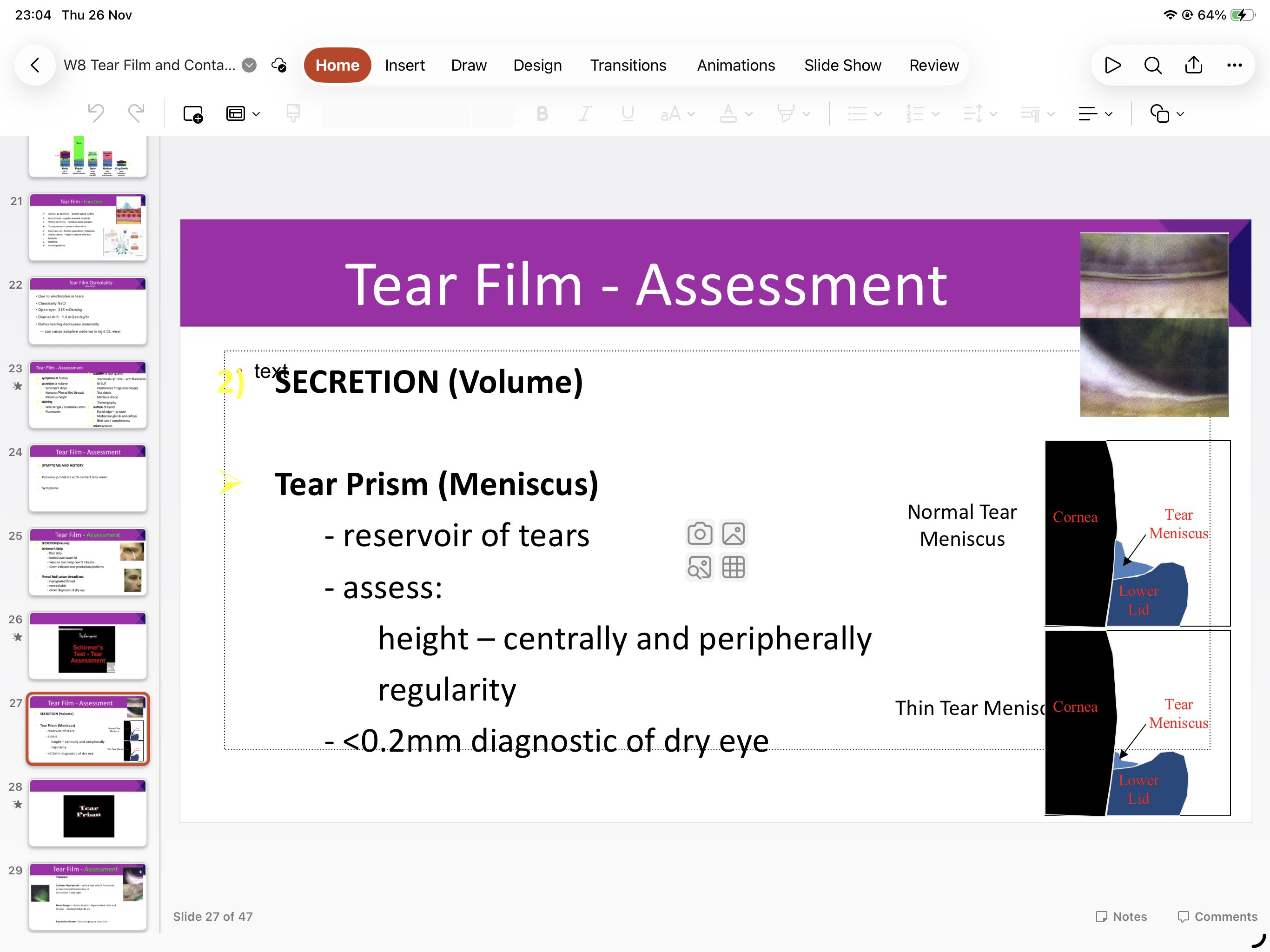
How do we measure tear prism (meniscus) height in mm?
Use slit lamp to assess height
<0.2mm indicates dry eye
Why is rose bengal unavailable in the UK?
Stains dead or degenerated cells and mucus- stings a lot
How do we do invasive TBUT with fluorescein?
Instruct px to blink twice then don’t blink
Stop timer when px can’t keep eye open or appearance of dry black patch anywhere in cornea starts to form
<10 secs indicates tear film deficiency
What is the function of a tearscope?
Non-invasive TBUT
Measures tear meniscus and corneal surface irregularities
What are pre-ocular tear film lipid patterns?
…

What does coldness in thermography indicate?
That area of the eye dries up very quickly
What does an unhealthy conjunctiva look like?
Varying bags and patterns along the line- a healthy conjunctiva will have a smooth line

What is the tear exchange of RCL vs soft contact lenses?
10-20% under RCL with blink
2% tear exchange under soft lenses with blink
What is meibomian gland dysfunction?

What is blepharitis?
Unstable tear film- glands are blocked and the tears that come out are thick like toothpaste
