Blood and Tissue Parasites
 Call Kai
 Learn
Learn Practice Test
 Spaced Repetition
 Match
Match Flashcards
 Knowt Play
1/34

There's no tags or description
Looks like no tags are added yet.
Name | Mastery | Learn | Test | Matching | Spaced | Call with Kai | Chat |
|---|
No analytics yet
Send a link to your students to track their progress
35 Terms
Malaria Genetic Protection
Sickle Cell disease and trait - stresses parasites
G-6-PD - oxidative damage
Diffy Neg - P. vivax protection
Malaria Vector
Female Anopheles Mosquito
Malaria Life Cycle (inside human)
blood meal, injects sporozoites
to liver ~ 3o mins
ring stage in RBC, troph, schizont, gametocyte
blood meal, ingest gametocyte
Malaria Disease Manifestation
Initial - flu-like
fever cycles
high fever
joint pain
no lymphadenopathy - rules out if present
Recrudescence
Repeated attack of malaria due to survival of parasites in RBCs or liver cells
Days to weeks later
Dormancy period
Relapse
Recurrence of disease after apparent cure through treatment
Weeks to months later
May be due to insufficient treatment
Plasmodium falciparum
Tropics
"malignant tertian fever", "blackwater fever"
high levels of parasitemia
fatal in 8-10 months, severe malaria
36-48 hour cycles (3 days)
neurological manifestations
Kidney failure, metabolic acidosis, hypoglycemia
Blood bananas
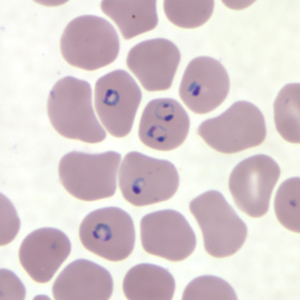
Plasmodium falciparum Ring Stage
Thin, delicate, 1/5 diameter of RBC
1-2 chromatin dots per ring
Multiple rings in one RBC
Normal RBC size
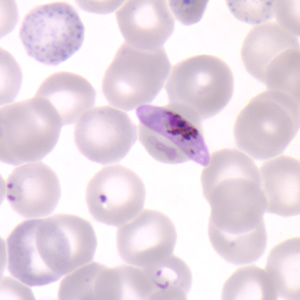
Plasmodium falciparum Gametocytes
Blood bananas
1.5x diameter of RBC
coarse chromatin
crescent or sausage shaped
Severe Malaria
No previous exposure, immunocompromised, pregnant people
Cerebral malaria (neurological)
Severe anemia - intravascular hemolysis
Hemoglobinuria
Pulmonary edema or acute respiratory distress syndrome
Blood coagulation abnormalities and thrombocytopenia
Cardiovascular collapse and shock
Plasmodium vivax
Most common malarial infection
Tropics, subtropics, temperate zones
“benign tertian malaria”
moderate to severe
non-fatal, but relapses common
~48 hour life cycle (3 days cycle)
splenomegaly
Duffy Negative provides protection
Plasmodium vivax Ring form
Thick cytoplasm, single large chromatin dot
Cytoplasm becomes amoeboid
Schuffner’s dots
Larger RBCs
Sometimes multiple rings per RBC

Plasmodium vivax Troph
Amoeboid
Schuffner’s dots
Large RBCs
Fine brown pigment
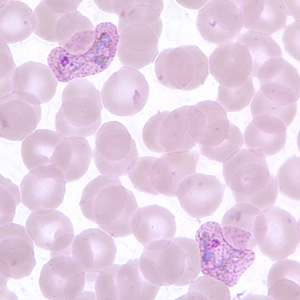
Plasmodium vivax Schizont
16-24 merozoites
Large, amoeboid

Plasmodium vivax Gametocyte
Oval, fill host RBC
Large RBC
Dark blue cytoplasm with fine brown pigment
Schuffner’s dots

Plasmodium malariae
Common
Sporadic distribution
“Benign quartan malaria”
Low parasitemia levels
non-fatal, recrudescence common
life cycle: 72 hours, (4 day cycle)
associated with Kidney Disease: proteinuria, nephrotic syndrome, possibly due to Ag-Ab complex deposits
Plasmodium malariae Ring
Normal RBC size
“bird’s eye”
Usually 1 chromatin dot
Thicker cytoplasm ring

Plasmodium malariae Troph
“Band Form” or “basket form”
Elongate across host RBC
Coarse pigment

Plasmodium malariae Schizont
6-12 merozoites
Rosette or cluster
Fill most of normal sized RBC
Coarse pigment

Plasmodium malariae Gametocye
Compact
Tend to fill RBC
Normal-small RBC
Dark pigment scattered through cytoplasm

Plasmodium ovale
2nd rarest form of malarial infection
Limited to Central West Africa and Pacific Islands
Non-fatal, spontaneous recovery
48 hour life cycle
Visually similar to P. vivax
Plasmodium ovale Ring
1-2 chromatin dots
Can be multiple rings per RBC
RBCs not enlarged

Plasmodium ovale Troph
Compact
RBCs tend to become oval with fimbriation (spiked/jagged edges)
Schuffner’s dots
Pigment less-coarse, more diffused

Plasmodium ovale Schizont
4-16 merozoites
Oval shape with fibrillation (jagged edges) common
Lighter, less coarse pigment
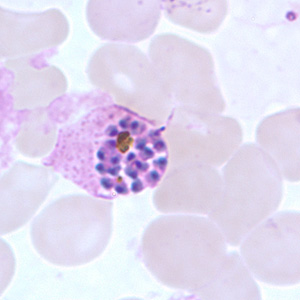
Plasmodium ovale Gametocyte
RBC not enlarged
Fill most of RBC
Fimbriation may occur

Plasmodium knowlesi
Newest and rarest form of human malaria, previously known in monkeys
Difficult to distinguish from P. falciparum and P. malariae
24 hour cycle
must use molecular methods to diagnose
renal dysfunction and thrombocyopenia
more severe and higher parasitemia than P. malariae
Immunological responses: Naive vs Native
Naive populations: more frequent, more severe disease
Native populations: acquired innate immunity, much less severe disease state
Immunological Responses to Malarial Stages
effective in adults after uninterrupted lifelong heavy exposure
Injected sporozoites: attacked by circulating antibodies, not effective
Liver stage: Cytotoxic T cells and interferon mediate killing in liver (exoerythrocytic)
RBC stage: Antibodies inhibit growth, block merozoite invasion, block adhesion to RBC surface (erythrocytic)
Mosquito stage: human antibodies kill ingested parasites