econ dirk review #2
 Call Kai
 Learn
 Practice Test
 Spaced Repetition
 Match
 Flashcards
 Knowt Play
1/41

There's no tags or description
Looks like no tags are added yet.
42 Terms
accounting profit vs. economic profit
· Accounting profit – revenue – explicit costs
· Economic profit – revenue – (explicit + implicit costs)
Coase Theorem
if there are no boundaries to negotiations, and if property rights are fully specified, interested parties will bargain to correct externalities
closing time (shut down rule)
shut down if the profit falls below average variable costs (AVC)
cost graphs

congestion charges
dynamic pricing is the most efficient and promotes sustainability; prices varies with supply and demand (encourages ride sharing, using smart parking meters, and toll lanes)
defects of monopoly
· few choices
· high price
· lower output
· rent seeking
Differences between pure competition and monopoly
· Pure competition – many sellers and buyers, selling similar or nearly identical products, no price control, more efficient, easy to enter and exit
· Monopoly – one seller and many buyers, no good substitutes, some price control, barriers to entry
diminishing marginal product
occurs when successive increases in input are associated with a slower rise in output
Economic efficiency
operating at the lowest point on the ATC curve for competitive markets
efficient scale
entry and exit result in zero economic profit in the long run; the output level that minimizes average total cost in the long run
explicit and implicit costs
· Explicit – tangible, out-of-pocket expenses
· Implicit – the costs of resources already owned, for which no out-of-pocket payment is made; hard to calculate and easy to miss (opportunity cost of capital)
externalities
– the cost or benefits of a market activity that affect a 3rd party, a form of market failure; positive and negative externalities
· Positive externality – market Q less than socially desirable (ex. Vaccines)
· Negative externality – market Q more than socially desirable (ex. People farting on planes)
· Correcting negative externalities – regulations, taxes, private negotiations
· Enhancing positive externalities – subsidies, other incentives, private institutions
four types of goods (private, common, club, and public)
· Private – excludable and rival, only one person can enjoy it at a time (ex. A pizza, a sandwich, a drake t-shirt)
· Common – rival and nonexcludable (ex. River fishing)
· Club – nonrival and excludable (ex. Sorority membership, cable tv)
· Public – nonrival and nonexcludable (ex. A rainbow, national defense)
free-rider problem
occurs when someone receives a benefit without having to pay for it
marginal cost
the increase in cost that occurs from producing one additional unit of output; (cost of producing n units) – (cost of producing n-1 units)
minimum wage
the lowest hourly wage rate that firms may legally pay their workers
optimal amount of pollution
occurs when the marginal cost is equal to the marginal benefit
Perfectly competitive firm and long-run profits
positive accounting profit, zero economic profit
price ceiling
a legally established max price for a good or service, only binding if lower than the equilibrium (ex. Rent control, leads to a shortage)
price gouging
place a temporary price ceiling on the prices that sellers can charge during times of emergency
price and output effects
price effect - lower prices affect revenue
output effect - lower prices affect the number of customers
price floor
legally established minimum price for a good or service, only binding if it’s higher than the current one (ex. minimum wage, leads to a surplus)
response to political pressure from suppliers to keep prices high
profit maximizing graph
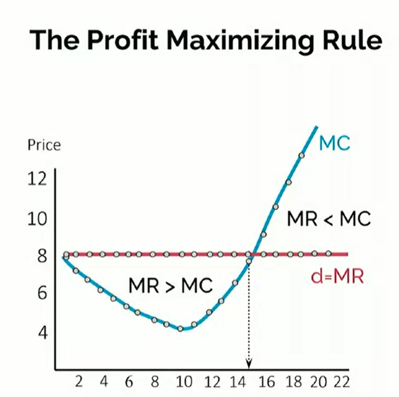
profit maximizing rule
profit maximization occurs when a firm chooses the quantity of output that equates marginal revenue and marginal cost, MR = MC; in the short run, need MR>MC
profit maximizing rule (table)
never stop at the first unit that’s leaving money on the table
profit maximizing price (solve with equations)
set MR = MC
rent seeking
occurs when resources are used to secure monopoly rights through the political process
scale
the size of the production process
· Efficient scale – the output level that minimizes average total cost in the long run
· Economies of scale – occur when long-run average total costs decrease as output expands, lower prices
· Diseconomies of scale - occur when long-run average total costs increase as output expands, higher prices
· Constant returns to scale – occur when long-run average total costs remain constant as output expands
sunk costs
unrecoverable costs that have been incurred as a result of past decisions (no bearing on future decisions)
Short-run versus long-run
continue to produce if losing money in the short-run, shut down if losing money in the long-run
tragedy of the commons (in general)
occurs when a common-resource becomes depleted
tragedy of the commons table of llamas
in auction they choose 1 llama, 22% return
do monopolies lead to deadweight loss?
yes
should a firm stay in business if it is pessimistic about future profitability?
no, shut down
will discrimination increase if a new binding price ceiling is passed?
yes
what is output a function of?
labor and capital
when there is diseconomies of sale, what should happen with production?
production should be lowered
which curves rise with output?
MC, ATC, and ACV
NOT AFC
steve’s sandwich shop (a competitive firm) is producing where MR>MC. what should he do to increase profits?
produce more output
when is there a fixed level of capital?
in the short run
a monopolist will have negative profits and exit the industry in the long run if in the long run…
price<ATC
if you could only choose one curve…
MC